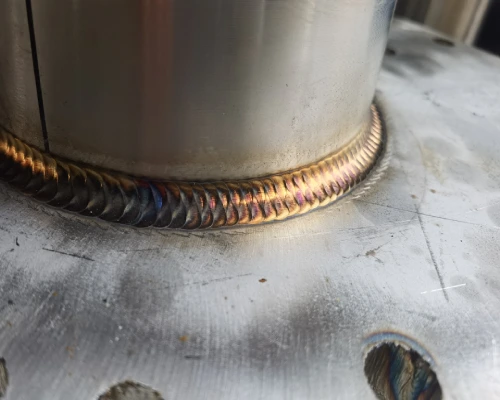



In high-end manufacturing, GTAW welding aluminum serves as the joining process for achieving high-strength, high-integrity aluminum alloy structures. It directly impacts the reliability, service life, and safety margin of the final product.
The high thermal conductivity, surface oxide layer, and extreme hydrogen sensitivity of aluminum alloys make GTAW aluminum welds highly susceptible to defects such as porosity, hot cracks, and lack of fusion. This necessitates that GTAW aluminum welding manufacturers systematically build a defense system: from rigorous pre-weld cleaning and material science selection, to precise coordinated control of heat input and power source AC waveforms, ultimately validated through stringent non-destructive testing.
This paper analyzes the root causes of defects in GTAW aluminum welds based on engineering practice and presents a predictable, repeatable solution to ensure the structural integrity of your welded components.
Material Properties and Their Interaction with the GTAW Aluminum Welding Process
In custom sheet metal fabrication, welding is the preferred process for joining aluminum alloy structures. However, a deep understanding of the complex interaction between alloy material properties and GTAW aluminum welding parameters is fundamental to achieving superior weld quality. As a specialized GTAW aluminum welding manufacturer, Supro recognizes that this interaction governs the welding heat cycle, metallurgical reactions, and the mechanical properties of the final joint.
Welding Metallurgy of Aluminum Alloys
GTAW aluminum welding is influenced by the material’s unique physical and metallurgical properties. Firstly, aluminum alloys’ exceptionally high thermal conductivity means welding heat rapidly dissipates from the molten pool throughout the workpiece. This necessitates concentrated and sufficient heat input during welding to establish and maintain a stable molten pool, otherwise leading to incomplete fusion. Simultaneously, severe solidification shrinkage generates significant residual stresses in GTAW aluminum welds, increasing susceptibility to hot cracking.
Further complicating matters is the aluminum oxide film on the surface, whose melting point far exceeds that of the aluminum base metal. If not effectively removed, this oxide layer impedes liquid metal fusion, leading to inclusions and lack-of-fusion defects in GTAW aluminum welds.
Furthermore, molten aluminum exhibits extremely high hydrogen solubility, whereas hydrogen solubility in solid aluminum is extremely low. During GTAW aluminum welding, any hydrogen absorbed from the shielding gas, filler wire, or surface moisture of the base metal will precipitate during solidification, forming porosity. Thus, aluminum alloys are inherently sensitive to heat input, prone to oxidation, and susceptible to hydrogen absorption.

Advantages of the GTAW Aluminum Welding Process
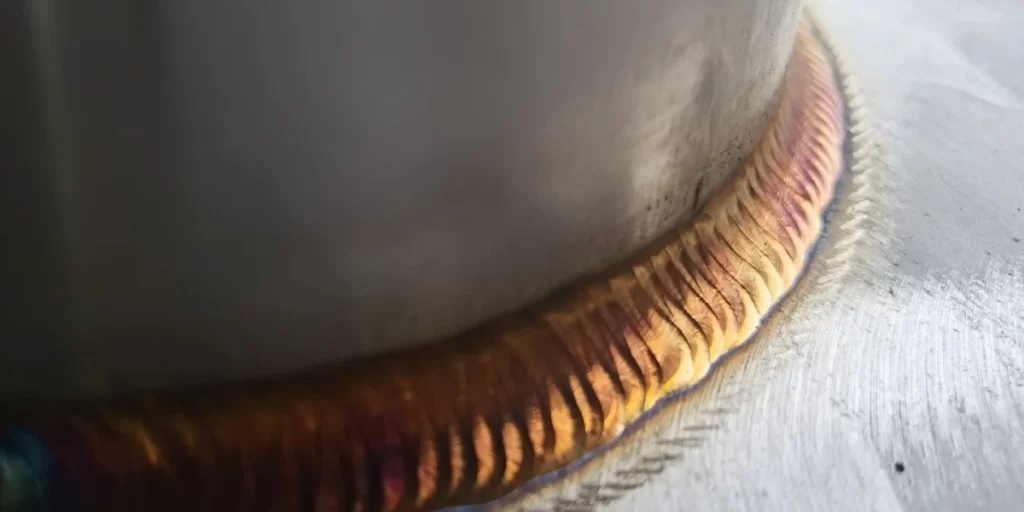
In response to these challenges, the GTAW aluminum welding process excels by providing precise, controllable responses. The stability and energy concentration of the GTAW arc enable fine-grained management of heat input, facilitating control over weld distortion and minimizing the heat-affected zone. Simultaneously, the inert gas shielding (typically argon) effectively isolates the molten pool from the atmosphere, preventing further oxidation at high temperatures.
The core technology of GTAW aluminum welding lies in the use of alternating current (AC). During the electrode’s positive half-cycle, the workpiece acts as a cathode, where positive ions bombard its surface, creating a “cathodic sputtering” effect that effectively breaks down and removes aluminum oxide layers. During the negative half-cycle, the heat from the arc is used to melt the metal.
Challenges in the GTAW Aluminum Welding Process Due to Interactions
The high reflectivity of the aluminum alloy molten pool surface, coupled with the intense and unstable arc light, makes online visual monitoring and quality assessment extremely difficult. This means control of the welding process and defect prevention rely heavily on the GTAW aluminum welding process procedures and the welder’s consistent operation. Additionally, the material’s thermal conductivity characteristics influence GTAW aluminum welding techniques.
Inexperienced operators may unconsciously slow down at the weld’s conclusion, leading to excessive accumulated heat input. This not only intensifies hydrogen absorption in the molten pool but may also introduce new contamination due to altered gas shielding effects, resulting in concentrated porosity or oxidized inclusions at the weld’s termination. Therefore, the GTAW aluminum welding process system must encompass every detail—from material preparation and parameter settings to operator technical specifications—to ensure high-quality GTAW aluminum welds are produced despite these complex interactions.
Only 4 steps
online custom metal fabrication parts
Contact our experts team and experience the efficiency and economic benefits of digital metal fabrication services.
Upload Design Files
STL , STEP (.stp), IGES (.igs), (.ZIP), or PDF.
Also be a sample or an idea
Quote & Design Analysis
Instant factory quotes and DfM reports, the most reasonable solution.
Manufacturing Begins
Digital processes can initiate order tasks within 24 hours.
On-Time Delivery
Keeping delivery promises, approved by 3000+ Global Company buyers.
Analysis of Weld Defect Mechanisms in GTAW Welding of Aluminum
For GTAW aluminum welding manufacturers, predicting weld defects and controlling them is critical. Weld defects not only affect appearance but also directly compromise the long-term integrity of structures under dynamic loads or harsh environments.
Next, we will delve into the formation mechanisms of three core defect types in the GTAW aluminum welding process, revealing their underlying material science and process physics.
Porosity Issues in GTAW Welded Aluminum
Porosity represents one of the most prevalent yet concealed defects in GTAW aluminum welds. Its formation fundamentally stems from the drastic change in hydrogen solubility. While hydrogen dissolves readily in liquid aluminum, its solubility plummets by over 20 times during the instantaneous solidification of aluminum.
In the GTAW aluminum welding process, hydrogen sources are extensive: trace moisture in shielding gas, environmental humidity adsorbed on the welding wire or base metal surface, or even sweat from the operator’s gloves can all contribute hydrogen. This hydrogen decomposes into atomic hydrogen at the high temperatures of the arc and dissolves into the molten pool.
As the molten pool begins to solidify, supersaturated hydrogen aggregates and recombines into molecular hydrogen gas, which then escapes. However, the rapid solidification rate of the aluminum alloy molten pool means that, if GTAW aluminum welding parameters are improperly controlled, these minute hydrogen bubbles can become trapped within the weld metal, forming circular or elliptical pores.
These porosities significantly reduce the effective load-bearing cross-sectional area of GTAW aluminum welds and act as stress concentration points, leading to fatigue cracking under cyclic loading.
Hot Cracking in GTAW Aluminum Welds
Hot cracking during the GTAW aluminum welding process is mechanistically linked to the solidification metallurgy of aluminum alloys. Aluminum alloys do not solidify at a single temperature point but undergo liquid-to-solid transformation within a “brittle temperature range.” At the end of this range, small amounts of low-melting-point eutectic liquid phases (e.g., Al-Si or Al-Mg-Si phases) remain between grains. These liquid films act like glue but possess low strength.
Simultaneously, GTAW aluminum welds generate significant tensile stresses during cooling due to thermal contraction. When contraction stresses act upon grain boundaries encircled by these liquid films, the boundaries tear open, forming solidification cracks distributed along the grain boundaries.
Although the GTAW aluminum welding process offers precise heat input, stress concentration can be exacerbated under certain conditions. These include selecting an inappropriate filler metal for a specific alloy (e.g., using 4043 welding wire on 5083 aluminum alloy may alter the solidification path) or mismatching the welding speed with the heat input, resulting in deep and narrow weld profiles. Such conditions significantly increase the thermal cracking susceptibility of GTAW aluminum welds and compromise the structural integrity.
Oxide Inclusion and Poor Fusion Issues in GTAW Welded Aluminum
Oxide inclusions and poor fusion in GTAW welded aluminum typically stem from the same root cause: interference from the aluminum oxide film on the surface. Aluminum oxide has a melting point of approximately 2050°C, significantly higher than aluminum’s 660°C. During the GTAW aluminum welding process, if the “cathodic sputtering” effect is insufficient and fails to completely break down the oxide layer, oxide fragments entrained into the molten pool struggle to float due to their density being similar to aluminum. This ultimately forms ribbon-like black inclusions.
Poor fusion is more closely related to heat input and molten pool hydrodynamics. The high thermal conductivity of aluminum alloys causes rapid heat dissipation. If the heat input set by GTAW aluminum welding parameters is insufficient, or if the torch angle is improper, the fluidity and wettability of the molten metal deteriorate.
It cannot spread adequately and achieve metallurgical bonding with the base metal or the previous weld metal, resulting in unfused defects at the interface. As a specialized GTAW aluminum welding manufacturer, Supro prevents such issues by precisely balancing AC waveforms, ensuring sufficient and focused heat input, and implementing rigorous pre-weld cleaning procedures.
Are you looking for reliable & cost-effective
China Sheet Metal Fabricators
More than 150,000 OEM metal fabrication products delivered to 5,000+ global buyers.
And benefit from it!
Solutions for Weld Defects in GTAW Welding of Aluminum
Achieving high-quality GTAW aluminum welds requires a shift from passive defect detection to proactive prevention through systematic engineering.
Defect solutions are not isolated techniques but encompass process chain control throughout the entire welding lifecycle. Supro has established a three-tier defense system: from foundational pre-treatment, to precise process control through optimized GTAW aluminum welding parameters, culminating in the integration of advanced process technologies.
Pre-Treatment for GTAW Welding of Aluminum
Pre-weld preparation serves as the first line of defense for achieving defect-free welds, with its quality directly determining the baseline performance of the GTAW aluminum welding process. Both the base metal and filler wire require mechanical cleaning using specialized stainless steel brushes prior to GTAW aluminum welding, followed by immediate degreasing with high-purity acetone solvent. The interval between cleaning and welding must be minimized to within 2 hours. This process eliminates primary external sources of hydrogen and oxide inclusions, creating clean metal surfaces for subsequent welding.
Filler metal selection is fundamental to preventing hot cracks and ensuring weld performance in GTAW aluminum welding. It requires scientific selection based on base metal composition, product usage conditions, and crack resistance requirements. For example, when GTAW welding aluminum 6061, ER4043 filler wire effectively resists hot cracking due to its low solidification temperature range and excellent flowability. When welds require high strength or anodizing, ER5356 should be selected.
Pure argon gas with a purity of at least 99.996% is recommended as the shielding gas. For plates exceeding 6 mm thickness, a helium-argon mixture (e.g., He 25%–Ar 75%) may be employed to enhance arc heat input and penetration depth. GTAW aluminum welding parameters such as shielding gas flow rate must be precisely set according to nozzle size and welding environment, ensuring laminar flow protection.
Precise Parameter Control During the GTAW Aluminum Welding Process
Once foundational conditions are established, controlling GTAW aluminum welding parameters becomes critical for determining weld metallurgical quality and mechanical properties.
Modern inverter power sources provide AC balance control for the GTAW aluminum welding process: increasing the electrode positive percentage (EP% to 30-40%) enhances cathode sputtering, suitable for heavily oxidized surfaces; increasing the electrode negative percentage (EN% to 70-80%) delivers deeper penetration. Elevating AC frequency from standard 60Hz to 120-200Hz tightens the arc, significantly improving penetration profiles in thin-plate welding while reducing heat-affected zone width.
Heat input is the primary factor influencing welding distortion, residual stress, and HAZ softening. Supro employs a “low heat input, multi-pass” GTAW aluminum welding strategy with strict interpass temperature control.
Regarding welding technique: Maintain a short, stable arc length (approximately 1.5 times the tungsten electrode diameter) to ensure effective arc force; The torch should maintain a 10-15 degree forward tilt to promote molten pool front wetting of the base metal and prevent lack of fusion. For manual welding, operators must undergo systematic training to master constant wire feed speed techniques, avoiding heat input inconsistencies and molten pool disturbance caused by speed fluctuations during the GTAW aluminum welding process.
Advanced Processes and Automation Applications in GTAW Aluminum Welding
Pulsed GTAW technology achieves precise control over heat input parameters in the GTAW aluminum welding process by periodically switching between high-peak and low-base currents. Peak current ensures sufficient penetration and fusion, while base current allows partial cooling of the molten pool.
This advanced aluminum GTAW welding technology delivers benefits including: significantly refined weld grain structure enhancing mechanical properties; effective control of welding distortion and heat-affected zone softening by reducing average heat input; improved molten pool fluidity facilitating gas escape and reducing porosity tendency.
Automated welding systems fundamentally eliminate manual inconsistencies, serving as the primary method for achieving high-quality production of aluminum GTAW welds.
Their integrated sensor systems, such as laser vision sensors, enable real-time tracking of joint position to compensate for workpiece assembly tolerances; arc voltage control maintains constant arc length. More advanced systems utilize CCD cameras to analyze molten pool geometry (e.g., width, trailing angle) and compare it against process models, enabling real-time adaptive adjustment of GTAW aluminum welding parameters.
Why choose Supro MFG's Custom Metalworking Services
Provide the most cost-effective cost solution for manufacturing and assembling products, expanding product competitiveness.
a technical team specializing in custom shell manufacturing for more than 30 years.
Advanced Manufacturing Equipment: Industry-leading custom metal enclosure manufacturer with in-house sheet metal, die casting, precision machining workshops, and surface coating workshops.
ISO 9001-2015, PPAP III level, RoHS, NEMA, CE and other certified production standards.
24H*7 online English technical support: The professional English team responds quickly to users’ technical questions online at any time.
help users from product design, prototype, batch manufacturing, surface treatment, assembly and packaging, transportation and a series of value-added services.
With in-house mechanics and chemistry laboratories, it can quickly monitor manufacturing process quality control to ensure the delivery of high-quality products.
Accept to sign NDA documents to ensure that customers’ product information is protected.
Door-to-door delivery in customizable secure packaging after complying with the delivery details agreed with the customer.
Quality Verification of GTAW Welded Aluminum Joints
As a specialized GTAW aluminum welding manufacturer, Supro regards quality verification as a technical process equally critical to welding itself.
High-quality GTAW aluminum welds demand not only exceptional production processes but also a systematic, quantifiable verification framework. We will now detail two primary verification methods—non-destructive testing (NDT) and destructive testing—providing a technical framework for evaluating weld quality, structural integrity, and service performance.
Non-Destructive Testing Methods for GTAW Welded Aluminum Joints
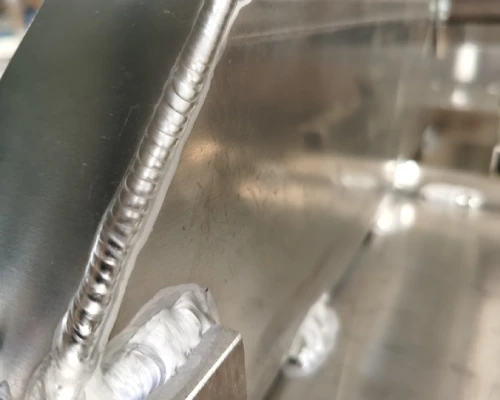
Non-destructive testing (NDT) is a critical means to evaluate the internal and surface integrity of GTAW welded aluminum joints without compromising their usability. NDT programs typically combine multiple techniques to address different defect types. Radiographic testing is the preferred method, clearly revealing internal defects such as porosity, slag inclusions, and lack of fusion. For more sensitive planar defects like lack of fusion or minute hot cracks, ultrasonic testing holds advantages. It generates detailed cross-sectional images of GTAW aluminum welds, providing depth and dimensional information on defects.
For verifying surface quality of GTAW aluminum welds, liquid penetrant testing offers an economical and efficient approach. This method utilizes the capillary penetration of dye into surface defects to visualize flaws like surface cracks and porosity edges. When GTAW-welded aluminum structural components are used in vacuum or pressure vessels, helium mass spectrometry leak testing serves as an advanced verification of weld integrity. It detects extremely low leak rates, ensuring absolute gas tightness of GTAW-welded aluminum welds in demanding environments.
Mechanical Properties and Corrosion Testing
Mechanical and corrosion testing directly quantifies the performance of GTAW aluminum welds.
This involves sampling for tensile, bend, and macro/micro metallographic examinations. Tensile testing provides yield strength, ultimate tensile strength, and elongation data for the weld metal. Results are compared against base material properties and design requirements to verify that the GTAW aluminum welding process has not caused unreasonable strength loss. Bend testing evaluates weld ductility and bonding quality by observing whether cracks appear in the weld zone after specimen bending.
Metallographic analysis precisely measures penetration depth and width, observes grain morphology and heat-affected zone width, and identifies microcracks. For components used outdoors or in corrosive environments, salt spray testing is the standard method to evaluate GTAW aluminum welds‘ resistance to uniform corrosion and pitting, while electrochemical testing quantifies their intergranular corrosion susceptibility.
Looking for a reliable custom sheet metal fabrication companies?
Talk To Supro MFG Expert Team
Contact us for competitive ex-factory prices,
and a full range of technical support services.
Conclusion
The exceptionally high thermal conductivity, surface oxide layer, and extreme hydrogen sensitivity of aluminum alloys necessitate precise control over thermal cycling, metallurgical reactions, and fluid dynamics in the GTAW aluminum welding process. A professional GTAW aluminum welding manufacturer must possess this systematic process capability, enabling the development of preventive solutions that address defect formation at its root cause.
Supro is a specialized GTAW aluminum welding manufacturer. Leveraging advanced equipment, extensive manufacturing experience, and a professional engineering team, we provide flawless aluminum GTAW welding services to over 3,000 companies worldwide, backed by genuine manufacturer pricing.
We deliver diverse products efficiently and on schedule. From product design and rapid sheet metal prototype fabrication to mass production, we provide expert technical support and exceptional quality. Furthermore, we offer one-stop manufacturing solutions and highly cost-competitive product supply!