sheet metal stamping

aluminum sheet metal bending metal corner bracket parts

Custom Metal Corner Brackets: Definition, Advantages, and Applications

Custom metal corner brackets play a crucial role in ensuring structural stability and safety across various applications, including home furnishings, industrial equipment, medical devices, and construction projects. But do you truly understand this common hardware structural element? What exactly is it, and what are its advantages and disadvantages? This article will analyze metal corner brackets, covering their fundamental definition, pros and cons, application scenarios, and common issues to help you recognize and appropriately utilize them. What is a custom Metal Corner Bracket? A metal corner bracket is a structural connector made of metal, typically shaped like a right-angled L. Its core function is to reinforce, support, or connect two components that are perpendicular or at an angle to each other, ensuring structural stability, strength, and load-bearing capacity. Characteristics of Metal Corner Brackets Shape: Most commonly 90 degrees, though other angles (e.g., 45 degrees, 135 degrees) or adjustable designs exist. Metal corner brackets typically feature one or more triangular reinforcing ribs, […]

Custom Metal Corner Brackets: Definition, Advantages, and Applications Read More »

custom metal fabrication process

How to Prevent  corrosion of  fabricated metal products

Fabricated metal products are the cornerstone of modern industry and people’s daily life, from structural steel fabrication in public buildings to sophisticated daily tools, they are everywhere. However, custom fabricated metal products are susceptible to corrosion due to environmental factors, which often leads to performance deterioration, shortened service life, and even safety hazards and economic losses, so corrosion prevention has become a key aspect of protecting custom metal works. The article will systematically discuss the causes of corrosion of fabricated metal products, identify common types of corrosion, and introduce seven practical and efficient anti-corrosion methods in detail, aiming to provide you with a comprehensive guide to the protection of sheet metal products to help you maximize the service life of the products and protect their value and safety. What causes fabricated metal products to corrode? The nature of corrosion of fabricated metal products is the process of electrochemical corrosion reaction between the metal and the environment, which is a redox

How to Prevent  corrosion of  fabricated metal products Read More »

aluminum sheet metal bending services

Sheet metal bending technology: 10 essential and important knowledge

For the sheet metal manufacturing industry, having specialized manufacturing technology is one of the most important competencies. Superior manufacturing technology is demonstrated through the accumulation of extensive manufacturing experience, continuous technological updates, and advanced manufacturing equipment that optimizes the advantages of sheet metal bending in terms of low cost and high economic efficiency. In this article, Supro MFG’s team of senior sheet metal bending engineers, relying on 30 years of manufacturing experience, explains the technical knowledge and solutions of sheet metal bending that most designers are unaware of. 1.Types of bending molds Sheet metal bending tools (mold/dies) is one of the essential tools in the sheet metal forming process. Sheet metal bending molds are composed of upper and lower parts, with the upper mold representing the bending angle and the lower mold representing the forming angle. By applying pressure to the molds through the CNC bending machine, the sheet metal is pressed between the molds, and the sheet metal can

Sheet metal bending technology: 10 essential and important knowledge Read More »

China sheet metal fabrication services

About Sheet metal fabrication process

Cutting material: According to the unfolded graphics of the product design, use equipment or molds to cut the metal sheet, and pre-produce the required material size, which is helpful for the next sheet metal bending, deep drawing, sheet metal stamping and other sheet metal Forming work.Different cutting methods can be reasonably selected according to different materials, product requirements and quantity conditions. include: Laser cutting: Fast and efficient cutting of thin metal plates by laser beam, with flat cross section and no shape restrictions, suitable for large sheet metal parts, or cutting of complex shapes, but not suitable for high-thickness plates. Water jet cutting: suitable for thick metal plates, it can accurately cut complex shapes and neat sections, but the efficiency is low and the cost is high. Plasma cutting: suitable for cutting metal plates with a thickness of 10mm-50mm, it cannot be accurate, the section is not neat, and requires precision machining. Die blanking: It is suitable for cutting small-sized

About Sheet metal fabrication process Read More »

sheet metal stamping parts

Sheet metal stamping parts: common quality problems

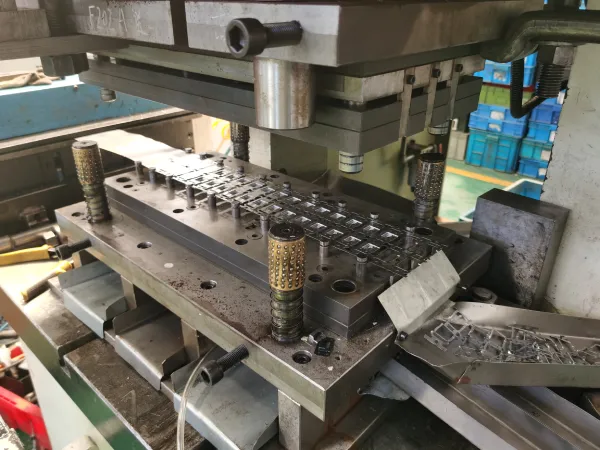
What is sheet metal stamping? Sheet metal stamping is to apply external pressure to various materials such as metal sheets, metal pipes, metal bars, etc. through hydraulic or mechanical presses by means of stamping dies, so as to deform and separate the metal materials, and obtain a product design structure that fits the mold cavity. Production method. Sheet metal stamping parts are widely used in various industries, suitable for a variety of metal sheet materials, mainly including: carbon steel, stainless steel, cold rolled steel, aluminum alloy, copper alloy, galvanized steel, titanium alloy and so on. Sheet metal stamping does not change the properties of the material during processing. The material is changed into products of various shapes, sizes and properties through pressure, which is very suitable for the manufacture of large-scale sheet metal parts, with low cost, high efficiency and uniformity. gender and other characteristics. Stamping dies, materials, and stamping equipment are the three most important elements in the stamping

Sheet metal stamping parts: common quality problems Read More »

china sheet metal stamping factory

Sheet Metal Stamping : The advantages and disadvantages

Compared with castings, forgings and precision machined parts, sheet metal stamping parts have the characteristics of uniform wall thickness, small wall thickness, light weight and high strength, and have unique advantages. In order to meet the application of high-strength products, stamping parts can easily produce products with special details such as reinforcing ribs, reinforcing ribs, irregular undulations, and flanging, which can effectively improve the rigidity and strength of the product. Relying on high-precision stamping dies, precision stamping parts with a tolerance of 0.005mm can be manufactured, and it has the advantages of high repetition rate, low cost, high efficiency, etc., and the product accuracy remains consistent. Generally speaking, any stamping parts with complex structure can be constructed by means of moulds without the need for precision cnc machining secondary processing. At Supro MFG, we usually save the investment of moulds in order to help customers save costs and choose to use 5 Axis laser custting services to Special details are

Sheet Metal Stamping : The advantages and disadvantages Read More »

Scroll to Top