
During TIG welding of aluminum, welders employ high-purity argon gas, specialized tungsten electrodes, and strictly adhere to cleaning procedures, yet issues such as weld porosity, unstable bead formation, and oxide inclusions persist. The root cause lies in the mismatch between the power source output characteristics of TIG welding aluminum and the physical nature of aluminum alloys.
The high thermal conductivity, instantaneous oxidation tendency, and low melting point of aluminum alloys demand precise heat input control and rapid dynamic response from the power source. Traditional base power sources provide only simple AC output for TIG welding aluminum, failing to balance cathode cleaning with heat input management.
This results in incomplete oxide layer removal or tungsten electrode overheating. In contrast, modern advanced inverter power sources utilize adjustable balanced waveforms (e.g., 70/30 EN/EP ratio), high-frequency pulse modulation, and microsecond-level dynamic response. These features stabilize the TIG welding aluminum arc shape, suppress impurity entrainment, and maintain stable molten pool flow.
This article analyzes how professional TIG welding aluminum power sources become critical for high-quality welding through precise energy control, examining both physical fundamentals and engineering practice.
Physical Properties of TIG Welding Aluminum and Power Source Functions
From a materials science perspective, the physical properties of aluminum alloys directly determine the challenges of TIG welding aluminum. However, the power source has evolved from a simple electricity supplier into the core controller of arc and heat management. The quality and controllability of its output waveform can address aluminum’s high thermal conductivity and susceptibility to oxidation, enabling high-quality TIG welding of aluminum.
Physical Properties of Aluminum Materials
When configuring TIG welding settings for aluminum, we must first understand the physical properties of aluminum and its alloys. Aluminum alloys exhibit thermal conductivity as high as 220–250 W/m·K, dissipating heat far more rapidly than steel. This demands that the heat source possess extremely high energy density and precise instantaneous control capabilities; otherwise, insufficient penetration or lack of fusion defects will occur.
The oxide layer instantly forming on aluminum alloy surfaces has a high melting point of 2050°C, far exceeding that of the aluminum base metal (660°C). This significant melting point difference renders traditional DC TIG welding completely ineffective at breaking through this dense oxide layer.
Practical experience reveals that incomplete oxide layer removal results in distinct non-fusion lines and black inclusions within the weld, severely compromising the joint’s mechanical properties and corrosion resistance. These inherent physical characteristics of aluminum alloys dictate that simple heat sources cannot meet the demands for high-quality TIG welding of aluminum.
Core Function of TIG Welding Aluminum Power Source
Professional welding power sources play a central role in thermal management and arc control during TIG welding of aluminum. Their core value lies in delivering precise AC output, achieving dual functions through periodic switching of electrode polarity:
During the electrode positive half-wave (EP), positive argon ions bombard the workpiece surface, creating a cathodic sputtering effect that effectively breaks down oxide layers; During the negative half-wave (EN) of the electrode, the electron stream bombards the workpiece, delivering thermal energy for TIG welding aluminum.
Modern advanced inverter power sources enable independent adjustment of the EN/EP ratio during TIG welding aluminum. For instance, setting the ratio to 70-80% EN ensures sufficient cleaning while optimizing tungsten electrode heat dissipation and controlling total heat input into the base metal.
Problems and Solutions Arising from Incorrect Selection of TIG Welding Power Sources for Aluminum
When performing TIG welding on aluminum, the selection of the power source is critical. Its output current waveform directly determines the welding process’s ability to handle the physical properties of aluminum. Below are several core issues caused by improper power source selection and their solutions.
Insufficient Oxidation Layer Removal and Uneven Penetration in TIG Welding of Aluminum
This manifests primarily as residual black oxide film along the weld edges, unclear fusion lines, and unstable penetration depth. These defects severely compromise structural strength and corrosion resistance.
Standard AC TIG welding systems lack precise balance control capabilities. Insufficient cleaning intensity or duration during the electrode positive half-wave (EP) fails to effectively break down the high-melting-point aluminum oxide layer. Simultaneously, imprecise heat input control during the negative half-wave (EN) leads to depth fluctuations.
Our experience indicates that advanced power sources with independent AC Balance control can be employed for TIG welding aluminum. Precisely adjusting the EN/EP ratio to a 70-80% EN range ensures sufficient cathode cleaning while optimizing heat input distribution. Combined with square-wave AC technology, this further enhances cleaning effectiveness and depth control.
Arc Drift, Tungsten Electrode Contamination, and Molten Pool Disturbance in TIG Welding of Aluminum
These issues primarily manifest as poor arc stability during TIG welding of aluminum, resulting in random drift; abnormal spheroidization or chipping of the tungsten electrode tip; and irregular agitation of the molten pool, leading to poor weld bead formation.
This phenomenon arises because traditional sine-wave AC power sources experience arc extinction and re-ignition delays when passing through zero-crossing points during TIG welding of aluminum. Simultaneously, the slow polarity switching speed of low-frequency AC output fails to maintain a stable arc electric field, causing the arc to drift as it seeks conductive points on the aluminum surface.
In this case, we recommend selecting a square-wave AC power source with high-frequency arc stabilization and rapid polarity switching capabilities. Modern inverter technology provides square-wave frequencies up to 250Hz, ensuring continuous arc stability. Combined with adjustable arc force control, this effectively suppresses arc drift, maintains the geometry of the tungsten electrode tip, achieves a stable molten pool, and delivers high-quality TIG welding of aluminum.
TIG Welding of Aluminum: Burn-Through Deformation in Thin Plates and Insufficient Penetration in Thick Plates
Selecting an incorrect TIG welding power source for aluminum can result in uncontrolled heat input during thin plate welding, causing burn-through or severe deformation. Conversely, insufficient energy during thick plate welding leads to penetration failing to meet design requirements.
Traditional power sources lack precise pulse modulation capabilities. Excessive heat input occurs during TIG welding of thin aluminum sheets, while continuous current during thick plate welding results in insufficient heat accumulation, preventing the establishment of adequate thermal gradients.
In TIG welding aluminum practice, we employ a multi-parameter independently adjustable pulse function. For thin plates (0.5-2mm), high-frequency pulses (150-250Hz) combined with low base current disperse heat input. For thick plates (>6mm), high peak current paired with an appropriate pulse duty cycle establishes an effective thermal gradient.
Rough Weld Bead Formation and Irregular Scalelike Patterns in TIG Welding of Aluminum
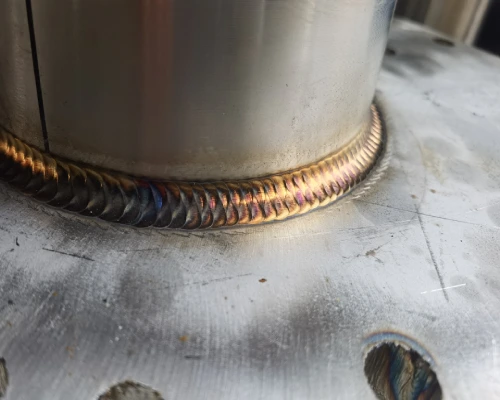
This primarily manifests as a rough, uneven weld surface with irregularly sized fishscale patterns and raised edges along the weld bead, compromising both aesthetic quality and functional performance.
This phenomenon arises from excessive current ripple in the TIG welding aluminum power source, causing fluctuations in arc force and heat input. Simultaneously, the absence of pulse synchronization control leads to mismatched movement of the welding torch and heat input rhythm, resulting in irregular solidification of the molten pool.
To address this, a digital inverter power source with a pure output waveform can be selected. Enabling Synergic Pulse mode automatically adjusts pulse parameters to match welding speed. By precisely controlling peak current duration and base current levels, each pulse forms a consistent molten pool size, resulting in uniform, aesthetically pleasing fish scale patterns and a smooth weld surface.
Narrow Process Window for TIG Welding Aluminum
When welding high-strength aluminum alloys, cast aluminum, or performing all-position operations, TIG welding aluminum settings have a narrow range. Minor fluctuations can cause welding defects, resulting in low product yield rates.
The primary reason is that standard TIG welding aluminum power sources offer limited functionality, unable to provide customized energy output modes tailored to the thermal sensitivity of special materials.
To address this, we employ specialized power systems featuring advanced waveform control and multi-parameter storage for TIG welding aluminum. For high-strength aluminum alloys, specific pulse waveforms can be programmed to prevent alloy element burn-off. For all-position welding, distinct pulse parameter combinations can be configured to counteract gravitational effects.
Professional TIG Welding Aluminium Power Source
In the field of TIG welding aluminum, the distinction between professional-grade power sources and standard equipment lies in their precise control over AC waveforms and thermal management processes. Below are common features and characteristics of professional TIG welding aluminum power sources.
AC Waveform Control Technology in TIG Welding Aluminium Power Sources
The core of a professional TIG welding aluminum power source lies in advanced AC waveform control. Unlike traditional sine wave power sources, modern inverter power sources deliver precise square wave AC output with independent balance control and frequency adjustment capabilities.
Its balance control allows operators to precisely set the electrode negative (EN) ratio within a 30%-70% range, enabling optimized management of cathode cleaning intensity and heat input distribution. Simultaneously, the adjustable frequency range from 20Hz to 250Hz enables welders to adapt settings based on material thickness and TIG welding aluminum position: low frequencies enhance cleaning efficiency, while high frequencies improve arc stability and rigidity.
This precise waveform control ensures thorough removal of aluminum oxide coatings while maintaining ideal heat input management, fundamentally resolving the inherent contradiction of insufficient cleaning and overheating in traditional AC TIG welding aluminum processes.
Precision Multi-Parameter Pulse Functionality
The key to addressing aluminum’s high thermal conductivity lies in precision multi-parameter pulse functionality. A professional TIG welding aluminum power source must offer independent adjustment of peak current, base current, pulse frequency, and duty cycle. By configuring high peak current for instantaneous penetration depth, combined with low base current to maintain arc stability and allow heat diffusion, operators can precisely control thermal input within the optimal range for TIG welding aluminum.
Practical experience shows that for thin aluminum sheets (0.5-2mm), high-frequency pulses of 150-250Hz effectively disperse heat input to prevent burn-through. For plates thicker than 6mm, adjusting the duty cycle to 70%-80% establishes sufficient penetration depth. This sophisticated thermal management capability enables TIG welding aluminum power sources to cover a wide range of applications, from precision thin sheets to thick structural plates.
Dynamic Response and Arc Characteristics
The dynamic response characteristics of TIG welding aluminum power sources directly impact welding process stability. Inverter architectures based on IGBTs or MOSFETs deliver microsecond-level response speeds, ensuring constant energy output during arc length variations or external disturbances.
Professional TIG welding aluminum power sources feature adjustable arc force functionality. This optimizes arc rigidity through instantaneous current compensation, preventing molten pool disturbance caused by arc length fluctuations. Particularly in all-position TIG welding of aluminum, rapid dynamic response enables instantaneous switching between peak and base currents. This provides stable mechanical support to the molten pool, effectively counteracting gravitational forces to achieve high-quality weld bead formation and control.
No design files? Let Supro MFG do it for you.
We often come across clients who have no professional design drawings and documentation, only a creative idea, which leads to the project being at a standstill.
If you are in this situation, then contact our team of experts.
Supro MFG, as an industry-leading custom metal fabricator, has an ever-experienced team of engineers who utilize their extensive fabrication experience and technical expertise to build your idea into a real product and create design files such as STEP/STP/SLDPRT/DXF/PDF/PRT/DWG/AI.
That’s what makes SUPRO MFG so great, and 2,000 corporate, entrepreneurial, artist, and other purchasers from around the world enjoy working with us and benefiting from our one-stop manufacturing services.
Selecting TIG Welding Aluminium Power Source Configurations Based on Application Scenarios
For light maintenance and hobbyist applications, the core requirements are operational simplicity and cost-effectiveness. Compact inverter power sources are recommended for TIG welding aluminum, with current ranges covering 30-150 amperes. This adequately addresses basic welding requirements for aluminum sheets ranging from 0.8 to 4mm thick. When selecting equipment, prioritize ease of use and maintenance convenience over pursuing excessively high performance parameters. The key focus should be on achieving reliable fundamental welding capabilities.
In general manufacturing, TIG welding aluminum power sources must withstand demanding daily continuous operation while delivering exceptional process stability and repeatability. Industrial-grade inverter power sources are recommended. Their rapid dynamic response (response time <50μs) ensures precise arc control, enabling welding of thin sheets to medium-thick structural components—the foundation for efficient, high-quality manufacturing.
Aerospace and shipbuilding sectors impose the most stringent quality standards for aluminum TIG welding. Power source configurations and welding settings must comply with industry specifications like AMS and DNV-GL. Such critical applications demand top-tier welding systems where waveform control precision, output stability, and parameter traceability are paramount to guarantee structural integrity and safety.
Conclusion
In the field of TIG welding aluminum, we must recognize that the welding power source is not merely a simple energy conversion device, but rather an intelligent system that precisely controls the physical welding process. The fundamental solution to common issues in TIG welding aluminum—such as incomplete oxide layer removal, poor arc stability, and difficulty controlling heat input—lies in selecting the appropriate power source.
TIG welding aluminum transforms simple sheets into critical components across industries, making it ubiquitous in our daily lives. If you require TIG welding aluminum services, contact us immediately!
At Supro, we offer comprehensive TIG welding aluminum services—not only assisting you in selecting the right aluminum materials for your project but also efficiently delivering the parts you require. Certified to ISO9001 and TS16949 standards, we provide expert technical guidance and complete manufacturing solutions for precision engineered aluminum alloy components, aluminum enclosures, standard aluminum extrusions, or custom aluminum prototypes!