


In aluminum fabrication, MIG welding is a key process for achieving both structural strength and aesthetic appeal. The core challenges of aluminum welding lie in its unique physical properties: the melting point of the surface oxide layer (approximately 2050°C) is significantly higher than that of the base metal (approximately 660°C), coupled with high thermal conductivity and a high coefficient of thermal expansion. If not handled properly, this can lead to contamination of the molten pool, porosity, and distortion.
As a trusted MIG welding aluminum manufacturer, we emphasize that successful aluminum welding processes begin with proper surface preparation of the base material. The oxide layer must be thoroughly removed using stainless steel wire brushes or chemical methods, and oil contamination must be eliminated with specialized degreasers such as acetone. This is the first step in preventing hydrogen embrittlement (porosity) in the weld.
This article will provide an in-depth analysis of the MIG welding of aluminum process, covering strict surface pretreatment, precise parameter settings for 6061 aluminum alloy, and why a spool gun is recommended for critical applications to address wire feeding instability, among other topics. By dissecting these technical details, we aim to demonstrate how MIG welding of aluminum enables the manufacture of custom metal components with zero defects, ensuring consistent high-quality delivery for your projects from prototyping through mass production.
4 Steps To Prep Aluminum Surfaces
Getting ready for mig welding aluminum is not just wiping off dust and hoping for the best. Solid prep makes aluminum welding smoother, cleaner, and way less frustrating. If you want stable arcs and clean beads during mig welding aluminum, surface work is where it all starts.

Clean the Aluminum Surface: Preparing for MIG Welding
Proper surface preparation is key to successful MIG welding. When preparing any aluminum surface, cleanliness directly affects weld quality.
1) Key cleaning methods include:
Removing loose contaminants: Use lint-free cloths; avoid using shop rags with oil stains.
Brushing the joint area: Use a stainless steel brush designed specifically for aluminum, brushing gently and evenly to avoid embedding particles into the surface.
2) For MIG welding of aluminum in production workshops:
Inspect incoming materials: Check for packaging residues and ensure dry storage conditions.
Prepare immediately before welding: Clean the joint immediately before striking the arc; avoid touching the joint edges with your hands.
At Supro, we regard cleanliness as a non-negotiable principle. Clean metal ensures a stable arc, better penetration, and smoother MIG welding results.
How to Remove Oxide Layers from Aluminum
Before beginning MIG welding of aluminum, removing the oxide layer is the first step in ensuring fusion quality and the integrity of the final component, and it is a core quality control point for us as a professional MIG welding manufacturer.
The melting point of aluminum oxide is approximately 2050°C, which is significantly higher than that of the aluminum base material (approximately 660°C). If not removed, this “skin” will hinder fusion during welding, leading to slag inclusion and weld defects. In our MIG welding process for aluminum, mechanical cleaning is the most reliable method: specialized stainless steel wire brushes must be used, and brushing must be performed in a single direction to avoid introducing contaminants into the molten pool. For MIG-welded aluminum workpieces requiring high precision, we use certified chemical cleaning agents for degreasing and strictly adhere to rinsing and drying procedures.
Critical Timing: Welding must begin immediately after cleaning and removing the oxide layer. This is because the oxide layer reforms instantly on a clean aluminum surface, and any delay could render the preparatory work ineffective. Therefore, performing a final cleanup before striking the arc is the golden rule for ensuring a high-quality MIG welding process for aluminum.
Why Surface Contamination Affects MIG Welding Results
Even trace amounts of oil, grease, or dirt can cause serious MIG welding defects, such as porosity and cracks, thereby compromising the overall quality of the weld.
1)Common sources of surface contamination:
Handling with bare hands
Cutting fluids
Shop humidity
2) Effects on the welding of aluminum:
The gas shield is compromised, and trapped moisture forms pores.
The arc becomes unstable, and contaminants alter heat transfer.
The American Welding Society noted in its 2025 industry outlook that contamination remains a leading contributor to porosity in aluminum GMAW applications, especially in high-speed production lines.
When running mig welding aluminum, even tiny contaminants can wreck an otherwise perfect aluminum MIG weld.
Proper Degreasing Techniques for Aluminum Welding
When performing high-quality MIG welding of aluminum, degreasing is key to preventing porosity (hydrogen embrittlement) in the weld. As a manufacturer providing professional MIG welding services for aluminum, we adhere to strict workshop standards.
Grease and moisture on the surface of aluminum are the primary sources of hydrogen causing porosity in welds. We specify the use of acetone or isopropyl alcohol in conjunction with clean, lint-free cloths for wiping, and the cloths must be changed frequently to prevent recontamination. It is essential to wait until the solvent has completely evaporated. The use of compressed air containing oil mist for drying is strictly prohibited, as this can blow contaminants back into microscopic pores.
In Supro’s aluminum welding processes, we integrate this solvent cleaning with mechanical cleaning into a seamless workflow. When the metal is properly degreased, the filler metal achieves clean, consistent wetting, ensuring that every product we deliver has stable, defect-free weld integrity.
online custom metal fabrication parts
Only 4 steps
Contact our experts team and experience the efficiency and economic benefits of digital metal fabrication services.
Upload Design Files
STL , STEP (.stp), IGES (.igs), (.ZIP), or PDF.
Also be a sample or an idea
Quote & Design Analysis
Instant factory quotes and DfM reports, the most reasonable solution.
Manufacturing Begins
Digital processes can initiate order tasks within 24 hours.
On-Time Delivery
Keeping delivery promises, approved by 3000+ Global Company buyers.
Essential Settings For Aluminum MIG Welding
The key to mastering MIG welding of aluminum lies in precise parameter settings. Aluminum’s high thermal conductivity and thermal expansion coefficient mean that the MIG welding process is extremely sensitive to heat input. At Supro, we control the flow of the molten pool by precisely matching voltage, wire feed speed, and gas flow. Correct parameter settings ensure consistent penetration and clean weld beads in aluminum welding processes, thereby significantly reducing rework—this is the technical foundation of our high-quality MIG welding services.

Optimal MIG Welding Parameters for 6061 Aluminum
When welding 6061 aluminum alloy, balanced welding parameters ensure that the molten pool remains stable during the MIG welding process.
1) Basic Equipment Settings
Current Control: Set the current according to thickness; choose 90–130 A for 3 mm and 160–210 A for 6 mm.
Voltage Adjustment: Adjust the voltage in conjunction with the wire feed speed to maintain spray transfer.
Feed Rate Control: Maintain a sufficient feed rate to prevent burn-through.
2) Heat Input Balance
Excessive temperature: Overpenetration. Collapsed weld edges.
Insufficient temperature: Lack of fusion. Stringy welds.
Supro Mfg fine-tunes these parameters daily to ensure stable MIG welding of aluminum, particularly during the welding of 6061 structural frames.
3) MIG Welding of Aluminum Parameter Reference
Material Thickness (mm) | Amperage (A) | Voltage (V) | Travel Speed (cm/min) |
2 | 80–110 | 18–20 | 45–60 |
3 | 100–140 | 19–22 | 40–55 |
5 | 150–190 | 22–24 | 30–45 |
6 | 170–210 | 23–25 | 25–40 |
Setting Wire Feed Speed and Voltage for Aluminum Alloys
Stable arc behavior in aluminum alloys depends on syncing wire feed speed and voltage. Push one too high and the arc gets wild. Drop both too low and fusion suffers.
Start with your welding machine chart, then adjust for material thickness and joint type.
Thin lap joints need slightly higher voltage for wetting.
Thick butt joints prefer increased wire feed speed to support spray transfer.
ER4043 runs smoother; ER5356 gives stronger tensile results.
In MIG aluminum welding, a crisp buzzing sound usually means your wire feed speed matches voltage. Harsh popping? Back it down a notch.
At supro mfg, operators test on scrap before full production. That habit saves time and keeps mig welding aluminum beads consistent across batches.
Gas Flow Rate and Shielding Gas Selection for Aluminum MIG Welding
In the MIG welding of aluminum, a clean shielding gas is essential. Inadequate coverage can directly cause porosity and result in poor weld quality.
1) Selection of gas for MIG welding of aluminum
Pure argon: Best suited for welding thin sheets; provides a stable arc strike.
Argon + helium: Offers greater penetration depth; better suited for welding thick sheets.
2)Setting the appropriate gas flow rate
Indoor shop: 20–25 CFH
Light draft: 25–30 CFH
Avoid excess flow; turbulence pulls air in.
3)Troubleshooting Porosity in MIG Welding Aluminum
Check regulator and hoses
Inspect nozzle for spatter buildup
Confirm consistent gas pre-flow
For high-volume mig welding aluminum, supro mfg standardizes gas checks at shift start. It sounds simple, yet steady shielding gas control keeps aluminum MIG welds bright, clean, and solid.
Are you looking for reliable & cost-effective
China Sheet Metal Fabricators
More than 150,000 OEM metal fabrication products delivered to 5,000+ global buyers.
And benefit from it!
Are porosity issues common in MIG welding of aluminum?
In the MIG welding of aluminum, porosity (i.e., hydrogen embrittlement in the weld) is a typical critical defect, often caused by an unstable arc resulting from inconsistent wire feeding. As a professional MIG welding aluminum manufacturer, we utilize a spool-to-torch configuration at critical workstations, minimizing the wire feed distance to the absolute minimum. This completely eliminates the vibration and friction issues associated with soft aluminum wire in long feed hoses, ensuring a laminar shielding gas flow and a stable molten pool during the MIG welding process, thereby delivering clean, porosity-free welds. This is one of the core guarantees of our high-quality MIG welding aluminum services.

Spool Gun vs. Regular MIG Welding: Handling Porosity Issues
In mig welding aluminum, controlling porosity starts with how wire feeds and how gas shielding protects the puddle.
1)Wire Delivery System
Standard MIG welding with liner:Long liner path increases drag on soft aluminum wire.Inconsistent wire feed leads to arc instability.Arc flutter traps gas, creating weld defects.
Spool gun configuration:Wire spool mounted directly on the gun.Short feed path reduces deformation.Stable arc lowers porosity in mig welding aluminum.
2) Gas Control in MIG Welding of Aluminum
Traditional MIG torch:Higher chance of airflow disturbance.Contact tip wear affects gas coverage.
Spool-based torch:Tighter nozzle-to-puddle distance.Improved gas shielding consistency.
3)Practical Shop Impact
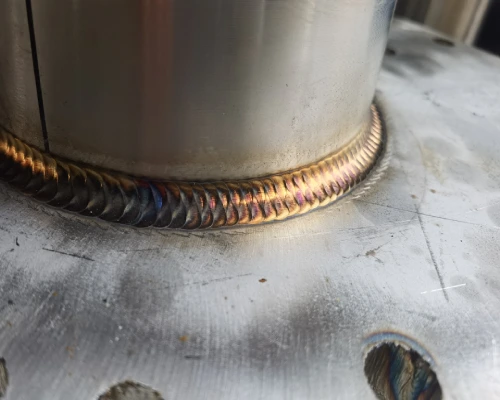
Fewer reworks in aluminum MIG welding.Cleaner bead profile.Better penetration control.
Many fabrication teams working with mig welding aluminum at supro mfg report that switching to a spool gun noticeably cuts internal porosity and scrap rates.
How to Adjust Spool Gun Settings for Cleaner Aluminum Welds
In the MIG welding of aluminum, adjusting the wire feeder and torch parameters to achieve a clean weld is not a matter of guesswork. Subtle adjustments are critical.
To fine-tune mig welding aluminum with a spool gun:
Set baseline voltage from thickness chart.
Increase wire speed until arc sounds smooth, not erratic.
Adjust travel speed so the bead stays flat, not piled up.
Ensure that the gas flow rate for MIG welding of aluminum is stable; avoid airflow interference.
Once all the parameters are properly adjusted, the MIG welding process for aluminum becomes fully controllable. The molten pool flows smoothly, the arc is compact, and those pesky porosity issues are finally resolved.
Material Thickness (mm) | Voltage (V) | Wire Speed (m/min) | Gas Flow (L/min) |
2.0 | 18–19 | 5–6 | 14–16 |
3.0 | 19–21 | 6–7 | 16–18 |
4.0 | 21–23 | 7–8 | 18–20 |
6.0 | 23–25 | 8–10 | 20–22 |
Get instant ex-factory price quotation.
If you only have an idea or an old sample,Let us know.
with photo or video and get our quotation and manufacturing solutions.
- Product design drawings or 3D model files.
- Material standards and appearance requirements.
- Product quantity demand.
- Industry standards in the application field.
- Functional requirements
FAQs about Mig Welding Aluminum
What surface preparation is critical before mig welding aluminum?
Clean metal decides weld quality before the arc even starts.
Remove oxide from 6061 aluminum or 5052 aluminum using stainless wire brushes or light grinding wheels.
Wipe aluminum sheet or extruded aluminum with acetone and lint-free cloths.
Keep filler metal (ER4043 or ER5356 solid wire) dry and sealed.
If oil or moisture remains, porosity forms fast during GMAW. A quick visual inspection of the aluminum plate and torch nozzles often prevents hours of rework later.
How do voltage and wire feed speed affect weld quality in MIG welding?
Arc behavior shifts dramatically with small parameter changes.
Low wire feed speed → unstable arc length, weak penetration.
Excess voltage → burn-through on thin aluminum sheet.
Balanced amperage + travel speed → smooth bead and controlled heat input.
With a calibrated MIG welder and steady wire feeder, Pulse MIG settings can reduce distortion on 7075 aluminum while maintaining strong fusion. Stable parameters protect both weld quality and productivity.
Why is a spool gun recommended for aluminum MIG welding?
Soft aluminum filler wire bends easily inside a standard liner.
A spool gun keeps spool wire close to the welding torch.
Reduces feeding issues and contact tip wear.
Improves consistency during long production runs.
For high-volume GMAW on aluminum alloys, spool gun welding or push-pull gun welding limits downtime and keeps penetration uniform across multiple parts.
Which shielding gas works best for mig welding aluminum?
The choice of gas for MIG welding of aluminum affects the shape of the molten pool and the final surface finish.
Pure argon from a properly regulated cylinder provides stable arc transfer in most aluminum sheet applications. For thicker sections requiring higher heat input, a helium-argon mixture can increase penetration depth.
Maintain the correct MIG welding gas flow rate for aluminum and regularly inspect the diffuser, nozzle, and gas regulator. Inadequate shielding gas coverage can lead to porosity and cracks—issues that no post-weld inspection can fully conceal.
Conclusion
Mastering the art of MIG welding aluminum lies in systematizing a rigorous process. From pre-treatment to thoroughly remove the oxide layer, to precisely matched spray transition parameters for 6061 alloy, to the use of a wire-spool torch configuration to address porosity issues, every variable directly impacts the structural and aesthetic integrity of the final component.
Supro is a professional MIG aluminum welding manufacturer. Leveraging advanced equipment, extensive manufacturing experience, and a dedicated engineering team, we provide flawless metal fabrication services to over 3,000 companies worldwide, offering genuine manufacturer pricing. We deliver a wide range of products efficiently and on time. From product design and rapid sheet metal prototype fabrication to mass production, we provide professional technical support and exceptional quality. We offer one-stop manufacturing solutions and highly cost-competitive product supply!