Quality problems

aluminum sheet metal bending metal corner bracket parts

Custom Metal Corner Brackets: Definition, Advantages, and Applications

Custom metal corner brackets play a crucial role in ensuring structural stability and safety across various applications, including home furnishings, industrial equipment, medical devices, and construction projects. But do you truly understand this common hardware structural element? What exactly is it, and what are its advantages and disadvantages? This article will analyze metal corner brackets, covering their fundamental definition, pros and cons, application scenarios, and common issues to help you recognize and appropriately utilize them. What is a custom Metal Corner Bracket? A metal corner bracket is a structural connector made of metal, typically shaped like a right-angled L. Its core function is to reinforce, support, or connect two components that are perpendicular or at an angle to each other, ensuring structural stability, strength, and load-bearing capacity. Characteristics of Metal Corner Brackets Shape: Most commonly 90 degrees, though other angles (e.g., 45 degrees, 135 degrees) or adjustable designs exist. Metal corner brackets typically feature one or more triangular reinforcing ribs, […]

Custom Metal Corner Brackets: Definition, Advantages, and Applications Read More »

7075 aluminum CNC machining parts

CNC Fabrication vs 3D Printing: Understanding the Differences

In industries such as automotive, electronics, aerospace, and medical devices, CNC fabrication and 3D printing stand as two core manufacturing technologies, each supporting diverse production needs with unique strengths. CNC fabrication produces parts by precisely cutting away material from solid blocks, while 3D printing transforms digital designs into physical components by layering materials. These two processing technologies exhibit significant differences in material selection, surface finish, and the ability to handle complex geometries. Understanding their respective strengths and limitations is crucial for product development and production. This article provides a detailed analysis of CNC fabrication and 3D printing, covering their fundamental definitions, advantages and disadvantages, and key distinctions. It aims to help you correctly understand and appropriately apply these two processing technologies. CNC Fabrication services CNC fabrication services is a subtractive manufacturing process. It uses computer software and code to control large industrial machine tools and equipment, progressively removing excess material from a solid block (known as a blank) until it

CNC Fabrication vs 3D Printing: Understanding the Differences Read More »

custom aluminum extrusion parts manufacturer in China

Understanding Aluminum Extrusion Dies

The aluminum extrusion process transforms aluminum and its alloys into various complex and continuous profiles, finding extensive applications in aerospace, medical devices, construction engineering, industrial equipment, and other fields. However, the core to achieving this process lies in the aluminum extrusion die, whose design and application directly determine the precision, performance, and production efficiency of aluminum extrusion parts. With the continuous advancement of aluminum processing technology, the design and manufacturing of aluminum extrusion dies also face increasingly stringent requirements. This article analyzes aluminum extrusion dies, first defining the core principles of the extrusion process, then introducing primary die types, and finally highlighting the functional value of supplementary tooling. Aluminum Extrusion Process The aluminum extrusion process shapes aluminum alloy materials into profiles with fixed cross-sectional shapes through dies. Its fundamental principle resembles squeezing toothpaste—by applying pressure, soft aluminum rods are forced through an aluminum extrusion die, forming long, strip-like profiles matching the die’s shape. Primary Steps of the Aluminum Extrusion Process

Understanding Aluminum Extrusion Dies Read More »

aluminum sheet metal bending metal corner bracket parts

About Aluminum Fabrication: 4 Things Need to Know!

Since its discovery in 1827, aluminum has become an important raw material in many fields such as aerospace, automotive manufacturing, medical devices, and industrial equipment. It has many advantages, such as light weight, durability, recyclability, good electrical conductivity, etc. But do you know some trivia about aluminum? Understanding the performance characteristics of aluminum can help you make full use of aluminium fab to meet your various needs, next, the article will introduce you 4 aluminum related knowledge in detail to help you fully recognize and understand aluminum alloy and aluminium fab. 4 Things about aluminum 5052 aluminum: the optimal choice for metal prototyping and batch sheet metal processing Not all aluminum has the same performance characteristics. 5052 aluminum belongs to the aluminum-magnesium non-heat treatment alloy, which retains the lightweight characteristics of aluminum and increases its tensile strength to 230MPa, and at the same time, has excellent ductility, bending, forming, and weldability. In the processes of stamping, cutting and bending in

About Aluminum Fabrication: 4 Things Need to Know! Read More »

custom metal fabrication process

How to Prevent  corrosion of  fabricated metal products

Fabricated metal products are the cornerstone of modern industry and people’s daily life, from structural steel fabrication in public buildings to sophisticated daily tools, they are everywhere. However, custom fabricated metal products are susceptible to corrosion due to environmental factors, which often leads to performance deterioration, shortened service life, and even safety hazards and economic losses, so corrosion prevention has become a key aspect of protecting custom metal works. The article will systematically discuss the causes of corrosion of fabricated metal products, identify common types of corrosion, and introduce seven practical and efficient anti-corrosion methods in detail, aiming to provide you with a comprehensive guide to the protection of sheet metal products to help you maximize the service life of the products and protect their value and safety. What causes fabricated metal products to corrode? The nature of corrosion of fabricated metal products is the process of electrochemical corrosion reaction between the metal and the environment, which is a redox

How to Prevent  corrosion of  fabricated metal products Read More »

7075 aluminum CNC machining parts

anodic oxidation of metal parts

Anodic oxidation, the electrochemical oxidation of metals or alloys. In the real process, for aluminum alloy anodic oxidation, more, usually used in daily life, military industry, aerospace, communications equipment, and precision instrumentation manufacturing industry. Because of the characteristics of this process, the surface of the aluminum parts to produce a hard protective layer, so that the corrosion resistance of metal materials, wear resistance, decorative, insulation, as well as heat dissipation have been significantly improved. This article will discuss how anodizing works, its uses, material compatibility, and the advantages and disadvantages it has. What is anodic oxidation? Anodic oxidation, the electrochemical oxidation of metals or alloys. Anodic oxidation is an electrochemical process in which a dense oxide film is formed on the surface of aluminum and its alloys by means of an electric current to improve corrosion resistance, abrasion resistance and decorative properties. Depending on the electrolyte and temperature, it can be divided into acidic, alkaline, normal temperature and high temperature

anodic oxidation of metal parts Read More »

aluminum sheet metal bending services

Sheet metal bending technology: 10 essential and important knowledge

For the sheet metal manufacturing industry, having specialized manufacturing technology is one of the most important competencies. Superior manufacturing technology is demonstrated through the accumulation of extensive manufacturing experience, continuous technological updates, and advanced manufacturing equipment that optimizes the advantages of sheet metal bending in terms of low cost and high economic efficiency. In this article, Supro MFG’s team of senior sheet metal bending engineers, relying on 30 years of manufacturing experience, explains the technical knowledge and solutions of sheet metal bending that most designers are unaware of. 1.Types of bending molds Sheet metal bending tools (mold/dies) is one of the essential tools in the sheet metal forming process. Sheet metal bending molds are composed of upper and lower parts, with the upper mold representing the bending angle and the lower mold representing the forming angle. By applying pressure to the molds through the CNC bending machine, the sheet metal is pressed between the molds, and the sheet metal can

Sheet metal bending technology: 10 essential and important knowledge Read More »

China sheet metal fabrication services

About Sheet metal fabrication process

Cutting material: According to the unfolded graphics of the product design, use equipment or molds to cut the metal sheet, and pre-produce the required material size, which is helpful for the next sheet metal bending, deep drawing, sheet metal stamping and other sheet metal Forming work.Different cutting methods can be reasonably selected according to different materials, product requirements and quantity conditions. include: Laser cutting: Fast and efficient cutting of thin metal plates by laser beam, with flat cross section and no shape restrictions, suitable for large sheet metal parts, or cutting of complex shapes, but not suitable for high-thickness plates. Water jet cutting: suitable for thick metal plates, it can accurately cut complex shapes and neat sections, but the efficiency is low and the cost is high. Plasma cutting: suitable for cutting metal plates with a thickness of 10mm-50mm, it cannot be accurate, the section is not neat, and requires precision machining. Die blanking: It is suitable for cutting small-sized

About Sheet metal fabrication process Read More »

sheet metal stamping parts

Sheet metal stamping parts: common quality problems

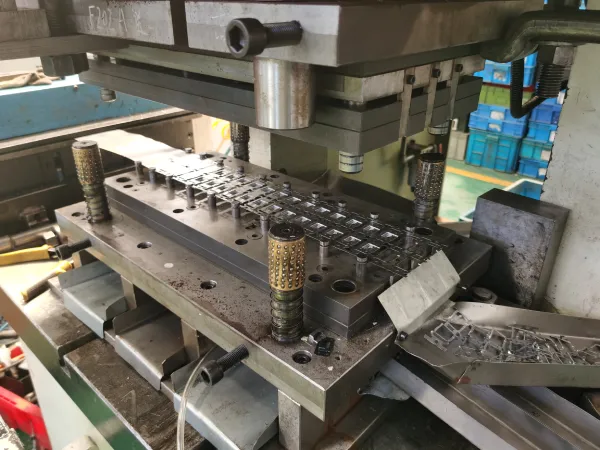
What is sheet metal stamping? Sheet metal stamping is to apply external pressure to various materials such as metal sheets, metal pipes, metal bars, etc. through hydraulic or mechanical presses by means of stamping dies, so as to deform and separate the metal materials, and obtain a product design structure that fits the mold cavity. Production method. Sheet metal stamping parts are widely used in various industries, suitable for a variety of metal sheet materials, mainly including: carbon steel, stainless steel, cold rolled steel, aluminum alloy, copper alloy, galvanized steel, titanium alloy and so on. Sheet metal stamping does not change the properties of the material during processing. The material is changed into products of various shapes, sizes and properties through pressure, which is very suitable for the manufacture of large-scale sheet metal parts, with low cost, high efficiency and uniformity. gender and other characteristics. Stamping dies, materials, and stamping equipment are the three most important elements in the stamping

Sheet metal stamping parts: common quality problems Read More »

Scroll to Top