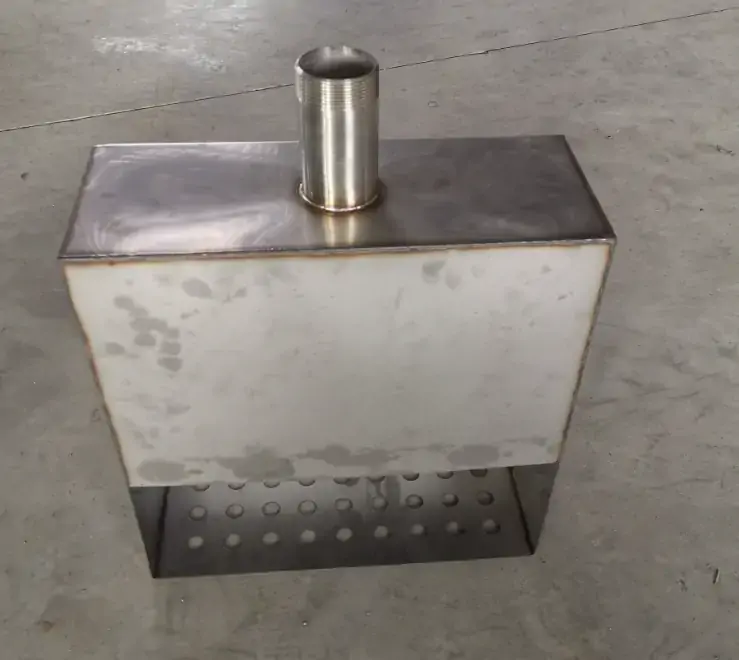
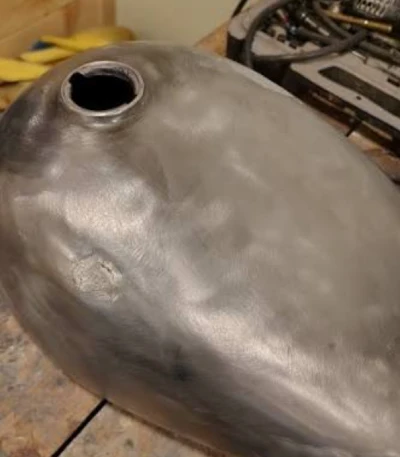

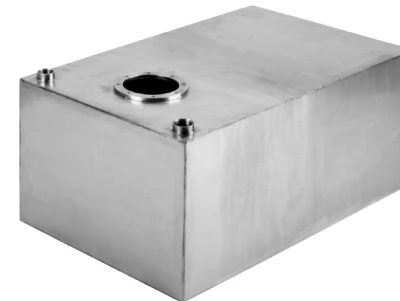
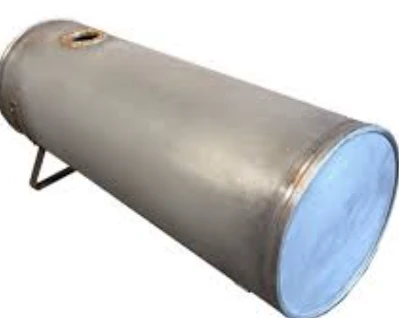
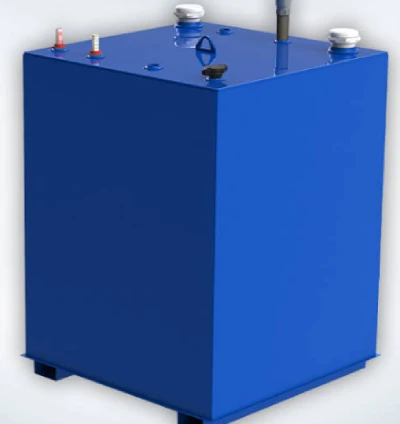

Modern automotive fuel systems place increasingly stringent demands on seal reliability, and welding deformation of the top flange on metal gasoline tanks has become a critical process bottleneck affecting the assembly quality of fuel pump modules.
Fuel senders or high-pressure fuel pump assemblies are typically mounted to the top of metal gasoline tanks via a flange whose thickness is significantly greater than that of the tank wall. This substantial difference in cross-sectional thickness leads to a severely uneven distribution of heat input during the welding process: the thick flange area absorbs a large amount of heat and heats up slowly, while the thin-walled tank rapidly reaches high temperatures due to its low heat capacity and limited heat dissipation pathways.
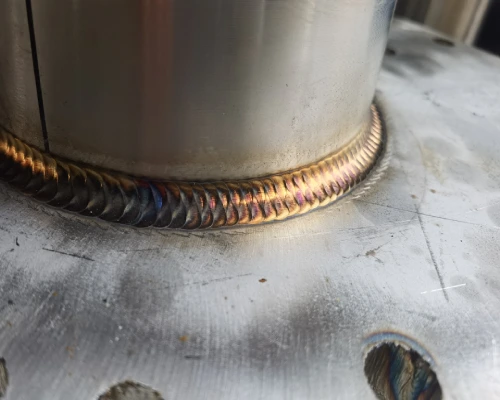
Local expansion caused by the welding heat cycle and the subsequent cooling contraction accumulate to form residual stresses within the weld and the heat-affected zone (HAZ), ultimately manifesting as angular distortion and loss of flatness on the flange sealing surface.
For O-rings, flange flatness is the core geometric tolerance that determines the sealing performance of custom metal gasoline tanks. Seals rely on uniform compression to achieve media isolation—deviations from flatness mean that local high-pressure and low-pressure zones exist on the sealing surface, and insufficient compression in the low-pressure zones creates pathways for fuel leakage.
Gasoline’s low surface tension and high permeability mean that even micron-level gaps are sufficient to cause leaks, and the operating conditions of high-pressure fuel systems further amplify this risk. Therefore, the flange sealing surface must maintain strict flatness tolerances after welding is completed.
This article will provide a detailed analysis of how to address thermal warping of fuel pump flanges during the manufacturing of metal gasoline tanks, including process control during welding, fixture strategies, and post-weld finishing.
Understanding the Root Causes of Thermal Warpage in Metal Gasoline Tank Flanges
Thermal warpage in metal gasoline tank flanges is not caused by a single factor, but rather is the inevitable result of the combined effects of variations in material thickness, uneven heat input distribution, and constraint conditions. Understanding the physical nature of warpage is a prerequisite for developing effective process control strategies and a key technical dimension for evaluating the comprehensive welding and machining capabilities of metal gasoline tank manufacturers.
Thermodynamic Characteristics of Welding Thick Flanges to Thin-Walled Metal Gasoline Tanks
There is a significant difference in wall thickness between the flanges and the tank body of a metal gasoline tank—flange thickness can reach several millimeters, while the tank body wall thickness is typically only 0.8 to 2.0 mm. This abrupt change in cross-section leads to a severely uneven distribution of heat input during the welding heat cycle: the thick flange side has a large heat capacity and heats up slowly, while the thin-walled tank side reaches high temperatures rapidly due to its low heat capacity.
Asymmetric thermal expansion and plastic compression occur within the weld and the heat-affected zone (HAZ). During the cooling phase, this asymmetric strain is converted into residual stress, whose bending moment effect is sufficient to cause significant angular distortion (Angular Distortion).
The thin-walled structure of custom metal gasoline tanks lacks inherent stability and has limited constraint capacity, making it unable to effectively resist the deformation caused by the welding heat cycle. Controlling heat input, reducing the amount of deposited metal, and implementing appropriate preheating and post-welding treatments are key process strategies for minimizing such deformation.
Why Is Flange Flatness Critical to the Integrity of the Fuel System?
The flatness of the flange sealing surface directly determines the uniformity of compression on the O-ring. The seal relies on consistent compression along the entire sealing circumference to achieve media isolation—flatness deviations result in localized high-pressure and low-pressure zones on the sealing surface, where insufficient compression in the low-pressure areas creates pathways for fuel leakage.
Given gasoline’s low surface tension and high vapor pressure, even micrometer-level flatness deviations are sufficient to cause leaks. As fuel systems evolve toward higher pressures, increased operating pressures further amplify this risk.
The industry typically requires the flatness tolerance of the fuel pump flange sealing surface in metal gasoline tanks to be controlled within 0.05 mm. This stringent geometric precision requirement has elevated post-weld machining from an optional process to a necessary manufacturing step.
The flatness of custom metal gasoline tank flanges is typically inspected using a precision straightedge in conjunction with a plug gauge; for mass production, coordinate measuring machines (CMMs) must be introduced to implement process control.
Are you looking for reliable & cost-effective
China metal fabrication manufacturer
More than 150,000 OEM metal fabrication products delivered to 5,000+ global buyers.
And benefit from it!
Process Control During the Welding of Metal Gasoline Tanks
Controlling heat input and geometric constraints during the welding process are key to preventing warping of the flanges on metal gasoline tanks. Parameter optimization and heat dissipation via copper fixtures work in tandem and directly determine the controllability of post-weld deformation.
Managing Heat Input Through Parameter Optimization
Welding heat input is the key variable affecting the width of the heat-affected zone (HAZ) and the magnitude of residual stresses. It is calculated using the formula: H = EI/v (current × voltage / welding speed).
For welding metal gasoline tank flanges, reducing current and voltage decreases instantaneous heat input, while appropriately increasing welding speed shortens the duration of heat exposure—combining these two approaches effectively controls the extent of the heat-affected zone and limits the thickness of the plastic compression layer.
Replacing continuous arc welding with a pulsed welding process can further reduce average heat input and minimize heat accumulation in the weld. Furthermore, replacing continuous weld passes with intermittent welding allows heat to dissipate segment by segment by increasing the cooling interval, thereby preventing a sustained rise in temperature in localized areas.
The thin-walled bodies of custom metal gasoline tanks have limited heat capacity; any heat input exceeding the design benchmark will directly result in welding distortion. Therefore, precise control of the parameter window is a fundamental prerequisite for minimizing the amount of subsequent correction.
Fixturing Strategies for Welding Metal Gasoline Tanks: The Role of Copper Heat Sink Fixtures
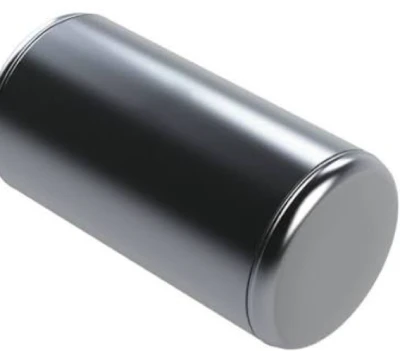
Copper has a thermal conductivity of approximately 400 W/m·K, which is about eight times that of steel, making it the most effective passive heat dissipation medium for flange welding of metal gasoline tanks.
Heavy-duty copper heat sink fixtures must be designed to fit snugly against the flange area to create the shortest heat transfer path, rapidly dissipating welding heat from the heat-affected zone, reducing the peak temperature of the base metal, and minimizing dwell time at high temperatures. At the same time, the fixtures act as rigid constraints, using mechanical clamping force to lock the relative geometric positions of the flange and the custom metal gasoline tank, thereby resisting out-of-plane displacement caused by thermal expansion during welding.
For mass production of metal gasoline tanks, the incorporation of internal water-cooling channels maintains the copper fixtures’ continuous heat dissipation capacity, ensuring consistent thermal boundary conditions for each product.
The cleanliness and fit of the contact surfaces between the fixtures and the workpiece directly affect thermal conductivity efficiency—any gap will create thermal resistance and impair heat dissipation. The thermal capacity and mass of the copper fixtures themselves must also be matched to the workpiece to achieve an optimal balance in heat dissipation rates.
Only 4 steps
online custom metal fabrication parts
Contact our experts team and experience the efficiency and economic benefits of digital metal fabrication services.
Upload Design Files
STL , STEP (.stp), IGES (.igs), (.ZIP), or PDF.
Also be a sample or an idea
Quote & Design Analysis
Instant factory quotes and DfM reports, the most reasonable solution.
Manufacturing Begins
Digital processes can initiate order tasks within 24 hours.
On-Time Delivery
Keeping delivery promises, approved by 3000+ Global Company buyers.
CNC Machining After Welding of Metal Gasoline Tanks
Residual stresses and geometric deviations introduced by the welding heat cycle cannot be completely eliminated through process control alone; post-weld CNC face milling is an essential process for achieving a flatness tolerance of 0.05 mm on the flange sealing surfaces of custom metal gasoline tanks.
Why Pre-machining Alone Is Insufficient
Machining the flange to its final dimensions and surface finish prior to welding cannot prevent the geometric deviations introduced by the welding process in the manufacturing of metal gasoline tanks.
The welding heat cycle causes non-uniform thermal expansion and plastic contraction in the weld and heat-affected zone. After cooling, the release of residual stresses leads to out-of-plane distortion of the flange sealing surface, with the amount of deformation typically far exceeding the 0.05 mm tolerance range. Even if the flange flatness is controlled within 0.02 mm prior to welding, post-weld angular distortion may degrade the flatness to 0.1–0.2 mm.
The thin-walled bodies of custom metal gasoline tanks lack sufficient cross-sectional stiffness to resist bending moments; once deformation occurs, it cannot be self-corrected through subsequent cooling. Therefore, scheduling the final machining of the sealing surface after welding is completed is the only reliable way to fundamentally compensate for the effects of thermal expansion.
CNC Face Milling Strategy for Sealing Surfaces
Post-weld CNC face milling must use machined features on the metal gasoline tank assembly (such as the lower locating holes or edge reference surfaces) as clamping and positioning references to ensure that the milling allowance is evenly distributed across the flange sealing surface.
It is recommended to use a precision face milling cutter with carbide inserts, with a cutting depth controlled between 0.2 and 0.5 mm; the feed rate must be matched to the spindle speed to prevent secondary thermal deformation caused by cutting heat.
For the flange of the metal gasoline tank, the final flatness target is set at 0.05 mm, while the surface roughness (Ra) value should be controlled below 1.6 μm to ensure the contact and compression characteristics of the O-ring.
During the milling process, compressed air or a minimal amount of coolant should be used to remove chips and reduce frictional heat. Deburring must be performed after machining to prevent microscopic protrusions along the sealing line from affecting the sealing performance of the custom metal gasoline tank.
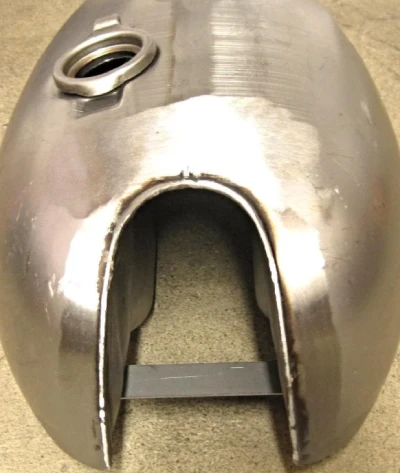
Quality Verification and Dimensional Inspection of Metal Gasoline Tanks
Flatness verification typically involves using a precision straightedge in conjunction with plug gauges of specified thicknesses for full-circumference inspection—the straightedge is placed against the flange surface, and the gap distribution is measured with the plug gauges to determine whether the 0.05 mm tolerance is met.
For high-volume manufacturing of metal gasoline tanks, the use of a coordinate measuring machine (CMM) enables automatic scanning of the flange’s three-dimensional contour and error analysis, while simultaneously verifying flatness and relative positional accuracy. Surface roughness is verified by sampling multiple locations on the sealing surface using a portable roughness tester.
Inspection data should be incorporated into Statistical Process Control (SPC) to monitor the impact of milling tool wear, fixture positioning repeatability, and equipment thermal stability on the Process Capability Index (Cpk), ensuring that every custom metal gasoline tank meets design specifications and preventing repairs caused by seal failure after installation in vehicles.
Conclusion
Thermal warping of flanges in metal gasoline tanks stems from the inherent conflict between the welding heat cycle and the thin-walled structure, and cannot be completely eliminated by any single method. Supro’s production experience has demonstrated that combining heat input control during the welding phase with heat dissipation constraints via copper fixtures, along with post-weld CNC face milling finishing, is a reliable process path to ensure that the flange sealing surface meets a flatness tolerance of 0.05 mm.
For fuel pump modules, the geometric accuracy of the sealing surface directly determines the service life of the O-ring and the system’s leak-proof performance. Any simplified solution relying on pre-weld machining or post-weld correction cannot maintain a consistent level of quality in the mass manufacturing of metal gasoline tanks.
Supro is a professional custom metal gasoline tank manufacturer. Leveraging advanced equipment, extensive manufacturing experience, and a professional engineering team, we provide flawless custom metal gasoline tank services to over 3,000 companies worldwide and offer genuine manufacturer quotes.
If you require technical consultation, system design solutions, product specifications, or OEM partnership inquiries, please feel free to contact our engineering team at any time.