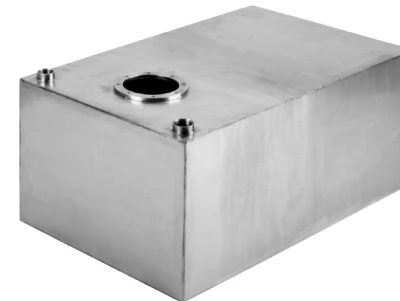

Evaporative emissions (EVAP) compliance for metal fuel tanks is no longer merely a matter of quality assurance—it is a matter of market access.
Starting with the 2000 model year, both the U.S. Environmental Protection Agency (EPA) and the California Air Resources Board (CARB) have mandated that OBD II systems must be capable of detecting system leaks equivalent to a hole larger than 0.5 millimeters (0.020 inches) in diameter. This regulatory threshold imposes stringent requirements on the manufacturing process of custom metal fuel tanks: any welding porosity—that is, gas voids trapped within the weld pool during solidification—can form microscopic vapor pathways, triggering P0456 or P0442 fault codes when the vehicle is started.
Traditional hydrostatic testing relies on water as the pressurizing medium, but its resolution is insufficient to reveal these sub-millimeter defects; surface tension effects often mask minute leaks that would otherwise allow vapor to escape under the influence of fuel vapor pressure.
For a metal fuel tank to pass certification, its manufacturing process must incorporate 100% in-line leak detection. Helium mass spectrometry offers a detection sensitivity of up to 10⁻⁸ Pa·m³/s, providing the necessary margin of safety compared to the pressure decay method to ensure zero-leak integrity.
Understanding Porosity in Metal Fuel Tank Welds
In any custom metal fuel tank, weld porosity is a volumetric discontinuity caused by shielding gas or surface contaminants becoming trapped in the solidified weld pool. These internal voids form sub-millimeter-scale interconnected channels that are difficult to detect during hydrostatic testing—but under thermal cycling conditions, they allow sufficient hydrocarbon vapor to escape, triggering OBD fault codes. Understanding this formation mechanism helps in selecting an appropriate leak detection strategy.
What Are Porosity Defects? How Do They Form in the Welding of Metal Fuel Tanks?
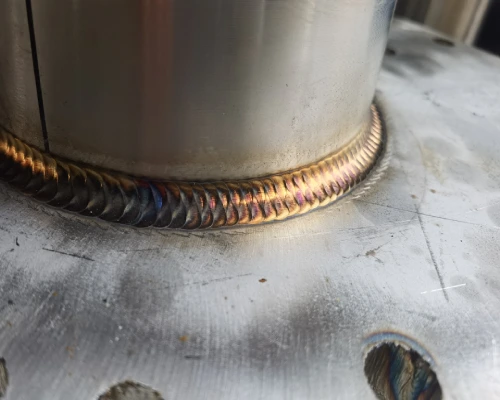
Porosity in the welds of metal fuel tanks is defined as a volumetric discontinuity—that is, voids formed when gas becomes trapped within the weld metal during solidification. The formation mechanism is straightforward: as the weld pool cools, dissolved gases (primarily hydrogen, but also nitrogen and oxygen) must escape before the metal solidifies. If the cooling rate exceeds the gas’s ability to rise to the surface, the gas becomes trapped within the weld in the form of spherical or elongated voids.
In the manufacturing of steel fuel tanks, hydrogen is the primary cause of porosity. Its sources are diverse: they include moisture in the shielding gas, insufficiently dried filler materials, hydrocarbon residues from lubricants or drawing aids on the steel plate surface, and even atmospheric moisture condensed on the workpiece surface.
Even as little as 1% air entrapment in the shielding gas can produce diffuse porosity; if it exceeds 1.5%, distinct surface porosity will appear. For custom metal fuel tanks, this is not merely a cosmetic issue—each porosity represents a potential vapor pathway, which the OBD II diagnostics of the EVAP system will eventually detect.
Why Is Porosity in Metal Fuel Tanks Difficult to Detect Using Traditional Methods?
The challenge lies in the scale and nature of the defects. Traditional hydrostatic testing—filling the metal fuel tank with water and pressurizing it to observe external leaks—relies on visual inspection for water seeping from defects. This method lacks the resolution to detect sub-millimeter-sized pores. Surface tension effects within water-filled voids often seal microchannels through which fuel vapor would otherwise escape under the pressure of the vapor.
Bubble testing (soapy water method) suffers from the same limitations: it can detect obvious leaks but fails to detect defects at the 0.5-millimeter threshold specified by U.S. Environmental Protection Agency (EPA) and California Air Resources Board (CARB) regulations. Even low-pressure air tests—such as the 2 psi hold-pressure test typically required for boundary welds on metal fuel tanks—may fail to detect pinhole leaks.
The fundamental issue is that porosity typically manifests as internal voids that do not penetrate the surface; these voids do not communicate with the exterior until the metal fuel tank undergoes thermal cycling or vibration during actual use. Consequently, a metal fuel tank may pass routine pressure testing at the factory but trigger the P0456 fault code (extremely small EVAP leak) once installed in a vehicle.
This discrepancy between workshop testing and real-world performance is precisely why helium mass spectrometry has become the industry standard for verifying EVAP compliance.
Are you looking for reliable & cost-effective
China Sheet Metal Fabricators
More than 150,000 OEM metal fabrication products delivered to 5,000+ global buyers.
And benefit from it!
Leak Detection Solutions for Metal Fuel Tanks Compliant with EVAP Standards
Selecting the appropriate leak detection method for custom metal fuel tanks requires striking a balance between sensitivity, inspection frequency, and capital investment. Not every technology can meet the 0.5-millimeter EVAP threshold requirement; the optimal solution depends on production volume and target leak rate specifications.
Pressure Decay Testing
The principle behind pressure decay testing is straightforward: the metal fuel tank is pressurized with dry air or nitrogen to a specified pressure—typically 1.5 times the working pressure, ranging from 0.1 to 1.0 MPa—then the gas supply is shut off, and the pressure drop is monitored over a set dwell time.
Provided the internal volume of the metal fuel tank under test is known, the rate of pressure decay is directly proportional to the leakage rate. For automotive fuel system components, the typical acceptable leakage rate range is 1 to 5 cc/min. This method is best suited for medium-volume production environments where the required detection threshold is no less than 10⁻⁴ Pa·m³/s.
However, pressure decay testing is inherently temperature-sensitive: a 1°C temperature fluctuation during the test cycle can cause pressure shifts, thereby masking true microleaks. For metal fuel tanks required to comply with EPA/CARB standards, the pressure decay method serves as an effective tool for screening major defects—but its resolution is insufficient to reliably detect the 0.5-millimeter EVAP threshold.
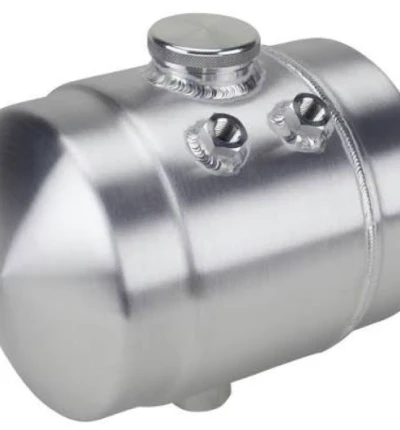
Helium Leak Testing—The Gold Standard for Micro-Leak Detection in Metal Fuel Tanks
When EVAP standards require validation at a pore equivalent of 0.5 mm or less, helium mass spectrometry is the only method ready for mass production that provides the necessary margin of safety.
The procedure is straightforward: the custom metal fuel tank is evacuated to a pressure of approximately 0.1 Pa (10⁻³ torr), filled with helium or a helium-nitrogen tracer gas, and then analyzed using a mass spectrometer tuned to the mass of the helium atom (4 amu) to detect any tracer gas escaping through weld porosity or weld defects.
According to the ASTM E1603 standard, detection sensitivity can reach 1 × 10⁻⁸ Pa·m³/s; modern systems can even detect leaks as low as 5 × 10⁻¹³ Pa·m³/s—which is approximately four orders of magnitude higher than the detection sensitivity of the pressure decay method.
The low background concentration of helium in the atmosphere (5.2 ppm) ensures minimal signal interference, while its chemical inertness makes it safe and harmless to all materials used in fuel systems. For metal fuel tank manufacturers, helium leak testing is an effective means of verifying zero-leak integrity prior to delivery.
Selecting the Appropriate Testing Method Based on the Production Scale of Metal Fuel Tanks
Selecting the appropriate leak detection solution for custom metal fuel tanks requires balancing three variables: target leak rate, production throughput, and capital expenditure.
For low- to medium-volume production with an annual output of less than 50,000 units and a leakage rate requirement higher than 10⁻⁴ Pa·m³/s, pressure decay testing is a cost-effective solution, as it requires relatively low equipment investment and minimal operator training.
When production volume expands to over 100,000 units and EVAP compliance becomes a non-negotiable requirement, helium mass spectrometry testing using a vacuum chamber configuration becomes economically viable. Automated helium testing systems can achieve a testing cycle of 40–70 seconds per custom metal fuel tank, while helium recovery systems can recover up to 98% of the tracer gas, thereby offsetting operating costs.
For large-scale production, cumulative helium testing—in which metal fuel tanks are placed in a sealed chamber and the total helium concentration is measured—provides fully automated testing without manual intervention, with a detection sensitivity of up to 10⁻³ mbar·L/s.
Only 4 steps
online custom metal fabrication parts
Contact our experts team and experience the efficiency and economic benefits of digital metal fabrication services.
Upload Design Files
STL , STEP (.stp), IGES (.igs), (.ZIP), or PDF.
Also be a sample or an idea
Quote & Design Analysis
Instant factory quotes and DfM reports, the most reasonable solution.
Manufacturing Begins
Digital processes can initiate order tasks within 24 hours.
On-Time Delivery
Keeping delivery promises, approved by 3000+ Global Company buyers.
Implementing a Robust Quality Control System for Metal Fuel Tanks
For custom metal fuel tanks, a rigorous quality control system extends beyond the final leak test. It requires integrating upstream process controls—including surface preparation prior to welding, shielding gas monitoring, and parameter stabilization—with in-line validation. Without statistical process control to manage welding variables, even the most sensitive helium detection system cannot compensate for inconsistencies in the manufacturing process.
Pre-Delivery Inspection Procedures for Custom Metal Fuel Tanks
Pre-delivery inspection of metal fuel tanks must follow a structured procedure that integrates dimensional verification, visual inspection, and leak testing. This procedure must first confirm that all components—filling nozzles, vent ports, fuel pump mounting flanges, and check valve bosses—conform to the customer’s drawing specifications.
Welds are visually inspected for surface cracks, porosity, undercut, and incomplete fusion. A critical step is the leak test: the custom metal fuel tank is pressurized with dry air to 0.03–0.05 MPa, and pressure decay is monitored over a specified dwell time, with temperature compensation applied to eliminate interference caused by thermal drift.
For production compliant with EVAP standards, after completing the above pneumatic screening, helium mass spectrometry testing must be performed in accordance with ASTM E1603; this test can detect leak rates as low as 4.4 × 10⁻¹⁴ mol/s (1 × 10⁻⁹ std-cm³/s).
All test records must be retained as objective evidence of compliance; in accordance with automotive industry quality requirements, the retention period is typically at least seven years. Strict adherence to pre-delivery testing procedures ensures that every metal fuel tank leaving the factory meets the customer’s leakage rate specifications prior to installation.
Beyond Leak Detection—Addressing Porosity at the Source
No matter how sensitive leak detection technology may be, it can only identify defects; it cannot prevent them. For metal fuel tank manufacturers, a more sustainable approach is to address the root cause of porosity.
The primary cause of porosity in welds is hydrogen entrapment, which can originate from moisture in the shielding gas, residual lubricants or drawing aids on the sheet metal surface, and insufficiently dried filler material.
Effective countermeasures begin with rigorous surface preparation: alkaline cleaning prior to welding metal fuel tanks, followed by thorough rinsing to remove hydrocarbons. The purity of the shielding gas must be continuously verified—even 1% air entrapment can lead to diffuse porosity—and the flow rate must be optimized to prevent insufficient gas supply and suction caused by turbulence.
The parameters for welding metal fuel tanks—current, voltage, travel speed, and heat input—must be maintained within statistically controlled limits and managed through real-time monitoring and automatic shutdown in the event of parameter deviations.
A Failure Mode and Effects Analysis (FMEA) should identify porosity as a high-risk failure mode and establish specific control measures. When these upstream measures are consistently implemented, volumetric discontinuities in custom metal fuel tanks after welding will be minimized, thereby transforming downstream leak detection into a verification step rather than a sorting operation.
Looking for a reliable custom sheet metal fabrication companies?
Talk To Supro MFG Expert Team
Contact us for competitive ex-factory prices,
and a full range of technical support services.
Conclusion
For custom metal fuel tanks, EVAP compliance determines market access—not a pursuit of quality. If weld porosity cannot be eliminated through rigorous surface preparation and shielding gas control, sub-millimeter-scale vapor pathways will form, triggering OBD fault codes.
Although pressure decay testing provides a rough screening method, only helium mass spectrometry offers sufficient sensitivity to ensure that custom metal fuel tanks meet the regulatory threshold of 0.5 millimeters. To meet regulatory requirements and achieve zero micro-leaks, upstream process controls and in-line helium validation should be integrated into a unified system, rather than implemented as sequential alternatives.
Supro is a professional custom metal fuel tank manufacturer. Leveraging advanced equipment, extensive manufacturing experience, and a dedicated engineering team, we provide comprehensive custom metal fuel tank solutions to over 3,000 companies worldwide and offer genuine manufacturer quotes.
If you require technical specifications or wish to discuss OEM partnerships, please contact our engineering team.