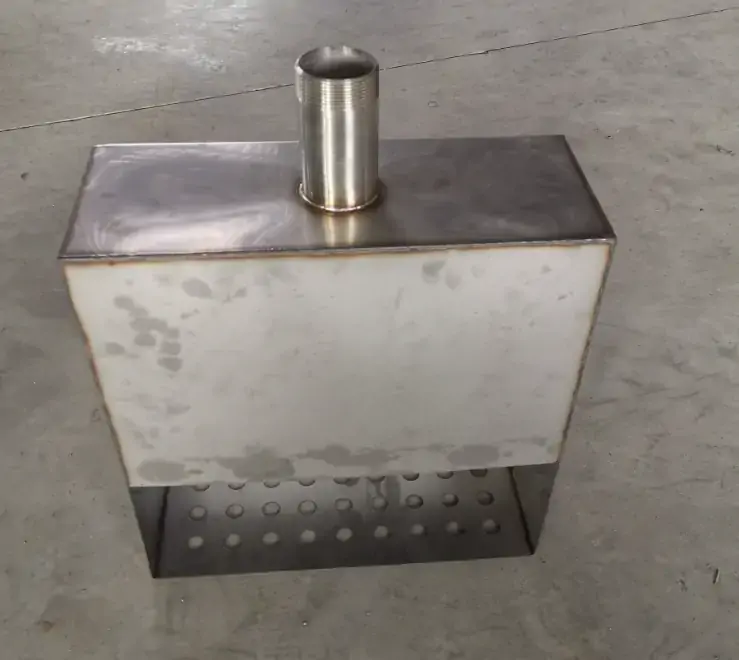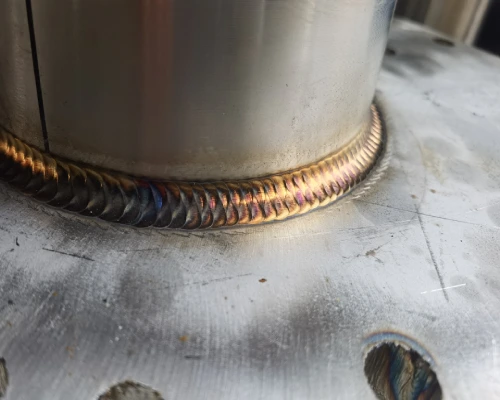




In the welding of metal oil tanks, weld integrity is not merely a quality metric—it is a prerequisite for ensuring the tank’s airtightness. Micro-leaks are often undetectable through hydrostatic testing alone, and their root cause typically lies in incomplete fusion at the root of the groove weld. Although such volumetric discontinuities may pass initial pressure tests, they can evolve into wall-penetrating cracks under cyclic operational loads.
A documented case of a crude oil storage tank rupture was directly caused by lack of fusion in a single-sided groove weld, fully corroborating this progression: the defect remained latent until brittle fracture occurred under combined stresses and low-temperature conditions. Therefore, to eliminate micro-leaks, final inspection alone is insufficient—it requires comprehensive process control from weld preparation to welding parameters, in accordance with recognized manufacturing standards such as AWS D1.1.
Supro is a professional metal oil tank manufacturer. We integrate quality control into every weld rather than relying on post-weld inspection, ensuring the delivery of leak-free metal oil tanks.
This article explores the root causes of incomplete penetration in metal oil storage tanks, as well as engineering control measures—ranging from precision CNC bevel machining to 100% radiographic testing—that ensure leak-tight reliability throughout the metal oil tank manufacturing process.
Understanding Incomplete Penetration—The Root Cause of Micro-Leaks in Metal Oil Tanks
Incomplete penetration in the welds of metal oil tanks refers to a volumetric discontinuity, meaning that the weld metal has not penetrated the entire thickness of the joint, resulting in a lack of fusion in the root area. This root discontinuity acts as a geometric stress concentration point, leading to fatigue cracks under cyclic pressure loads.
Fatigue testing has shown that the fatigue strength of butt weld joints with incomplete penetration is only 17% that of defect-free joints. For custom metal oil tanks, this reduction in strength directly leads to the risk of micro-leaks, and hydrostatic testing alone cannot completely eliminate this risk.
Definition of Incomplete Penetration in Metal Oil Tank Welds
According to the AWS D1.1 standard, lack of fusion in a weld refers to a root defect in a groove weld where the weld metal does not penetrate the entire thickness of the joint. This means that the root region of the weld is not fused—the weld fails to initiate at the root of the groove, resulting in grooves and gaps at the root.
This is not a surface defect but a volumetric discontinuity embedded within the weld cross-section. For pressure-bearing metal oil tanks, lack of fusion reduces the effective throat cross-sectional area, thereby directly affecting static strength and fatigue resistance. Unlike porosity or slag inclusions, which may be scattered throughout the weld, lack of fusion concentrates stress at discrete geometric notches, making it a particularly insidious defect in cyclic service applications.
Causes of Insufficient Weld Penetration in Metal Oil Tanks
In the manufacture of custom metal oil tanks, lack of fusion is typically attributable to three interrelated factors. First, welding parameters—insufficient current or excessive travel speed—prevent the generation of sufficient arc energy to penetrate the root of the joint.
Second, defects in joint preparation: an excessively thick root face, insufficient groove angle, or improper root gap can all hinder the weld pool from reaching the root area. Third, errors in automated welding trajectories: deviations in robotic paths or incorrect positioning of the welding gun relative to the weld centerline can prevent the arc from reaching the root of the joint at all.
The AWS D1.1 standard addresses these issues through pre-certified joint details and mandatory process qualification. The key point is that lack of full penetration is essentially a process control issue—it can be eliminated at the source through precise CNC bevel machining and validated welding parameters.
The Progression from Insufficient Weld Penetration to Micro-Leaks
Incomplete weld penetration does not necessarily lead to immediate leakage—this defect is often difficult to detect during hydrostatic testing. However, under the cyclic pressure loads typical of metal oil storage tanks during operation, the underpenetrated root area acts like a pre-existing crack.
Fatigue test data indicate that butt welds with incomplete penetration have a fatigue strength of only 17% that of defect-free welds. The geometry of the underpenetrated root creates severe stress concentrations; fatigue cracks initiate at the notch in the root and propagate along the remaining weld bead. Incomplete penetration behaves like a crack from the very beginning, and the majority of the total fatigue life is consumed by crack propagation rather than the initiation stage.
Records show that a crude oil storage tank rupture incident can be directly attributed to an incomplete penetration defect in a single-sided groove weld; this defect remained latent until brittle fracture occurred under combined stresses and low-temperature conditions. This process—from a latent volumetric defect to a through-wall leak—is precisely why any instance of incomplete penetration must be strictly eliminated during the manufacture of pressure-bearing metal oil tanks.
Are you looking for reliable & cost-effective
China Sheet Metal Fabricators
More than 150,000 OEM metal fabrication products delivered to 5,000+ global buyers.
And benefit from it!
Welding Standards and Qualification for Custom Metal Oil Tanks—The AWS D1.1 Framework
For pressure-bearing metal oil tanks, AWS D1.1 establishes a comprehensive framework ranging from joint design to final acceptance. AWS D1.1 covers welding requirements for any type of welded structure made from common carbon steel and low-alloy structural steel. This standard addresses design, processes, qualification, fabrication, inspection, and repair.
A key feature of the manufacturing process for custom metal oil tanks is the provision for pre-qualified welding procedure specifications (WPS)—provided all requirements in Chapter 3 are met, AWS D1.1 permits the use of pre-qualified WPS for common joint types and processes (SMAW, GMAW, FCAW, SAW) without the need for physical testing. This simplifies the production process while maintaining quality.
The standard stipulates that each WPS must specify preheat temperatures and interpass temperatures. For welders, performance qualification tests must follow a pre-qualified or qualified WPS applicable to the joint in question. When AWS D1.1 is specified in contract documents, all provisions must be followed unless explicitly modified by the engineer. For metal oil tank manufacturers, compliance with AWS D1.1 is not optional—it is the contractual benchmark for delivering leak-free metal oil storage tanks.
Process Engineering for Custom Metal Oil Tanks—Eliminating Lack of Penetration at the Source
In the fabrication of custom metal oil tanks, process engineering can address the issue of lack of fusion at its source. This involves controlling every upstream variable: ensuring consistent joint geometry through CNC machining to guarantee adequate weldability of the root pass; using validated welding parameters to deliver sufficient arc energy to the root pass; and employing robotic systems with real-time trajectory correction to maintain torch alignment even in the presence of thermal distortion.
Precise Joint Preparation—The Foundation of Penetration Control
Joint preparation determines whether the welding arc can reach the root area of the joint in metal oil storage tanks. AWS D1.1 specifies the required groove geometry—including groove angle, root gap, and root face—and these parameters must be maintained within the specified tolerances.
To improve production efficiency when GMAW welding 1.5-inch-thick steel plates, a groove angle of 60°–70°, a root gap of 0″–1/4″, and a root face of 0″–1/8″ are typically used.
CNC beveling provides a level of repeatable precision that cannot be achieved with manual torch cutting—according to the AWS D1.1 standard, bevel angle tolerances are within ±5°, and linear dimensional tolerances are within ±1/16″. The root face dimensions are particularly critical: an excessively large root face hinders arc penetration to the weld root, while an insufficient root face poses a risk of burn-through.
For custom metal oil tank manufacturers, precise joint preparation is the primary and most fundamental engineering control measure for preventing lack of fusion in any metal oil tank project.
Optimization of Welding Parameters to Achieve Full Fusion at the Root
The root pass parameters determine whether the weld metal can fully penetrate to the root of the joint during the welding of metal oil tanks. Current provides the electrical energy for penetration, while voltage controls the arc length—lower voltage produces a more concentrated arc cone, thereby achieving deeper penetration.
For GMAW root passes in pressure vessel applications, maintaining heat input at 20 kJ/in. or higher minimizes the risk of lack of fusion. Wire feed speed must be balanced: too fast a speed reduces penetration depth, while too slow a speed causes the molten pool to run ahead of the arc, thereby hindering fusion.
Electrode stick-out (ESO) also affects penetration depth—for SAW welding, the rule of thumb is that ESO should be equal to eight times the wire diameter. For custom metal oil tanks using multi-pass welding, each process (GMAW root pass, SMAW heat-affected zone welding, and SAW gap-filling) must be performed within its specified maximum heat input range. WPS parameters verified through process qualification are the engineering foundation for ensuring consistent root fusion.
Robotic Welding of Metal Oil Tanks—Trajectory Accuracy and Real-Time Monitoring
As long as trajectory accuracy is maintained, robotic welding can eliminate the variability inherent in manual welding. For custom metal oil tanks, the welding gun must track the weld centerline within strict tolerances—lateral deviation must not exceed 0.25 millimeters, and vertical deviation must be controlled within 0.63 millimeters.
Advanced systems use laser scanning technology to pre-measure joint geometry and generate real-time compensation parameters. Through dual-sensor fusion technology—combining vision cameras with laser sensors—precise tracking is achieved even when dealing with complex geometries.
Adaptive welding systems take this a step further: the ARC-EYE system provides real-time 3D weld tracking and simultaneously adjusts welding speed, current, voltage, and oscillation parameters. This real-time adjustment is critical because joint assembly tolerances—such as ovality, thickness variations, and inconsistent root gaps—are never completely uniform around the circumference of the vessel.
As a professional metal oil tank manufacturer, Supro utilizes robotic welding technology with real-time monitoring capabilities, transforming process control from passive detection to active prevention of incomplete penetration issues.
Only 4 steps
online custom metal fabrication parts
Contact our experts team and experience the efficiency and economic benefits of digital metal fabrication services.
Upload Design Files
STL , STEP (.stp), IGES (.igs), (.ZIP), or PDF.
Also be a sample or an idea
Quote & Design Analysis
Instant factory quotes and DfM reports, the most reasonable solution.
Manufacturing Begins
Digital processes can initiate order tasks within 24 hours.
On-Time Delivery
Keeping delivery promises, approved by 3000+ Global Company buyers.
Non-Destructive Testing of Metal Oil Tanks—Verifying Zero Defects Before Delivery
For pressure-bearing metal oil storage tanks, non-destructive testing is not merely an inspection task—it is intended to verify that zero lack of fusion has been achieved during the manufacturing process. The AWS D1.1 standard requires 100% visual inspection of all welds as a baseline, while also stipulating that additional volumetric testing must be performed on fully penetrated (CJP) welds subjected to cyclic tensile loads.
Hydrostatic testing—typically conducted at 1.5 times the design pressure—is a validation test for detecting through-wall leakage paths, but its limitations are well documented: the viscosity of water may mask fine cracks, and hydrostatic testing cannot detect subsurface weld defects that have not yet propagated to the surface.
Penetrant testing (PT) is used to detect discontinuities that penetrate the surface. According to the AWS D1.1 standard, after the developer is removed, PT indications should be evaluated based on the actual dimensions of the discontinuities (rather than the penetrant marks). Acceptance criteria follow the relevant visual requirements; for pipeline porosity with a diameter of 1 millimeter or greater, its length within any 1-inch segment of the weld shall not exceed 10 millimeters.
Radiographic testing (RT) provides volumetric imaging of the internal structure of the weld, detecting lack of fusion as dark linear indications along the weld centerline. Because radiographic testing produces permanent radiographic records and reveals the geometry and distribution of internal discontinuities, it remains the gold standard for critical welds in metal oil tanks.
For advanced verification, phased array ultrasonic testing (PAUT) provides 100% volumetric coverage of the weld, offering a higher probability of detection and precise defect sizing capabilities. Major construction codes, including AWS and ASME, have included PAUT within the scope of acceptable weld inspection methods.
The choice between radiographic testing (RT), ultrasonic testing (UT), and phased array ultrasonic testing (PAUT) depends on the joint geometry, material thickness, and accessibility.
As an experienced metal oil tank manufacturer, we define our non-destructive testing (NDT) strategy in advance as part of our quality plan—rather than determining it only after welding is complete—and tailor each method to specific defect types that could threaten the integrity of the metal oil tank. Through this layered, systematic NDT approach, we can verify zero micro-leaks.
Quality Assurance System for Metal Oil Tanks—From Incoming Materials to Final Release
The comprehensive quality assurance system for custom metal oil tanks covers the entire process, from incoming material inspection to the final handover of documentation.
Upon arrival of the materials, Supro reviews the mill test reports (MTRs) to confirm that the chemical composition and mechanical properties of the base metal meet the classification requirements specified in the welding procedure specification (WPS). The furnace number is recorded and linked to each manufactured component, ensuring full traceability throughout the process.
During the manufacturing of metal oil tanks, process inspections conducted in accordance with AWS D1.1, Section 6, verify joint preparation, alignment, preheating, interpass temperatures, and weld appearance before, during, and after welding. Each weld must be marked with the welder’s ID—which is traceable to the Welder Performance Qualification Record (WPQR) specified in AWS D1.1, Section 6—and accompanied by WPS reference information.
Throughout the entire production process of custom metal oil tanks, we maintain records of calibrated instruments and Non-Conformance Reports (NCRs) accompanied by verification of corrective actions.
The final delivery of metal oil storage tanks includes a complete set of documentation: WPS/PQR/WPQR records, non-destructive testing (NDT) reports, hydrostatic test data, and material certification certificates. For a custom metal oil tank manufacturer, this set of quality records is not merely administrative paperwork—it is verifiable evidence that every weld in the metal oil tank was completed by certified personnel using traceable materials and in accordance with approved processes.
Looking for a reliable custom sheet metal fabrication companies?
Talk To Supro MFG Expert Team
Contact us for competitive ex-factory prices,
and a full range of technical support services.
Conclusion
Zero micro-leaks in metal oil tanks are achieved through strict process control, rather than being detected during final inspection.
For pressure-bearing metal oil tanks, precision CNC beveling, validated welding parameters, adaptive robotic tracking with real-time compensation, and a tiered process involving 100% radiographic testing (RT) or automated ultrasonic testing (PAUT) of critical welds ensure that no root fusion defects will occur during service.
The quality assurance documentation package—including Material Test Reports (MTRs), Welding Procedure Specifications (WPS)/Welding Procedure Qualification Reports (PQRs), welder qualification certificates, Non-Destructive Testing (NDT) reports, and hydrostatic test data—provides verifiable traceability, demonstrating that the welds on each metal oil storage tank were completed by certified personnel in accordance with approved procedures. Zero leakage is the only acceptable delivery standard; anything less than this standard poses a potential risk of seal failure.
Supro is a professional metal oil tank manufacturer. Leveraging advanced equipment, extensive manufacturing experience, and a professional engineering team, we provide perfect custom metal oil tank services to more than 3,000 companies worldwide and offer genuine manufacturer quotes.
If you require technical specifications or have inquiries regarding OEM partnerships, please contact our engineering team.