
420 stainless steel, as a heat-treatable martensitic stainless steel, derives its core value from achieving synergistic high strength and moderate corrosion resistance through precise carbon-chromium composition design and heat treatment processes. Within a carbon content range of 0.15%-0.40% and chromium content of 12%-14%, carbon imparts high hardness to the quenched martensite (exceeding HRC 50), while chromium forms a passivation film providing fundamental corrosion resistance.
However, 420 stainless steel properties exhibit clear limitations: its corrosion resistance is suitable for neutral or mildly corrosive environments, but it is susceptible to pitting and stress corrosion cracking in chloride-containing media. Furthermore, welding and machining require specific process controls, such as preheating and post-weld heat treatment, to suppress heat-affected zone cracking.
The value of 420 stainless steel primarily lies in providing excellent corrosion resistance and strength superior to austenitic stainless steels for applications such as cutlery, moulds, and food processing components. It represents an engineering choice that balances cost and performance.
Fundamentals of Materials Science: Microstructure of 420 Stainless Steel
Understanding the microstructure of 420 stainless steel is pivotal to accurately assessing its performance value. At its core, 420 stainless steel is a martensitic chromium steel, with its properties fundamentally derived from its chemical composition and the controlled phase transformations induced by heat treatment.
Composition of 420 Stainless Steel
Its composition design centres on the precise balance between carbon (C: 0.15–0.40%) and chromium (Cr: 12–14%). Carbon is the primary determinant of 420 stainless steel’s strength; its elevated content directly translates to enhanced hardness and wear resistance following heat treatment. Chromium forms the cornerstone of corrosion resistance, responsible for generating a protective surface passivation layer.
However, during the heat treatment process of 420 stainless steel, carbon combines with chromium to form chromium carbides. While this increases hardness, it also consumes the effective chromium content within the matrix, potentially locally compromising the corrosion resistance of the 420 stainless steel. Therefore, attention must be paid not only to the total chromium content but specifically to the carbon range, as it directly determines the material’s ultimate performance potential and suitable applications.
Phase Transitions and Microstructure of 420 Stainless Steel
The composition of 420 stainless steel determines its performance potential, whilst heat treatment serves as the pivotal process for transforming this potential into desired properties. The value of 420 stainless steel lies in its capacity to develop the final microstructure through a controlled thermal cycle: austenitisation, quenching, and tempering.
Austenitisation refers to the metallurgical process of heating 420 stainless steel above its critical point to form austenite.
Quenching transforms 420 stainless steel from its high-temperature austenitic state into hard martensite, the direct source of its high strength. However, the material becomes highly brittle and exhibits elevated internal stresses at this stage.
The tempering process involves reheating at moderate temperatures (e.g., 300–600°C) to enhance the toughness of 420 stainless steel while maintaining high hardness and stabilising its microstructure.
The final material obtained is not a single-phase structure, but a composite microstructure comprising tempered martensite and fine carbides.
Why choose Supro MFG's Custom metal Fabrication Services
Provide the most cost-effective cost solution for manufacturing and assembling products, expanding product competitiveness.
a technical team specializing in custom shell manufacturing for more than 30 years.
Advanced Manufacturing Equipment: Industry-leading custom metal enclosure manufacturer with in-house sheet metal, die casting, precision machining workshops, and surface coating workshops.
ISO 9001-2015, PPAP III level, RoHS, NEMA, CE and other certified production standards.
24H*7 online English technical support: The professional English team responds quickly to users’ technical questions online at any time.
help users from product design, prototype, batch manufacturing, surface treatment, assembly and packaging, transportation and a series of value-added services.
With in-house mechanics and chemistry laboratories, it can quickly monitor manufacturing process quality control to ensure the delivery of high-quality products.
Accept to sign NDA documents to ensure that customers‘ product information is protected.
Door-to-door delivery in customizable secure packaging after complying with the delivery details agreed with the customer.

Properties of 420 Stainless Steel
Assessing the properties of 420 stainless steel requires more than merely consulting data sheets; understanding the intrinsic relationships and boundary conditions governing its performance is equally vital. Its core value lies in the unique combination of high strength and moderate corrosion resistance achievable through heat treatment.
Mechanical Properties
The mechanical properties of 420 stainless steel centre on its high strength and hardness, which can be regulated through heat treatment. In its annealed state, the material exhibits basic machinability. However, following quenching and low-temperature tempering, the martensitic transformation significantly elevates its hardness to HRC 48–53 (based on BS standard data for 420S45), while achieving tensile strengths of ≥735 MPa and conditional yield strengths of ≥540 MPa. This high hardness and wear resistance render it highly suitable for applications subject to mechanical abrasion, such as cutting tools, pump components, and bearings.
However, the elevated hardness of 420 stainless steel is accompanied by limited toughness, necessitating careful assessment of fracture risks in impact-loaded applications. Furthermore, the material’s ductility is reduced following heat treatment, requiring avoidance of stress concentration points in structural designs.
Corrosion Resistance
The corrosion resistance of 420 stainless steel derives from its 12–14% chromium content, which forms a passivation layer on the surface, providing fundamental protection against oxidising environments such as atmospheric exposure, water vapour, and weakly acidic media.
However, 420 stainless steel's corrosion resistance has clear limitations: it is suitable for general environments (e.g., food processing tools, non-implantable medical devices) but unsuitable for high-chloride, reducing acid, or high-temperature corrosive environments. Compared to austenitic stainless steels (e.g., 304/316), 420 stainless steel contains higher carbon levels (0.16–0.35%). This causes partial chromium to form chromium carbides, reducing the effective chromium concentration in the matrix. Consequently, its performance is limited in severe media such as seawater or chlorinated solutions.
In-depth Analysis of Corrosion Mechanisms in 420 Stainless Steel
Its primary corrosion failure modes include pitting corrosion, intergranular corrosion, and stress corrosion cracking. Pitting corrosion frequently occurs in chloride-containing environments, triggered by localised disruption of the passivation film. Intergranular corrosion arises from the precipitation of chromium carbides at grain boundaries during heat treatment or welding of 420 stainless steel, leading to the formation of chromium-depleted zones. Under combined tensile stress and corrosive media, 420 stainless steel exhibits sensitivity to stress corrosion cracking.
For instance, in marine environments or chemical processing equipment, chloride ions may accelerate crack propagation in 420 stainless steel. These mechanisms necessitate optimising processes—such as controlling heat input or implementing post-weld heat treatment—to suppress localised corrosion tendencies in scenarios involving welding or cold working.
Performance Optimisation Pathways
Methods to enhance the corrosion resistance of 420 stainless steel include material heat treatment and surface finishing. By adjusting tempering temperatures and cooling rates during heat treatment, a balance can be achieved between the hardness and corrosion resistance of 420 stainless steel. For instance, medium-temperature tempering helps reduce carbide precipitation, thereby improving uniform corrosion resistance. Surface coating techniques can also enhance the corrosion resistance of 420 stainless steel; physical vapour deposition coatings such as TiSiCN or TiCN significantly improve both corrosion resistance and wear resistance.
Only 4 steps
online custom metal fabrication parts
Contact our experts team and experience the efficiency and economic benefits of digital metal fabrication services.
Upload Design Files
STL , STEP (.stp), IGES (.igs), (.ZIP), or PDF.
Also be a sample or an idea
Quote & Design Analysis
Instant factory quotes and DfM reports, the most reasonable solution.
Manufacturing Begins
Digital processes can initiate order tasks within 24 hours.
On-Time Delivery
Keeping delivery promises, approved by 3000+ Global Company buyers.
Manufacturing Processes for 420 Stainless Steel
Understanding the critical aspects of 420 stainless steel manufacturing processes is fundamental to ensuring components supplied meet your end-use requirements. Its machinability directly impacts production costs, delivery lead times, and finished product reliability.
Machinability of 420 Stainless Steel and Mitigation Strategies
The machinability of 420 stainless steel is highly dependent on its heat treatment condition. In the annealed state, the material exhibits good machinability with a hardness typically below HRC 20, allowing standard machining parameters to be employed. However, once maximum hardness (HRC 50-55) is achieved through heat treatment, its wear resistance and strength increase significantly, causing machinability to decline sharply. In this high-hardness state, the material inflicts severe tool wear and exhibits pronounced work-hardening tendencies.
Mitigation strategies involve optimising cutting parameters for 420 stainless steel and employing specialised tooling. In practice, carbide tools with TiN or TiAlN coatings are prioritised, utilising specific cutting geometries to achieve effective chip breaking.
Welding Challenges and Solutions for 420 Stainless Steel
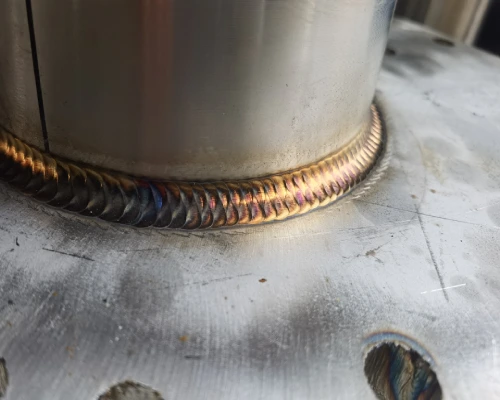
420 stainless steel is generally considered difficult to weld due to its martensitic microstructure and high carbon content. The primary risks lie in the welding heat cycle causing hardening within the heat-affected zone and the formation of brittle martensite through rapid cooling, thereby increasing susceptibility to cold cracking.
Strict process control is essential. Preheating the 420 stainless steel to approximately 300–400°F prior to welding is a critical first step, aimed at slowing the cooling rate. During the welding process of 420 stainless steel, we recommend using AWS E/ER420 or highly alloyed austenitic filler metals. Crucially, post-weld heat treatment must be performed immediately, typically involving tempering within the 1450-1550°F range to restore toughness and corrosion resistance in the heat-affected zone. For particularly critical applications, solid-state welding techniques such as friction welding may be considered.
Surface Treatment Techniques for 420 Stainless Steel
Surface treatment is pivotal for further enhancing the wear resistance, corrosion resistance, and fatigue life of 420 stainless steel. Traditional mechanical polishing not only improves appearance but also enhances corrosion resistance by forming a uniform passivation film. Furthermore, surface strengthening techniques like nitriding significantly boost 420 stainless steel’s wear resistance. For instance, nitriding at 520°C can achieve surface hardness up to HV 900, thereby multiplying the wear resistance of critical components by several orders of magnitude.
Are you looking for reliable & cost-effective
China Sheet Metal Fabricators
More than 150,000 OEM metal fabrication products delivered to 5,000+ global buyers.
And benefit from it!
Precision Applications of 420 Stainless Steel
It is not an all-purpose material, but rather achieves an optimal balance of high strength, wear resistance, and moderate corrosion resistance under specific operating conditions. Therefore, precisely identifying the appropriate application scenarios for 420 stainless steel is key to controlling project risks and costs.
Advantageous Application Areas for 420 Stainless Steel
Through simple heat treatment, 420 stainless steel achieves high hardness and wear resistance combined with moderate corrosion resistance, delivering outstanding cost-effectiveness in specific sectors. Its typical hardness reaches HRC 50-55, making it ideal for cutting tools (from table knives to surgical blades) and wear-resistant mechanical components (such as pump shafts, bearings, gears, and plastic moulds).
Within the food processing and domestic appliance sectors, 420 stainless steel achieves an excellent surface finish through polishing, facilitating easy cleaning and resisting corrosion from steam, oxidising acids, and atmospheric exposure.
Furthermore, 420 stainless steel exhibits a thermal expansion coefficient similar to carbon steel, presenting a significant advantage in applications involving assembly with carbon steel components.
Inappropriate Applications and Alternative Solutions
It is crucial to clearly understand the performance limitations of 420 stainless steel. Its corrosion resistance stems from a chromium content of 12-14%, enabling it to withstand atmospheric exposure, water vapour, and oxidising acids. However, the protective capabilities of 420 stainless steel have distinct boundaries. In chloride-rich environments—such as seawater, chemical plants, or de-icing salt conditions—this material is susceptible to pitting corrosion and stress corrosion cracking. Furthermore, its weldability is poor, requiring complex preheating and post-weld heat treatment to prevent cracking. This often renders it unsuitable for large welded structural components. In such cases, upgrading to austenitic stainless steels with higher chromium and nickel content (e.g., 304/316) or duplex stainless steels should be considered.
Looking for a reliable custom sheet metal fabrication companies?
Talk To Supro MFG Expert Team
Contact us for competitive ex-factory prices,
and a full range of technical support services.
Conclusion
From a materials engineering perspective, the core value of 420 stainless steel lies in its exceptional performance adjustability and outstanding cost-effectiveness. Through precise control of carbon content (0.15–0.40%) and complementary heat treatment processes, 420 stainless steel achieves a hardness range of HRC 48 to 55, meeting stringent surface hardness requirements for diverse wear-resistant components. Its 12–14% chromium content provides passivation protection, delivering sufficient corrosion resistance for routine industrial environments and food processing applications.
Supro is a specialist metalworking manufacturer. Leveraging advanced equipment, extensive manufacturing expertise, and a professional engineering team, we deliver flawless stainless steel processing services to over 3,000 global companies, offering genuine manufacturer quotations.
As an industry-leading metal processing manufacturer, we deliver diverse products efficiently and on schedule. From product design and rapid sheet metal prototype fabrication to mass production, we provide expert technical support and exceptional quality. Furthermore, we offer one-stop manufacturing solutions and highly cost-competitive product supply!