
Within modern automotive body engineering, automotive sheet metal fabrication forms the physical foundation of the body structure, whilst welding processes constitute the core technology enabling the high-strength, high-precision structural integration of hundreds of stamped sheet metal components. The quality of automotive sheet metal fabrication welding processes directly determines the body’s static and dynamic stiffness, fatigue durability, and crash safety performance, representing the most critical manufacturing stage affecting the vehicle’s structural integrity.
With advancing lightweighting trends, multi-material hybrid bodies incorporating high-strength steels and aluminium alloys present more severe challenges to automotive sheet metal fabrication welding processes. These include issues such as metallurgical compatibility between dissimilar materials, thermal deformation control, and joint reliability. Therefore, systematically understanding welding process principles, application boundaries, and associated typical quality risks is crucial for ensuring the final quality of automotive sheet metal fabrication, controlling production costs, and maintaining supply chain stability.
This paper provides an in-depth analysis of mainstream automotive sheet metal fabrication welding processes from an engineering practice perspective. It examines the formation mechanisms of common defects and closed-loop control strategies, offering a technical evaluation framework for professional decision-making.
The Central Role and Challenges of Welding Processes in Automotive Sheet Metal Fabrication
Within automotive sheet metal fabrication, welding serves not merely as an assembly step but as the foundational process transforming individual stamped components into integrated body structures. Its pivotal role lies in establishing continuous load paths, which directly determine a vehicle’s static torsional stiffness, dynamic NVH performance, and ultimate crash safety.
Current automotive sheet metal fabrication welding processes confront multifaceted challenges. The industry’s shift towards multi-material lightweighting, employing advanced high-strength steel (AHSS) and aluminium alloy hybrid materials, presents significant obstacles. These materials exhibit markedly different thermal conductivity, melting points, and thermal expansion coefficients, complicating the welding parameter window and increasing the risk of defects such as cold cracks in AHSS or porosity in aluminium.
Furthermore, when processing coated materials such as galvanised steel, ensuring consistent electrode life and weld quality remains a core challenge in high-volume automotive sheet metal fabrication. This directly impacts both cost efficiency and production productivity.
Mainstream automotive sheet metal fabrication welding processes and their engineering applications
Within automotive sheet metal fabrication systems, the selection of welding processes constitutes a critical engineering decision requiring a balance between structural requirements, material compatibility, and production efficiency. The current automotive sheet metal fabrication welding processes primarily encompass resistance spot welding (RSW), laser welding, various arc welding techniques, and mechanical fastening technology combinations.
Resistance Spot Welding
Within automotive sheet metal fabrication, resistance spot welding dominates as the primary process for joining steel components—particularly body structural elements—due to its exceptional reliability, high speed, and suitability for automated production.
This automotive sheet metal fabrication welding process operates on the principle of the Joule heating effect: pressure is applied to stacked sheets via electrodes while high current is passed through, generating localised intense heat through contact resistance and self-resistance between workpieces to form a weld nugget. Three critical parameters—welding current, welding time, and electrode pressure—must be precisely controlled within a narrow process window. Any deviation may result in insufficient weld nugget size (cold weld) or excessive spatter.
In this application, medium-frequency inverter direct current technology has become the mainstream variant. It delivers more stable current output, particularly advantageous for welding galvanised steel sheets, effectively suppressing electrode sticking and welding spatter caused by zinc vapour.
Laser Welding in Automotive Sheet Metal Fabrication
Laser welding in automotive sheet metal fabrication represents the highest quality standard for manufacturing exterior panels and critical seams. Its core advantage lies in its exceptionally high energy density, enabling precision joints with high aspect ratios and minimal thermal distortion.
Within automotive sheet metal fabrication, laser welding is categorised into three primary types: laser fusion welding for continuous sealing of roof panels and side panels, achieving both aesthetic appeal and high water resistance; laser brazing using copper-based or aluminium-based filler wires, applied to exposed areas such as boot lids to produce smooth, flawless Class A surfaces; and laser remote scanning welding, which employs high-speed galvo systems for inertia-free beam jumping, delivering exceptional processing speeds for short flanges.
However, quality control for laser welding in automotive sheet metal fabrication demands exceptionally stringent standards. It exhibits extreme sensitivity to workpiece assembly tolerances (typically requiring <0.1mm), sheet cleanliness, and beam precision. Automotive sheet metal fabrication manufacturers must employ high-precision fixtures, real-time weld seam tracking systems, and online process monitoring (such as monitoring plasma emission or rear thermal radiation) to ensure every weld meets dual standards of strength and aesthetics.
Arc Welding and Its Variants
For components of greater thickness or complex structure, such as chassis subframes, seat frames and cross members, gas-shielded arc welding and its advanced variants are indispensable automotive sheet metal fabrication processes.
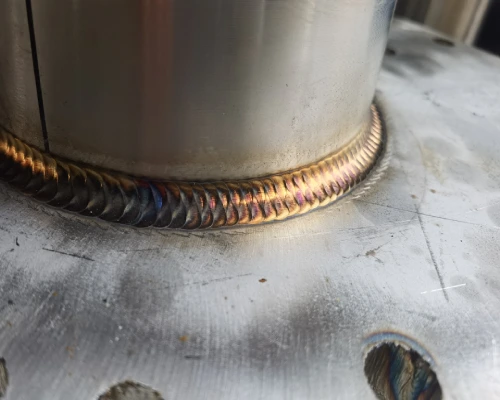
Metal inert/active gas shielded welding melts the filler wire and base metal via an arc under protective gas to form high-strength joints. Among these, Cold Metal Transfer (CMT) technology minimises heat input through precise ‘hot-cold’ cycles and mechanical droplet separation, virtually eliminating spatter and significantly reducing distortion in thin-sheet welding. This renders it an ideal choice for welding high-precision, thin-walled stainless steel or aluminium alloy components such as door hinges and battery trays.
Mechanical and Hybrid Joining Technologies in Automotive Sheet Metal Fabrication
Addressing challenges in steel-aluminium dissimilar material joining and lightweight composite applications, hybrid techniques combining mechanical fastening with adhesive bonding have become strategic choices in modern automotive sheet metal fabrication processes.
Self-piercing riveting requires no pre-drilled holes. Special rivets penetrate the upper material and cold-form an interlocking joint within the lower material, avoiding brittle phases produced by fusion welding of dissimilar metals while delivering excellent dynamic fatigue performance.
Flow drilling screws utilise friction heat generated by high-speed rotation to soften materials, simultaneously drilling, forming, and threading. This technique is particularly suited for joining aluminium and die-cast components in automotive sheet metal fabrication.
Adhesive bonding technology, especially high-strength structural adhesives, not only provides additional joint strength and stiffness but crucially achieves continuous sealing and damping. It also effectively isolates electrochemical corrosion between dissimilar materials.
Common Quality Issues and Control Strategies in Automotive Sheet Metal Fabrication Welding Processes
Systematic management of welding quality issues in automotive sheet metal fabrication is central to ensuring body structural integrity, safety, and cost-effective production. Common defects do not occur in isolation but result from the interplay of process, material, equipment, and management systems, necessitating containment through preventive engineering strategies.
Welding Distortion and Stress Concentration in Automotive Sheet Metal Fabrication
In automotive sheet metal fabrication, welding distortion and residual stresses fundamentally originate from uneven thermal cycling. During welding processes, localised high temperatures cause material expansion, yet this expansion is constrained by the surrounding cold metal, inducing compressive plastic strain.
Subsequent cooling and contraction then subject this region to tensile stress, ultimately forming residual tensile stresses. For stainless steel components, this effect is particularly pronounced due to their lower thermal conductivity and higher coefficient of thermal expansion, making them more susceptible to dimensional deviations, assembly gaps, or fatigue failure.
Control strategies are multi-layered. Optimising automotive sheet metal fabrication welding processes is the primary approach, prioritising low-heat-input techniques such as pulsed gas shielded welding or laser welding, alongside designing rational welding sequences to balance heat distribution.
Fixture and counter-deformation design are critical engineering considerations. High-rigidity fixtures enforce rigid clamping, while tooling incorporates pre-set counter-deformation compensation opposing the anticipated deformation direction. For highly precise or load-bearing structural components, post-welding treatments such as vibration stress relief or localised thermal stress relief serve as effective methods to release detrimental residual stresses, ensuring long-term dimensional and performance stability.
Welding Cracks in Automotive Sheet Metal Fabrication
Hot cracks occurring during automotive sheet metal fabrication processes manifest during the final solidification stage of welds. Low-melting eutectic phases form liquid films at grain boundaries, which are subsequently pulled apart under contraction stresses.
Austenitic stainless steels exhibit particular susceptibility. Countermeasures centre on optimising weld chemical composition by adding elements such as manganese to the filler material, thereby refining grain size and reducing harmful impurity segregation. Concurrently, thermal input during automotive sheet metal fabrication welding processes must be strictly controlled by employing lower welding currents and faster speeds to minimise dwell time within the brittle temperature range.
Cold cracks (hydrogen-induced cracks) occur during post-weld cooling to lower temperatures, resulting from the combined effects of diffused hydrogen, hardened microstructure, and restraint stresses. Solutions include: employing ultra-low hydrogen welding consumables with strict baking protocols; preheating the base metal prior to welding to slow cooling rates and prevent brittle martensite formation; and implementing post-weld hydrogen removal treatment where necessary to ensure complete hydrogen desorption – a critical step in guaranteeing structural integrity.
Defects Specific to Resistance Spot Welding
Cold spots/insufficient fusion are the most critical defects in automotive sheet metal fabrication welding processes, manifesting as inadequate melting at the weld core and extremely low strength. Causes include insufficient welding current, insufficient dwell time, excessive electrode pressure, or electrode tip wear leading to reduced effective current density. Employing constant-current monitoring systems alongside automatic electrode cap regrinding and replacement protocols based on spot count ensures consistent thermal input per weld.
Splatter occurs when molten metal ejects from the weld, compromising joint strength and contaminating components. Primary causes include excessively rapid current rise during initial welding or insufficient electrode pressure in automotive sheet metal fabrication. Solutions involve employing current waveforms with ramp-up functions and servo-pneumatic or servo-motor-driven constant pressure systems to precisely control metal melting and plastic deformation.
Electrode sticking during automotive sheet metal fabrication welding processes primarily occurs when welding galvanised steel or aluminium alloys. The low-melting-point zinc or aluminium layer reacts with the copper electrode, causing alloying and subsequent adhesion between the electrode and workpiece. This severely compromises electrode lifespan and workpiece surface quality. Countermeasures involve selecting high-hardness, high-conductivity chromium-zirconium copper electrodes and employing a segmented, incrementally increasing forging pressure process. Maintaining high pressure after power disconnection disrupts the adhered layer.
Porosity and Inclusions
Porosity in automotive sheet metal fabrication arises when gases within the weld pool fail to escape prior to solidification, forming voids that significantly reduce the effective cross-section and fatigue strength of the weld. Primary causes include impure shielding gas, or contamination of the filler wire or base metal surface by oil, rust, or moisture. During automotive sheet metal fabrication, stringent pre-welding cleaning protocols (e.g., solvent wiping or mechanical grinding) must be enforced, with regular monitoring of shielding gas purity and flow rate. Controlling ambient humidity is particularly critical for aluminium alloy welding.
Slag inclusion in automotive sheet metal fabrication welding processes refers to residual non-metallic solid inclusions within the weld, such as flux or oxides. This frequently occurs during multi-pass welding when interpass cleaning is inadequate, or when improper welding parameters result in poor molten pool fluidity and failure of slag to float.
Solutions involve establishing welding process specifications: thoroughly removing slag from previous passes during multi-layer welding; optimising welding current and voltage to achieve adequate molten pool agitation and slag separation; and selecting consumables with good slag detachment properties.
Looking for a reliable custom sheet metal fabrication companies?
Talk To Supro MFG Expert Team
Contact us for competitive ex-factory prices,
and a full range of technical support services.
Conclusion
Within the automotive sheet metal fabrication sector, welding techniques are far from mere joining operations; they constitute core engineering technologies that determine a vehicle’s structural performance, safety, and manufacturing costs.
Should you require automotive sheet metal fabrication services, contact us immediately! The Supro team stands ready to assist. Established in 2004, we are an automotive sheet metal fabrication manufacturer. Leveraging extensive manufacturing expertise, a robust technical team, and comprehensive production resources, we have delivered one-stop automotive sheet metal fabrication services to over 3,000 enterprises worldwide.
At Supro, our dedicated quality control team, seasoned QC personnel, and scientific quality assurance processes ensure products undergo rigorous inspection to meet specified technical standards. We maintain full traceability of defective items, encompassing: raw material inspection, tooling verification, equipment checks, process sampling, packaging review, and final product assessment.
Our QA (Quality Assurance) procedures guarantee products comply with essential tolerances and quality benchmarks. We guarantee timely delivery across all product stages – from design and rapid prototype fabrication to mass production – delivering expert technical support, exceptional quality, and highly cost-competitive supply.
Contact us today to initiate an efficient collaboration!