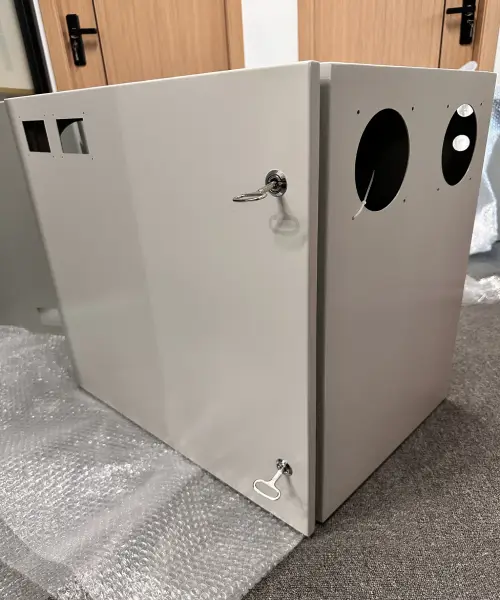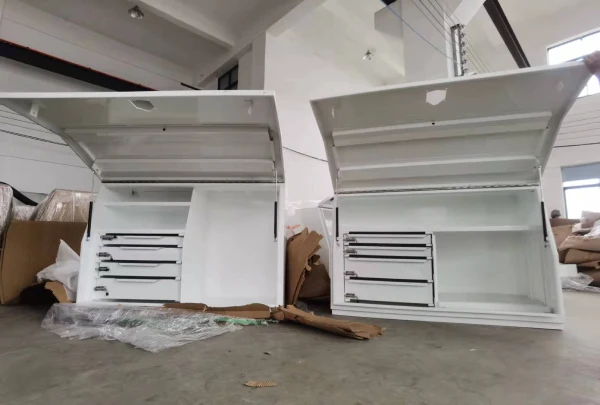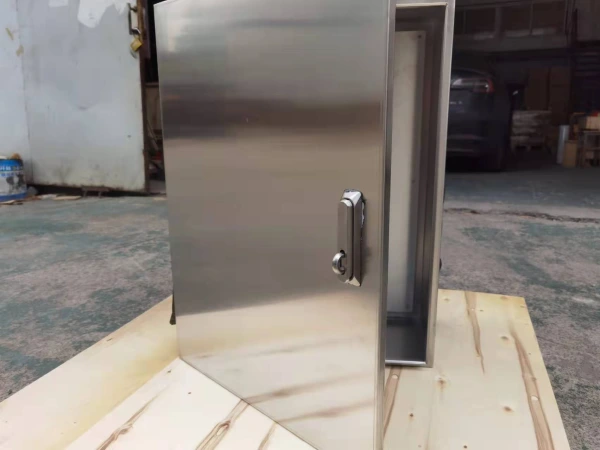

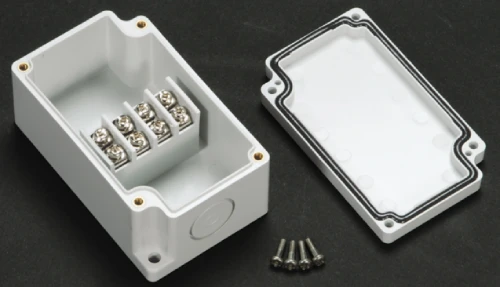
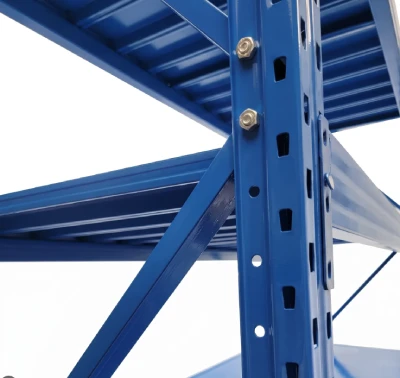
The manufacture of large-sized custom metal enclosures requires strict adherence to geometric dimensions and tolerances (GD&T) specifications. For IP65 or NEMA-rated industrial enclosures, the primary failure mode during manufacturing is panel warping.
When standard stamping forces are applied to large metal sheets, the sudden release of residual material stress inevitably causes springback and severe deformation, which directly affects the sealing performance of environmental gaskets and the alignment accuracy of the final assembly. To mitigate this physical reaction, it is necessary to transition from standard multi-station progressive stamping to the highly controllable compound die stamping process.
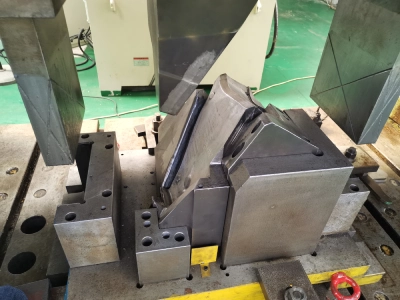
By performing internal punching and external perimeter blanking simultaneously within a single stamping cycle, the compound die stamping process utilizes a robust separation plate to apply uniform clamping pressure to the entire blank before the shearing stage begins. This mechanical clamping method eliminates localized stress release and structural warping.
This article provides an in-depth analysis of the specific operating principles of compound die stamping technology, detailing how the process controls strict dimensional tolerances, maintains concentricity, and ensures flat, distortion-free sheet metal for high-volume enclosure production.
The Challenge of Warpage in Sheet Metal Enclosures
When manufacturing large sheet metal enclosures, a critical geometric defect often occurs: sheet warpage. Traditional stamping forces inevitably disrupt the material’s equilibrium, resulting in a loss of flatness. To overcome this inherent structural deformation, a controlled compound die stamping process must be employed.
Residual Stresses and Material Springback
When manufacturing large custom enclosures, the violent fracture of the metal’s grain structure releases internal residual stresses, directly causing the material to twist and deform. Standard sequential stamping processes generate uneven tension across the panel, thereby exacerbating this issue. During the shearing stage, the raw material’s “memory effect” naturally triggers springback, causing the finished product to fall well outside the specified flatness tolerance range. To counteract this adverse physical reaction, the use of custom compound die stamping is strongly recommended.
This stamping process utilizes heavy-duty separation pads to firmly clamp the entire surface area before the die strikes. This mechanical clamping action counteracts the release of residual stress. For procurement engineers sourcing large-sized blanks, specifying compound die stamping technology effectively prevents severe springback that would otherwise compromise critical panel geometry.
Strict Tolerances for Industrial Panels with IP Protection Ratings
Industrial enclosures compliant with NEMA 4 or IP65 protection ratings require a perfect environmental seal. Even micrometer-level warping on a metal door panel can prevent the perimeter gaskets from remaining compressed. Once the gaskets fail, the ingress of moisture and dust will damage internal electronic components, leading to catastrophic failures in the field.
For thin-walled, large-area parts, it is often difficult to reliably meet these strict geometric dimensions and tolerances (GD&T) requirements using traditional continuous stamping dies. For this reason, the shift to precision compound die stamping has become a non-negotiable engineering requirement. This metal stamping process simultaneously performs internal punching and external blanking in a single stamping stroke, thereby absolutely guaranteeing the dimensional accuracy of the panels. It also ensures the exceptional flatness required to pass rigorous IP certification tests, eliminating the need for costly secondary flattening operations.
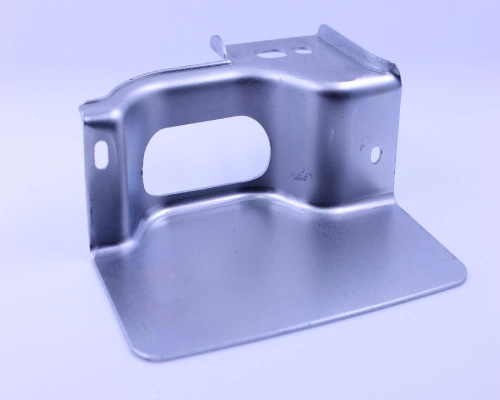
Mechanical Principles of Compound Die Stamping
Unlike continuous stamping processes, the core principle of the compound die stamping process lies in simultaneously performing internal punching and external blanking in a single stamping stroke. This integrated die design ensures absolute material stability, thereby eliminating the physical forces that cause sheet metal deformation.
Single-Stroke Blanking and Punching Operations
In the manufacture of large enclosures, cutting in stages can generate severe and difficult-to-control material stresses. The fundamental mechanical advantage of custom compound die stamping lies in its ability to perform internal punching and external perimeter blanking simultaneously. During a single stamping cycle, the upper and lower dies close simultaneously, precisely cutting out the entire geometric contour. Since the metal blank is firmly clamped by the hold-down plate throughout this precise stamping moment, compound die stamping effectively prevents the material from bending, shifting, or twisting.
For buyers evaluating precision manufacturing capabilities, understanding this single-stroke dynamic principle is crucial. It ensures that even complex enclosure designs naturally maintain their structural integrity. Specifying compound die stamping technology ensures that panels are flat and distortion-free the moment they are removed from the press, thereby completely eliminating the need for costly secondary straightening processes.
How Compound Die Stamping Maintains Concentricity and Positioning Accuracy
When assembling industrial enclosures that meet IP protection ratings, the alignment of internal mounting holes relative to the outer edges must be absolutely precise. Progressive dies advance the material through multiple stations, which inherently introduces minute transfer errors that can compromise strict positioning tolerances. In contrast, precision compound die stamping locks the blank in a single, fixed position, ensuring zero displacement during the shearing stage.
Since the internal punch and external die holder are integrated into a single die via wire-cut electrical discharge machining (Wire-EDM), the compound die stamping process naturally achieves perfect concentricity. Critical hole-to-edge dimensions are permanently fixed in the die steel and are therefore unaffected by sheet metal feeding deviations. For procurement managers, sourcing sheet metal manufactured using compound die stamping technology means that assembly bottlenecks will be completely eliminated on the production floor; each part will align perfectly with its mating components, ensuring fast, zero-scrap final assembly.
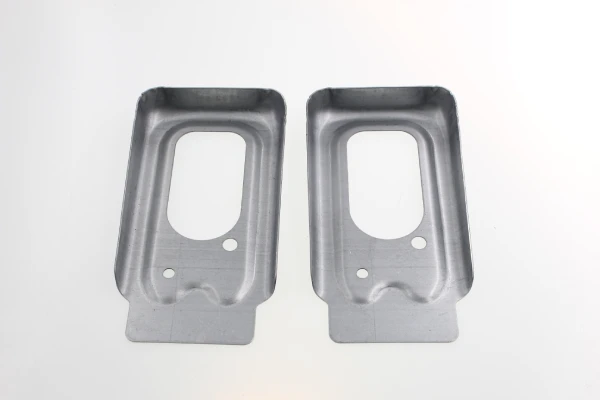
Why Compound Die Stamping Outperforms Progressive Stamping in Flatness Control
Continuous stamping generates repeated mechanical stress and causes cumulative transfer tolerances across multiple stations, which severely affects the flatness of large-sized panels. In contrast, precision compound die stamping eliminates these variables by simultaneously clamping and shearing the entire contour, thereby ensuring superior structural stability for custom enclosures.
Compound Die Stamping Eliminates Transfer Errors Between Stations
In the progressive stamping process, metal coil material passes sequentially through each station. Every time the guide pins release and re-clamp the strip, minute transfer tolerances accumulate. For large custom metal enclosures, these minor alignment errors can lead to significant geometric deviations and localized panel warping.
Custom compound die stamping completely eliminates this multi-step progressive process by confining all cutting operations to a single, static station. In the compound die stamping process, the sheet metal blank remains securely locked in place while the die simultaneously cuts the entire contour. This inherent “zero-transfer” method permanently eliminates the progressive stress buildup that naturally leads to a decline in material flatness.
When procuring critical IP-rated enclosures, avoiding movement between stations is crucial. Specifying precision compound die stamping ensures that dimensional relationships between all internal and external features remain flawless, completely eliminating dimensional drift caused by progressive stamping.
Uniform Force Distribution Over Large Areas
In large-scale sheet metal blanking operations, the most destructive factor is uneven clamping pressure, which causes the sheet metal to bend and twist at the shearing edges. Standard sequential stamping dies often fail to control this dynamic physical deformation. The decisive engineering advantage of compound die stamping technology lies in its heavy-duty ejector plate mechanism. Before the shear punch penetrates the material, this robust ejector plate is pressed downward, applying immense and uniform clamping pressure across the entire surface of the custom enclosure panel.
This balanced pressure physically locks the material’s grain structure, preventing the sheet metal from curling during the shearing stage. Because the compound die stamping process completely counteracts localized material yielding through this comprehensive force distribution, the resulting parts are able to maintain strict flatness tolerances. Consequently, parts produced using this process completely eliminate the need for costly secondary straightening operations.
Only 4 steps
online custom metal fabrication parts
Contact our experts team and experience the efficiency and economic benefits of digital metal fabrication services.
Upload Design Files
STL , STEP (.stp), IGES (.igs), (.ZIP), or PDF.
Also be a sample or an idea
Quote & Design Analysis
Instant factory quotes and DfM reports, the most reasonable solution.
Manufacturing Begins
Digital processes can initiate order tasks within 24 hours.
On-Time Delivery
Keeping delivery promises, approved by 3000+ Global Company buyers.
Engineering Considerations for Manufacturing Enclosures Using the Compound Die Stamping Process
For large metal enclosures, the transition to precision compound die stamping requires rigorous preliminary engineering design. To ensure absolute structural integrity and zero panel deformation, die engineers must rigorously evaluate the die clearances for specific alloys as well as the high-tonnage presses required for synchronous shearing.
Die Clearance Management for Different Alloys
When manufacturing custom metal enclosures from different materials, such as 5052 aluminum alloy or 304 stainless steel, using a one-size-fits-all die clearance setting constitutes a catastrophic engineering flaw.
In custom compound die stamping, the clearance between the punch and the die must be precisely calculated based on the specific alloy’s shear strength and material thickness. If the clearance is too small, excessive lateral stress will be generated, causing the sheet metal to deform immediately. Conversely, excessive clearance will cause the material to stretch and bend before shearing, resulting in unacceptable edge curling and burrs.
Since the compound die stamping process performs all cutting operations simultaneously, a perfectly optimized clearance is essential to ensure the blank maintains a flat structural geometry throughout. By employing advanced finite element analysis (FEA) simulation technology, die engineers can ensure that precision compound die stamping produces flawless, distortion-free edges, completely eliminating the alloy-specific stresses that typically compromise the contours of IP-rated panels.
Tonnage Requirements and Press Specifications
Simultaneous peripheral blanking and internal punching require instantaneous shear forces several times higher than those in sequential progressive stamping processes. Therefore, when employing compound die stamping, the required press tonnage must be rigorously calculated based on comprehensive data regarding the shear length and the sheet metal’s ultimate tensile strength. If equipment with insufficient tonnage is used, the punch will inevitably experience slight deflection during the impact. This mechanical deflection is directly transferred to the sheet metal blank, resulting in irreversible warping.
To achieve flawless precision compound die stamping, the press must possess extremely high bed rigidity and sufficient tonnage margin to absorb the immense impact forces generated during simultaneous shearing. For procurement engineers evaluating a factory’s production capacity, verifying that the manufacturer uses heavy-duty presses specifically calibrated for compound die stamping is a non-negotiable requirement for ensuring absolute flatness in the mass production of custom enclosures.

Maximizing Cost-Effectiveness in High-Volume Compound Die Stamping Production of Enclosures
Although initial tooling requires a significant capital investment, the compound die stamping process effectively reduces the total cost of ownership in high-volume production. By eliminating the secondary flattening process and reducing the rate of geometric defects, this reliable process ensures that enclosure buyers achieve the maximum return on investment.
Supro MFG’s Precision Compound Die Stamping Solution
At Supro MFG, we address large-scale enclosure manufacturing by directly tackling the root causes of panel warpage. Rather than attempting to correct warped blanks after the fact, our in-house engineering team designs highly optimized stamping dies to ensure absolute flatness from the very first stamping.
By utilizing high-quality die steel and precision wire-cut EDM, the dies we manufacture can withstand immense stamping forces during extended production runs without experiencing gap drift. This commitment to excellence in the custom compound die stamping process effectively prevents common structural defects—such as excessive burrs and severe material springback—that typically lead to assembly line downtime.
Partnering with Supro MFG means leveraging this precision compound die stamping to completely eliminate the hidden costs associated with secondary straightening, thereby ensuring highly predictable procurement cycles and achieving high profitability.
Supro MFG’s Rigorous Quality Control for Compound Die Stamping
When executing high-volume custom compound die stamping orders, the structural integrity of each chassis panel must be verified. During First Article Inspection (FAI), our quality assurance technicians use a Coordinate Measuring Machine (CMM) to verify that flatness dimensions strictly comply with specified Geometric Dimensioning and Tolerancing (GD&T) requirements.
Since compound die stamping technology inherently ensures concentricity and flatness, our quality control process focuses on monitoring die wear to prevent edge fractures and degradation of the shearing zone. By adhering to these uncompromising inspection standards, we ensure that every metal panel produced through the compound die stamping process is ready for seamless IP-rated assembly upon delivery to your company, ultimately safeguarding your brand’s reputation and profitability.
Conclusion
To ensure absolute flatness in large-sized custom enclosures, it is essential to eliminate the progressive mechanical stresses that cause panel warping. By using robust clamping plates to simultaneously clamp and shear the entire profile, precision compound die stamping counteracts material springback and permanently locks in critical Geometric Dimensioning and Tolerancing (GD&T) requirements.
For procurement teams, adopting compound die stamping technology directly results in predictable, zero-scrap IP-rated assemblies, completely eliminating the hidden costs associated with secondary flattening processes.
At Supro MFG, we leverage our deep die expertise and rigorous defect-tracking processes to design manufacturing solutions that protect your supply chain and profitability. Please contact our engineering experts to discuss how precision compound die stamping can optimize your next high-volume industrial enclosure project and ensure exceptional structural integrity.