

Selecting sheet metal materials for the compound die stamping process is far more complex than simply consulting standard material data sheets. Because this specialized manufacturing process performs blanking, punching, and forming operations simultaneously within a single stamping stroke, the selected alloy is subjected to extreme localized mechanical stresses and lacks the typical stress-relief mechanisms found in multi-stage progressive stamping processes.
For mechanical designers and procurement specialists, striking a balance between material formability and predictable springback is key to the success of a production run. If the ratio of an alloy’s yield strength to tensile strength is too high, it will severely restrict the metal’s flow during the compound die stamping process, often leading to microcracks in areas with small bending radii. Conversely, metals with high yield strength store greater elastic energy, and springback is significantly amplified once the compound die opens.
To achieve strict dimensional tolerances, the metal’s work hardening coefficient and elongation must be rigorously evaluated. This article details the precise metallurgical criteria required for selecting suitable materials for compound die stamping technology, ensuring that the geometry of your specified parts complies with actual physical limits before the die is cut.
Mechanical Principles of Material Stress in Compound Die Stamping
For procurement and engineering teams, understanding how metals behave when subjected to simultaneous forces is critical. Unlike progressive stamping, where operations are separated, custom compound die stamping forces the material to undergo shearing, punching, and bending simultaneously within a single stamping cycle. This instantaneous action creates a highly complex multiaxial stress state in the blank.
Because material flow is severely restricted in the compound die stamping process, the alloy undergoes rapid plastic deformation under the simultaneous action of intense tensile and compressive loads. If the specified alloy grade lacks the ductility required to dissipate these concentrated mechanical stresses, microcracks will inevitably form along the shear edges.
Therefore, analyzing the alloy’s shear strength and ultimate tensile strength (UTS) is an indispensable step in precision compound die stamping. Understanding these principles of internal stress mechanics ensures both component integrity and prevents costly premature die failure.
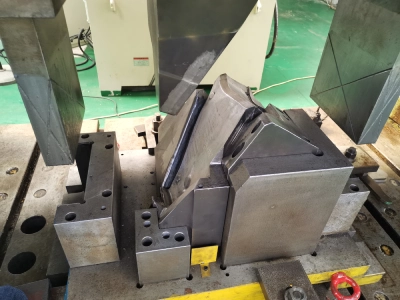
Evaluation of Formability for Precision Components
Evaluating the formability of precision components requires rigorous metallurgical validation, which goes far beyond a simple assessment of bendability. To ensure structural integrity during the compound die stamping process, precise mechanical properties must be evaluated to accurately predict material behavior before finalizing complex die designs.
Elongation and Tensile Strength Parameters
Combining an assessment of an alloy’s percentage elongation with its ultimate tensile strength (UTS) provides the precise data needed to predict stamping success. For procurement engineers, the most critical parameter remains the ratio of yield strength to tensile strength. A lower ratio indicates a wider plastic deformation window, allowing the metal to be stretched without tearing during the precision compound die stamping process. If the gap between yield strength and tensile strength is too small, the material will fracture rather than form under intense single-punch pressure.
Total elongation determines the absolute physical limits of draw depth and bend radius. When specifying metal materials for custom compound die stamping, selecting grades with elongation exceeding 20% can significantly reduce scrap rates. Analyzing these specific stretching parameters ensures that the selected alloy can withstand the severe mechanical shear forces inherent in compound die stamping without compromising the structural integrity of the final component.
Management of Strain Hardening Rate
In addition to basic stretching data, understanding a metal’s strain hardening index (n-value) is critical for long-term production stability. In the compound die stamping process, when sheet metal undergoes plastic deformation, its internal crystal structure compresses, causing the material to harden rapidly. A higher n-value prevents localized necking, thereby promoting uniform thickness distribution; however, severe work hardening immediately leads to a sharp increase in the required stamping tonnage. This sudden increase accelerates punch wear and triggers microcracks at small radii of curvature.
To protect the expensive dies used in custom compound die stamping processes, a balance must be struck between the alloy’s initial state and its hardening tendency. For alloys prone to severe work hardening, such as austenitic stainless steel, the integration of advanced die coatings and optimized punch clearances in compound die stamping technology has become essential to control die wear and maintain strict dimensional tolerances during high-volume production.
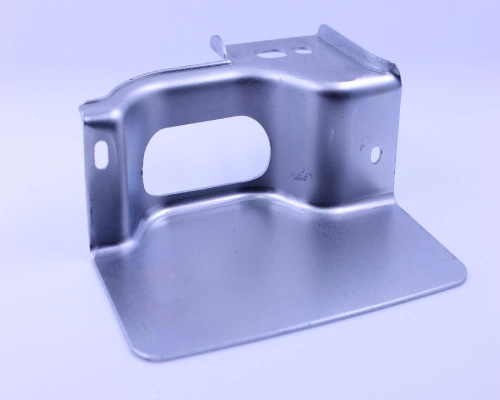
Quantification and Control of Springback in Compound Die Stamping
Once the die opens, unpredictable elastic springback immediately threatens strict dimensional tolerances. In the precision compound die stamping process, accurately quantifying this residual stress enables engineering teams to eliminate geometric deformation, thereby ensuring parts meet precise specifications and avoiding costly post-forming modifications.
Relationship Between Yield Strength and Elastic Recovery
The fundamental driver of geometric deformation is the ratio of a material’s yield strength to its elastic modulus. When sheet metal undergoes plastic deformation during custom compound die stamping, its internal structure stores a significant amount of elastic strain energy. Alloys with high yield strength—such as high-strength low-alloy steel or tempered aluminum alloys—intrinsically retain more of this energy than low-carbon steel. Once the die opens, this stored tension is suddenly released, causing flanges or bent sections to spring back outward.
Calculating this precise elastic springback rate is essential. If the released energy is ignored, simply selecting a higher-strength metal often leads to severe dimensional failures. Accurately mapping this yield-to-springback ratio ensures that all parts manufactured via the compound die stamping process maintain the strict positional tolerances required for automated downstream assembly.
Die Compensation and Over-Bend Strategies in Compound Die Stamping
To counteract elastic springback, engineers must incorporate predictive over-bend design directly into the initial die architecture. Since compound die stamping technology completes the entire contour forming in a single, independent stamping operation, there is extremely limited scope for iterative mechanical adjustments on the stamping floor.
To address this, experienced manufacturers use finite element analysis (FEA) to calculate precise over-bend allowances before cutting the steel. By intentionally reducing the punch radius and employing bottom-out technology, the die forces the metal to bend slightly beyond its nominal angle. When the compound die stamping press releases the pressure, the alloy naturally springs back, returning precisely to the specified tolerance range.
For procurement managers, it is crucial to find a manufacturing partner capable of simulating these compensatory variables in the compound die stamping process. This not only permanently eliminates costly secondary flattening operations but also significantly accelerates first-article validation.
Only 4 steps
online custom metal fabrication parts
Contact our experts team and experience the efficiency and economic benefits of digital metal fabrication services.
Upload Design Files
STL , STEP (.stp), IGES (.igs), (.ZIP), or PDF.
Also be a sample or an idea
Quote & Design Analysis
Instant factory quotes and DfM reports, the most reasonable solution.
Manufacturing Begins
Digital processes can initiate order tasks within 24 hours.
On-Time Delivery
Keeping delivery promises, approved by 3000+ Global Company buyers.
Comparative Analysis of Common Sheet Metal Alloys Used in Compound Die Stamping
Determining the optimal alloy requires balancing its inherent yield strength against strict formability constraints. By comparing the distribution of mechanical strain across different metals during precision compound die stamping, procurement teams can accurately match material properties with die life and structural requirements.
Aluminum Alloy Compound Die Stamping (e.g., 5052-H32 and 6061-T6)
When specifying aluminum alloy materials for custom compound die stamping, the procurement team must strictly distinguish between strain-hardened and age-hardened conditions. The 5052-H32 grade is an industry standard; its excellent yield-to-tensile strength ratio facilitates high-strength single-stroke forming, with predictable and minimal springback. Its superior ductility allows it to easily accommodate small bending radii without causing surface fractures.
Conversely, selecting 6061-T6 poses significant manufacturing risks. Due to the limited elongation of the T6 condition, it will fracture rapidly under the combined shear and bending loads inherent in precision compound die stamping. This structural alloy also stores a large amount of elastic energy, which can cause severe geometric deformation once the die is opened.
To optimize production yield and maintain strict tolerances in the compound die stamping process, switching the material for complex geometric parts from 6061 to 5052 remains an indispensable “design for manufacturability” strategy.
Stainless Steel Compound Die Stamping (304 and 316)
Austenitic stainless steels such as 304 and 316 possess excellent ductility, making them, in theory, ideal materials for extreme deformation processes. However, these alloys are well known for their extremely high work-hardening rates. In custom compound die stamping, as the metal deforms, its internal crystal structure hardens instantaneously, causing the required stamping tonnage to increase dramatically within a few milliseconds.
Although 316 is enhanced with molybdenum to improve resistance to chloride corrosion, its mechanical behavior is similar to that of 304, meaning both require heavy-duty equipment and advanced die substrates. If the die clearance is not designed with precision, this rapid work hardening can lead to severe galling and catastrophic punch wear during the compound die stamping process. Supro uses specialized extreme-pressure lubricants to counteract the intense thermal friction inherent in stainless steel compound die stamping, thereby maintaining strict dimensional tolerances during high-volume production.
High-Strength Low-Alloy (HSLA) Steel Compound Die Stamping
High-strength low-alloy (HSLA) steel is increasingly being adopted in modern engineering design to achieve significant weight reduction without sacrificing load-bearing capacity. However, applying HSLA steel to compound die stamping technology presents extreme technical challenges related to springback.
The high yield strength inherent in microalloyed steel greatly narrows the plastic deformation window, requiring enormous punching forces to exceed the elastic limit. Consequently, significant residual stresses remain in the metal, which trigger severe elastic springback once the compound die stamping cycle ends. To prevent structural dimensional failure, manufacturers must design precise bend-over and bottom-out features directly into the die.
When procuring HSLA components manufactured via precision compound die stamping, procurement teams must verify that suppliers have employed advanced finite element analysis (FEA) simulation technology to predict and counteract these massive springback forces through mathematical modeling before cutting the actual die steel.
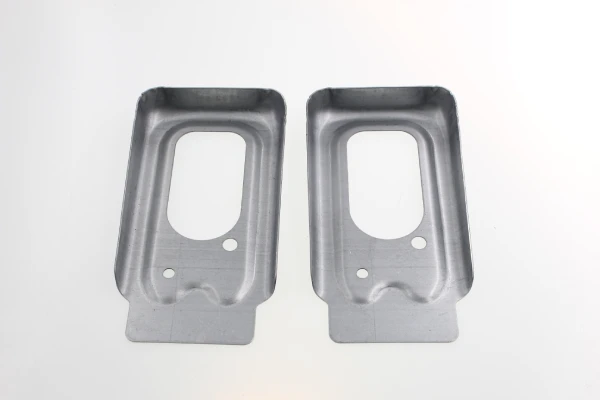
DFM (Design for Manufacturability) Guidelines for Compound Die Stamping
Implementing Design for Manufacturability (DFM) principles early in the engineering phase directly determines the commercial viability of any sheet metal part. Since the compound die stamping process applies all blanking, punching, and bending forces simultaneously, the part geometry must perfectly match the physical limits of the specified alloy.
For procurement and design teams, the most critical parameter remains the ratio of minimum bend radius to thickness (R/T). Specifying an excessively small radius for high-yield-strength materials will immediately cause outer-layer fiber fracture during the intense single-stroke process of custom compound die stamping. As a standard engineering benchmark, soft aluminum requires a minimum radius of 1T, while high-strength low-alloy steel (HSLA) requires at least 2.5T to prevent sidewall tearing.
The distance between holes and edges must also be rigorously reviewed. If punch features are too close to the formed flange, the intense localized tensile stresses inherent in precision compound die stamping will immediately distort circular holes into ellipses. Engineers must specify a minimum clearance distance equal to 1.5 times the sum of the material thickness and the bending radius. Adhering to these strict DFM constraints ensures that parts manufactured using compound die stamping technology possess flawless structural integrity, thereby permanently avoiding costly die modifications.
Partner with an Experienced Custom Sheet Metal Manufacturer
Bridging the gap between theoretical metallurgical data, local strain limits, and actual production requires a manufacturing partner with deep die-making expertise.
At Supro MFG, we have completely eliminated the traditional trial-and-error approach found in stamping shops. Instead, our in-house engineering team uses advanced finite element analysis (FEA) software to simulate metal flow and precisely quantify elastic springback before cutting steel for compound die stamping. By directly integrating the engineered over-bend allowance and optimized punch clearance into the initial die design, we eliminate the severe multi-axial stresses inherent in precision compound die stamping.
For procurement managers, this rigorous front-end validation means no costly die modifications are required and exceptional dimensional repeatability is achieved. Whether specifying high-strength alloys or temper-sensitive aluminum, our proven compound die stamping Design for Manufacturing (DFM) protocols ensure strict adherence to tolerance requirements, maximize die life, and structurally reduce your total cost of ownership (TCO) in high-volume supply chains.