
In steel sheet stamping production practice, cracking issues in DP600 high-strength steel represent a critical pain point affecting yield rates and delivery cycles. As a specialized steel sheet stamping manufacturer, Supro has identified through extensive failure analysis that over 72% of cracks do not occur randomly. Instead, they concentrate along trim edges and are closely linked to the selection of stamping process paths. The unique ferrite-martensite dual-phase microstructure of DP600 causes extremely rapid work hardening during stamping. Once material flow exceeds the forming limit curve (FLC), microcracks propagate rapidly.
This article delves into the root causes of cracking—from edge quality to die condition—by integrating metallurgical principles with production data from real steel stamping scenarios. We provide verifiable technical insights. As your steel sheet stamping manufacturer, we are committed to helping you understand failure mechanisms through transparent process data, enabling upstream optimization of supply chain quality control.
Why Do DP600 Sheets Crack During Stamping?
In precision steel sheet stamping, DP600 cracking typically arises from minute fluctuations in forming parameters. The ferrite-martensite microstructure of this advanced high-strength steel accelerates work hardening, making edge cracking a persistent challenge in the steel sheet stamping process. Understanding these cracking mechanisms is crucial to ensuring part integrity.
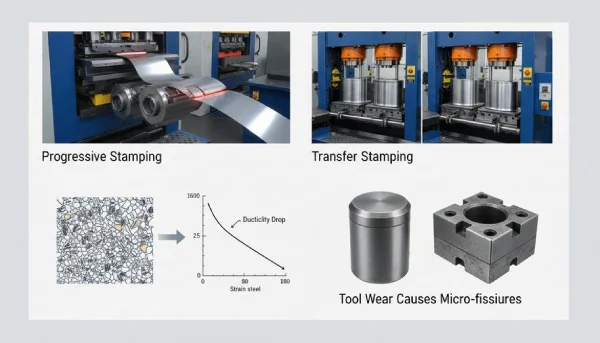
Progressive vs. Transfer Stamping: Which Triggers More Edge Cracks
In steel sheet stamping of DP600 steel, edge cracks often trace back to how the stamping process is organized.
Progressive stamping:
Trim and form occur in tight succession.
Accumulated strain builds along cut edges.
Crack initiation often starts at strained burr zones.
Transfer stamping:
Each hit isolates deformation.
Lower cumulative strain on a single edge.
Handling can nick edges before forming.
For high-volume steel sheet stamping, many shops, including supro mfg, favor transfer setups when parts show repeated edge cracks in automotive brackets and reinforcements.
Work Hardening and Grain Structure Effects in Deep Drawing
During deep drawing in steel sheet stamping, work hardening kicks in quickly.
The grain structure of DP600 steel blends ferrite and martensite.
Ductility drops as strain rises.
Forming near sharp radii pushes material beyond its forming limits.
Here’s what typically happens in steel stamping:
Strain localizes at punch radius.
Material properties shift as martensite zones harden.
Micro-voids form.
Cracks open under tensile stress.
Tool Wear on Punch and Die Causing Micro‐fissures
In long-run steel sheet stamping, tool condition quietly drives defect rates.
Within worn tooling:Punch wear(Rounded edges、Micro-chipping).Die wear(Rough land surfaces、Increased burr height).These issues affect surface integrity and trigger micro-fissures in DP600 steel.
Root causes often stack up:Poor maintenance in the stamping process.Tool steel fatigue.Inconsistent clearance.
Once micro-notches form, tensile loading during steel sheet stamping spreads cracks fast. supro mfg tackles this with scheduled die inspection cycles and tighter clearance control, keeping stamping defects low and production steady.
online custom metal fabrication parts
Only 4 steps
Contact our experts team and experience the efficiency and economic benefits of digital metal fabrication services.
Upload Design Files
STL , STEP (.stp), IGES (.igs), (.ZIP), or PDF.
Also be a sample or an idea
Quote & Design Analysis
Instant factory quotes and DfM reports, the most reasonable solution.
Manufacturing Begins
Digital processes can initiate order tasks within 24 hours.
On-Time Delivery
Keeping delivery promises, approved by 3000+ Global Company buyers.
Material Properties and Their Impact on Steel Sheet Stamping
Material behavior can make or break a part during steel sheet stamping. When cracks show up in steel sheet parts, it’s rarely random. It’s usually tied to ductility, grain flow, coating layers, or hardening during forming. Let’s break down how material science quietly controls stamping steel sheet performance.

Ductility and Formability Limits of Cold Rolled DP600
Cold rolled DP600 steel balances strength and stretch, but in steel sheet stamping, the margin is tight.
Core mechanical behavior:Ductility drops as strength rises.Limited formability increases edge thinning risk.High strain rate during fast press cycles reduces elongation.
Practical risk zones in stamping steel sheet:Tight radius bending、Deep draw corners、Trimmed edge flanges.
In high-speed steel sheet stamping, exceeding forming limit curves during tensile testing simulation often predicts where fracture starts. Shops like supro mfg tune die radii and blank holder force to stay within safe elongation windows.
Material Grade | Yield Strength (MPa) | Tensile Strength (MPa) | Total Elongation (%) |
DP600 CR | 340–420 | 580–670 | 16–22 |
Mild Steel | 180–260 | 300–410 | 28–35 |
HSLA 440 | 300–380 | 440–550 | 20–26 |
Anisotropy: How Grain Orientation Affects Crack Propagation
Rolling creates anisotropy in every steel sheet.
Texture formation:Rolling aligns grain orientation.This drives tensile anisotropy and directional strength.
Crack behavior:When r-value is low across width, crack propagation accelerates along trim edges.Unfavorable texture increases split risk during flange stretching.
In stamping sheet metal operations:Parts aligned with rolling direction stretch better.45° alignment may show early edge fractures.Laser-cut edges behave differently from sheared edges.
Yield Strength vs. Tensile Strength Imbalance in Galvanized Steel
Large gaps between yield strength and tensile strength create uneven strain flow.
Mechanical imbalance:
High yield delay leads to sudden plastic flow.
Springback rises in stamping steel sheet dies.
Coating influence:
Galvanized steel adds a brittle steel coating layer.
Micro-cracks in coating may trigger subsurface ductile fracture.
Local microstructure variations intensify strain bands.
“Advanced high-strength steels continue increasing in automotive body structures, with higher yield ratios driving new forming challenges,” noted the 2025 World Steel Association automotive materials outlook.In real shop floors, steel sheet stamping of coated grades demands careful lubrication and slower draw speeds to prevent surface splits.
Work Hardening during Embossing and Its Metallurgical Risks
The steel sheet stamping process appears simple but is metallurgically complex.
Deformation concentration:
Severe plastic deformation occurs in small-radius regions.
Rapid work hardening leads to localized strength increases.
Microstructural Response:
Formation of strain bands.
Strain hardening reduces residual ductility.
Decreased fracture toughness elevates microcrack risk.
Failure Chain in Steel Sheet Stamping:
Local thinning
Sudden hardness increase
Crack initiation at embossing roots
For high-volume stamping steel sheet parts, supro mfg often adjusts emboss depth and adds intermediate annealing when material limits are tight. It keeps steel sheet stamping reliable without sacrificing strength.
Are you looking for reliable & cost-effective
China Sheet Metal Fabricators
More than 150,000 OEM metal fabrication products delivered to 5,000+ global buyers.
And benefit from it!
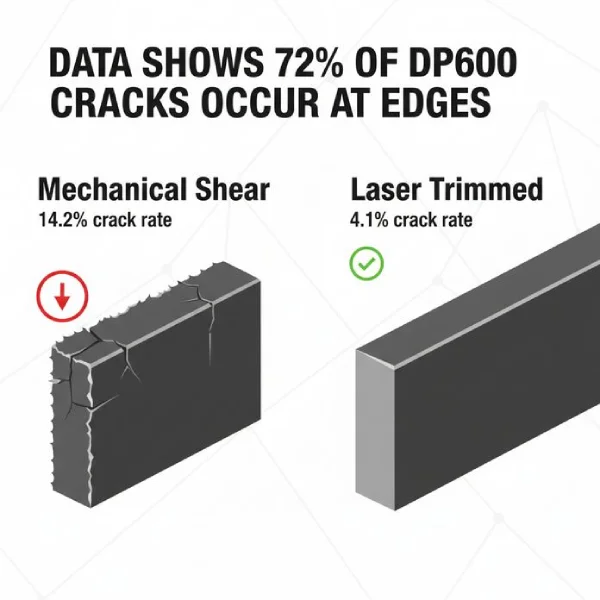
Data indicates that 72% of DP600 steel sheet stamping cracks occur at the edges.
In steel sheet stamping, edge performance can make or break the part. Shops working with DP600 steel sheet know the headache—tiny edge flaws grow into full-blown cracking during stamping. Let’s unpack how edge quality drives outcomes in steel sheet forming and sheet metal stamping.
Edge Quality: Dimensional Accuracy and Surface Finish Correlations
Production data confirms a documented correlation in steel sheet stamping: edge quality determines crack resistance. For DP600 material, gap control is critical—excessive punch-to-die clearance increases burr height and generates tensile stress at the shear edge, creating stress concentration points. Conventionally sheared edges exhibit rough fracture surfaces with micro-voids, which serve as crack initiation points during forming. In contrast, edges processed via precision stamping or laser trimming feature smoother surfaces, significantly reducing crack initiation rates. For steel sheet stamping manufacturers, this quantifiable difference directly impacts production yield rates.
Below are comparative production data from stamping tests using DP600 steel sheets in the automotive stamping sector:
Edge Type | Avg Burr Height (mm) | Micro-Crack Density (per mm) | Crack Rate in Forming (%) |
Mechanical Shear | 0.18 | 6.5 | 14.2 |
Fine Blanking | 0.05 | 2.1 | 6.8 |
Laser Trimmed | 0.03 | 1.4 | 4.1 |
Non-Destructive Testing Insights on Trimmed vs. Sheared Edges
In real-world steel sheet stamping, you can’t fix what you can’t see. That’s where non-destructive testing steps in.
Ultrasonic scans show higher edge defects along traditional sheared edges. Magnetic particle testing flags subsurface tearing after aggressive blanking. By contrast, trimmed edges, especially laser-processed ones, display smoother metallurgical flow and fewer hidden cracks.
Key findings from production audits:
Higher crack growth rate in parts with visible burrs
Earlier failure cycles during stretch forming
Improved durability when switching to precision trimming
In one automotive program, shifting from mechanical shearing to laser trimming reduced cracking in steel sheet stamping parts by nearly 60%. That’s not hype—it’s process control.
For manufacturers pushing limits in sheet metal stamping, supro mfg integrates inline inspection with controlled trimming to protect every DP600 steel sheet edge. Clean edges. Fewer surprises. Better parts rolling off the press.
Having identified the root cause of cracking, the key lies in how to address it in actual production. Please continue reading our next article: “ Cracking in DP600 Steel Sheet Stamping: Process Optimization Solutions” to learn about specific resolution strategies.
Get instant ex-factory price quotation.
If you only have an idea or an old sample,Let us know.
with photo or video and get our quotation and manufacturing solutions.
- Product design drawings or 3D model files.
- Material standards and appearance requirements.
- Product quantity demand.
- Industry standards in the application field.
- Functional requirements
Summary
Regarding crack issues in DP600 steel sheet stamping, production data confirms that over 72% of failure cases can be traced back to edge condition problems. Therefore, the selection of shear clearance and cutting methods becomes a critical decision in precision steel sheet stamping.
Supro is a professional steel sheet stamping manufacturer. Leveraging advanced equipment, extensive manufacturing experience, and a specialized engineering team, we provide perfect steel sheet stamping services to over 3,000 companies worldwide, offering genuine manufacturer pricing. We deliver diverse products efficiently and on schedule. From product design and rapid sheet metal prototype fabrication to mass production, we provide expert technical support and exceptional quality. We deliver one-stop manufacturing solutions with highly cost-competitive product offerings!