
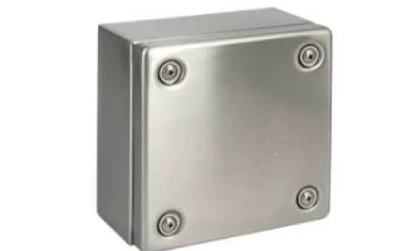
In the field of stainless steel sheet metal procurement and manufacturing, stainless steel sheet metal bending is far from a simple plastic forming process. The high work hardening rate, significant tendency toward elastic springback, and relatively low thermal conductivity inherent in stainless steel grades such as 304 and 316 distinguish the stainless steel sheet metal bending process from that of ordinary low-carbon steel, making it a technology that demands a high level of expertise and process control. Improper bending techniques can lead to cracking, inconsistent bend angles, surface damage, or excessive tool wear, directly affecting the structural integrity of the parts and delivery costs.
This article will systematically analyze the stainless steel sheet metal bending process—including material selection, precise die and equipment configuration, process parameters, and control strategies for managing springback—to achieve high-precision, consistent bending quality. Whether for rapid prototyping or large-scale custom stainless steel sheet metal bending, mastering these principles is the cornerstone for ensuring part performance, controlling costs, and optimizing supply chain reliability.
Challenges in Stainless Steel Sheet Metal Bending Process
Compared to low-carbon steel, the physical properties of stainless steel present several fundamental challenges in the bending process. First, stainless steel’s higher yield strength and tensile strength demand greater bending tonnage and significantly increase springback—a major obstacle to precise angle control.
Second, the process induces extremely high work hardening rates, meaning the material rapidly hardens and becomes brittle after initial bending. Improper process planning (such as excessively small bend radii or incorrect bending sequences) can easily trigger microcracks on the bend’s outer side.
Finally, stainless steel’s relatively low thermal conductivity concentrates heat generated during bending, potentially intensifying localized stresses and shortening tool life. Consequently, an efficient stainless steel sheet metal bending solution demands a systematic engineering response rather than mere parameter tweaking.
Materials Science of Stainless Steel Alloys
A deep understanding of stainless steel’s metallurgical properties is fundamental to mastering the stainless steel sheet metal bending process. Stainless steel is not a single material; its microstructure and mechanical properties depend primarily on alloying elements, particularly the content and balance of chromium, nickel, and molybdenum. For custom stainless steel sheet metal bending projects, selecting the correct stainless steel alloy series is critical.
Common austenitic stainless steels (e.g., 304/316) are popular for their excellent formability and corrosion resistance. Their face-centered cubic crystal structure undergoes significant work hardening during cold working. This means the strength in the bend zone increases rapidly during stainless steel sheet metal bending, while ductility decreases. This directly impacts the planning of the stainless steel sheet metal bending process: higher bending forces are required, and repeated forming operations at the same location are significantly restricted.
In contrast, ferritic stainless steels (e.g., 430) feature a body-centered cubic structure with lower work hardening rates. However, they exhibit insufficient toughness at room temperature, making them more prone to cracking risks when the stainless steel sheet metal bending radius is small.
Martensitic stainless steels (e.g., 410) exhibit high hardness and are generally considered unsuitable for complex sheet metal bending operations. Therefore, the success of stainless steel sheet metal bending processes requires scientifically selecting appropriate stainless steel alloy types based on component functional requirements (strength, corrosion resistance) and forming complexity.
Preliminary Preparation for Stainless Steel Sheet Metal Bending Process
Before commencing bending operations, systematic preliminary preparation is the core element determining the success, cost control, and final quality of custom stainless steel sheet metal bending projects. Effective preparation rests on two pillars: precise mathematical calculations and a comprehensive process route.
The core of mathematical calculations is the developed length, which relies on K-factor values adjusted for specific stainless steel grades and conditions. Second is establishing the bending sequence—optimizing the order of bends to prevent die interference, control material flow, and manage the cumulative effects of work hardening.
Bend Allowance Calculation
The core of bend allowance calculation lies in determining the K factor (neutral layer coefficient). For stainless steel sheet metal bending, generic values for low-carbon steel (e.g., 0.44) cannot be directly applied. Due to its higher yield strength and unique springback behavior, the neutral layer shifts more significantly toward the inner diameter during stainless steel bending. Taking austenitic 304 stainless steel as an example, in standard V-die bending, the empirically validated K factor typically ranges from 0.45 to 0.48.
The specific value depends on material thickness, actual bending radius, and lower die opening. An incorrect K factor will directly cause systematic deviations in subsequent unfolded dimensions, leading to material waste or assembly failure.
Process Roadmap Development
Developing a logically structured stainless steel sheet metal bending process roadmap is the critical planning step for transforming designs into qualified products. Fundamental principles include:
Prioritize bends that may interfere with subsequent operations
Progress from the sheet edges toward the center
For multiple bends, typically follow a short-edge-then-long-edge sequence to enhance stability
A complex stainless steel sheet metal bending operation requires decomposition into multiple sub-steps, interspersed with necessary trimming or secondary positioning. The roadmap must also specify tooling selection, press tonnage, and backgauge settings for each process. Meticulous planning not only prevents tool-workpiece collisions but also enhances yield and dimensional consistency by controlling material flow and work hardening sequence, ensuring the efficiency of custom stainless steel sheet metal bending projects.
Only 4 steps
online custom metal fabrication parts
Contact our experts team and experience the efficiency and economic benefits of digital metal fabrication services.
Upload Design Files
STL , STEP (.stp), IGES (.igs), (.ZIP), or PDF.
Also be a sample or an idea
Quote & Design Analysis
Instant factory quotes and DfM reports, the most reasonable solution.
Manufacturing Begins
Digital processes can initiate order tasks within 24 hours.
On-Time Delivery
Keeping delivery promises, approved by 3000+ Global Company buyers.
Equipment and Dies for Stainless Steel Sheet Metal Bending Process
Professional and well-matched equipment and dies are the fundamental physical guarantee for achieving high-quality stainless steel sheet metal bending. Improper hardware selection not only leads to uncontrolled part precision but also directly impacts production efficiency and costs.
First, custom stainless steel sheet metal bending equipment must possess sufficient tonnage margin and mechanical rigidity to overcome stainless steel's high yield strength, ensuring consistent bending angles. Second, the material science and geometric design of stainless steel sheet metal bending dies are critical. They must resist work hardening and abrasive effects from stainless steel while preventing surface scratches, indentations, or material adhesion (pick-up).
Equipment for Stainless Steel Sheet Metal Bending Process
A qualified CNC press brake is the cornerstone for executing precision stainless steel sheet metal bending. Selection hinges on ample tonnage reserve and exceptional rigidity. Due to stainless steel’s high yield strength, bending force requirements typically exceed those for equivalent-thickness low-carbon steel by 1.5 to 2 times.
Consequently, stainless steel sheet metal bending equipment must possess significant tonnage margin to prevent noticeable deflection of the ram when bending thick plates or small V-grooves. Additionally, a high-precision hydraulic deflection compensation system and a robust monoblock frame are crucial for ensuring consistent bending angles across the entire workpiece.
Dies for Stainless Steel Sheet Metal Bending Process
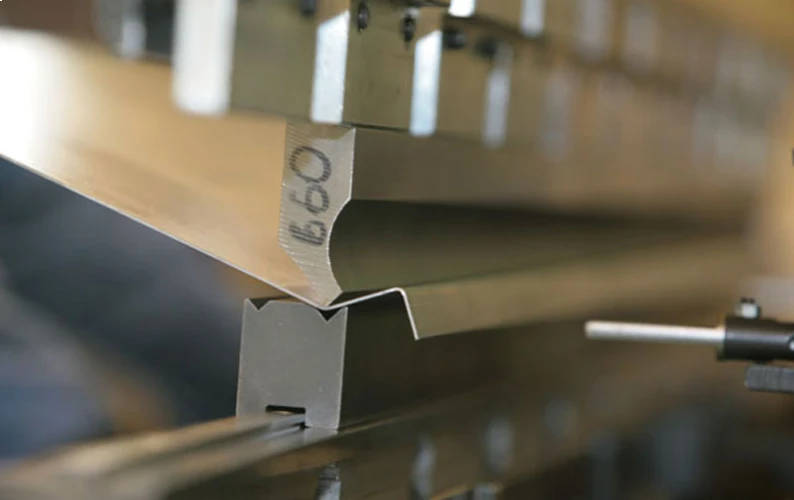
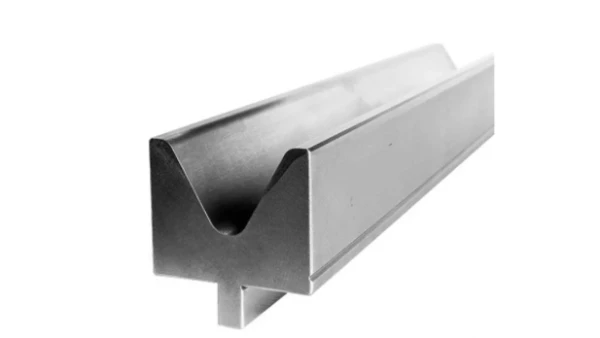
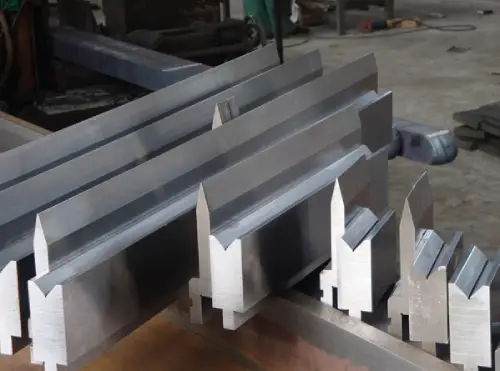
Dies are the critical components directly interacting with the material, and their selection determines the upper limit of quality achievable in custom stainless steel sheet metal bending. The upper die (Punch) should be made of high-hardness, high-toughness tool steel, such as DC53 or cemented carbide, with its tip radius precisely matched to the target inner bend radius. The V-groove opening width of the lower die (Die) is typically recommended at 6-8 times the material thickness to reduce required bending force and minimize the risk of surface scratches.
The surface finish of stainless steel sheet metal bending dies must achieve a mirror-polished level. High-polish die cavities minimize friction with stainless steel surfaces, effectively preventing scratches, sticking (material adhesion to dies), and extending die service life. This is a non-negotiable requirement for ensuring the surface quality of stainless steel sheet metal bending structural components.
Parameter Control in Stainless Steel Sheet Metal Bending Process
Precise and repeatable process parameter control is the core operational stage for translating design intent into physical precision. Parameter control strategies for stainless steel sheet metal bending focus on three interrelated core variables: speed, springback, and lubrication. Bending speed must be optimized for stainless steel's low thermal conductivity and high work hardening rate to control cracking and springback.
Springback requires precise control through techniques such as overbending, holding pressure, or die compensation. High-performance lubricants serve as the critical medium ensuring process stability in custom stainless steel sheet metal bending.
Speed Control in Stainless Steel Sheet Metal Bending Process
Our experience indicates that bending speed is not an arbitrarily adjustable parameter but a critical variable requiring optimization based on material properties. Unlike carbon steel, stainless steel’s low thermal conductivity and high work hardening rate necessitate slower bending speeds. Typically, ram speeds are recommended within the range of 15-25 mm/s.
Slower bending speeds allow sufficient time for plastic flow and internal stress redistribution, reducing localized stress peaks caused by excessive deformation rates. This facilitates preventing micro-crack formation on the bend’s outer edge, enhances bend angle stability, and achieves consistent bend radii in the stainless steel sheet metal bending process.
Springback Compensation in Stainless Steel Sheet Metal Bending
Springback is the most prominent phenomenon in stainless steel sheet metal bending and requires proactive management. The high yield strength of stainless steel causes significant elastic recovery upon unloading. Engineering practice primarily employs three strategies to address this:
First, the overbend method involves precisely calculating and setting a bending depth exceeding the target angle; Second, applying a brief pressure hold at the bottom of the bending stroke to reduce springback through stress relaxation; Third, employing custom stainless steel sheet metal bending dies with angle compensation designs.
Overbending Method
Overbending is the most direct and widely applied springback compensation technique in stainless steel sheet metal bending. Its principle involves precisely controlling the downward depth of the upper die to induce plastic deformation exceeding the target angle, ensuring the material achieves the desired angle after springback.
The required overbend amount is not fixed; it depends on the material’s specific yield strength, thickness, die V-groove opening, and target bend angle. This method demands high-precision depth control capabilities from the bending machine and serves as the fundamental approach for addressing springback in the stainless steel sheet metal bending process.
Bottom Dwell
Bottom dwell refers to maintaining the upper die under pressure for 0.5 to 2 seconds at the end of the bending stroke. This dwell time induces micro-creep and stress relaxation in the material, effectively reducing springback in the stainless steel sheet metal bending process. This method is particularly effective for controlling springback in thick plates or high-strength stainless steel sheet metal bending.
Its mechanism lies in the sustained pressure inducing time-dependent plastic flow near the yield point, partially offsetting elastic strain. In practice, the dwell time requires optimization: too short may yield insufficient results, while too long may exacerbate work hardening.
Die Compensation Design
Die compensation design is a strategy that counteracts springback in stainless steel sheet metal bending by modifying die geometry. Two common approaches exist: First, machining specific negative angles on both sides of the lower die’s V-groove—for instance, machining the lower die angle to 88 degrees to achieve a 90-degree workpiece. Second, performing targeted grinding on the upper die’s tip angle to make it slightly smaller than the target angle.
These geometrically compensated custom stainless steel sheet metal bending dies incorporate a pre-set reverse deformation during forming, achieving the target angle after springback. The advantage lies in the extreme process stability once the dies are manufactured, making it particularly suitable for high-volume, long-term stainless steel sheet metal bending projects. However, the drawbacks include higher manufacturing costs, strong specialization, and stringent requirements for design prediction accuracy.
The Critical Role of Lubrication
In the stainless steel sheet metal bending process, the use of specialized high-performance lubricants is a mandatory process requirement. General-purpose greases typically cannot withstand the high contact pressures generated during stainless steel bending. Metal forming-specific lubricants containing additives such as chlorine and sulfur must be applied to the contact area between the sheet and the lower die, as well as along the path of the upper die tip. This facilitates:
– Reducing the friction coefficient between the sheet and the dies, thereby decreasing bending force and wear
– Preventing material adhesion between stainless steel and die steel caused by high pressure, which is critical for preserving the surface finish of the workpiece
– Promoting material flow, contributing to the formation of a more uniform stainless steel sheet metal bending radius.
Looking for a reliable custom sheet metal fabrication companies?
Talk To Supro MFG Expert Team
Contact us for competitive ex-factory prices,
and a full range of technical support services.
Conclusion
A successful custom stainless steel sheet metal bending project begins with the precise specification of stainless steel grades and conditions, unfolding calculations and process planning grounded in physical principles, and ultimately relies on sufficiently rigid equipment, professionally designed dies, and precise control of parameters such as speed, pressure, and springback compensation.
Supro is a professional stainless steel sheet metal bending manufacturer. Leveraging advanced equipment, extensive manufacturing experience, and a specialized engineering team, we provide perfect stainless steel sheet metal bending services to over 3,000 companies worldwide, offering genuine manufacturer quotes.
As an industry-leading stainless steel sheet metal bending manufacturer, we efficiently deliver diverse products on schedule. From product design and rapid sheet metal prototype fabrication to mass production, we provide expert technical support and exceptional quality. We offer one-stop manufacturing solutions and highly cost-competitive product supply!