
Springback is not merely a nuisance factor but an essential physical phenomenon in sheet metal bending processes that cannot be ignored. This post-forming elastic recovery, determined by material yield strength and elastic modulus, directly impacts final angle accuracy and flange dimensional stability.
Uncontrolled springback in sheet metal bending processes leads to assembly failures, fit issues, and high scrap/rework costs. In lightweight applications involving advanced high-strength steels (AHSS) and aluminum alloys, sheet metal bend springback poses even greater challenges. Relying solely on historical compensation data tables is insufficient to address the variability inherent in modern material batches.
This article details five sheet metal bend springback control strategies, spanning from tooling engineering to adaptive machine control, facilitating the transition from passive compensation to active springback management.
Understanding the Mechanism of Sheet Metal Bend Springback
In sheet metal plastic forming, bend springback represents the inevitable elastic recovery after unloading. Its physical essence lies in the fact that any bending deformation encompasses both elastic and plastic strain regions. When the external bending moment is removed, the stored elastic strain energy within the material is released, causing the formed angle to spring back. The core drivers of sheet metal bend springback are the material's strain hardening behavior beyond yield point and its unloading modulus.
From an engineering mechanics perspective, the final springback angle (Δα) is directly related to the material's yield strength (σs), elastic modulus (E), strain hardening index (n), and the critical sheet metal bending process parameter—the relative bending radius (R/t). A larger R/t ratio indicates a greater elastic deformation zone, resulting in more pronounced sheet metal bend angle changes. A thorough understanding of this stress-strain relationship is essential for effective compensation.
Limitations of Traditional Sheet Metal Bend Processing Experience
Traditional shop floor sheet metal bending processes rely on empirical angle compensation tables or fixed K-factors, which may suffice for single, stable low-carbon steel sheets.
However, this approach has fundamental flaws: it assumes materials are homogeneous and linearly elastic, ignoring production variables. Modern manufacturing involves diverse high-strength steels (HSS), aluminum alloys, and stainless steels, where yield strength batch variations can exceed 15%. Empirical rules cannot quantify how such variations affect sheet metal bend springback, often leading to uncontrolled angular tolerances.
For instance, for the same AISI 304 stainless steel, differences in sheet metal bend springback due solely to batch variations can cause ±1.5° angular deviation, rendering processes based on fixed compensation completely ineffective.
Establishing a Sheet Metal Bend Springback Control Approach
Modern sheet metal bend springback control requires shifting from passive “post-event compensation” to proactive “process management.” This necessitates establishing a systematic cognitive framework: treating each sheet metal bend as an engineering system defined by material properties (derived from actual material certificates), tool geometry (V-groove width, die end radius), process path (bending sequence, speed), and machine dynamics (ram rigidity, backgauge positioning).
The objective is not to eliminate springback entirely, but to precisely predict and systematically intervene in these variables, controlling their impact within acceptable Statistical Process Control (SPC) limits. This signifies that sheet metal bending process planning must be grounded in precise mathematical models and real-time data feedback, rather than relying on empirical rules.
Only 4 steps
online custom metal fabrication parts
Contact our experts team and experience the efficiency and economic benefits of digital metal fabrication services.
Upload Design Files
STL , STEP (.stp), IGES (.igs), (.ZIP), or PDF.
Also be a sample or an idea
Quote & Design Analysis
Instant factory quotes and DfM reports, the most reasonable solution.
Manufacturing Begins
Digital processes can initiate order tasks within 24 hours.
On-Time Delivery
Keeping delivery promises, approved by 3000+ Global Company buyers.
Five Sheet Metal Bend Springback Control Solutions
Addressing the core challenge of sheet metal bend springback requires mature process control that relies on multiple approaches rather than a single solution.
Based on years of practical experience, Supro believes effective springback management is built upon a five-tiered solution framework, progressing from basic to advanced levels and from process-level to system-level control. Together, these solutions form a comprehensive technical system spanning passive compensation to active prediction and real-time regulation.
Path Intervention in Sheet Metal Bending Processes—Intelligent Bending Sequence Planning Based on Springback Prediction
This approach proactively manages and releases internal stresses through mechanical interactions between operations by planning the bending sequence during the design phase. This systematically reduces cumulative springback rather than relying on passive correction in the final operation.
The core of this sheet metal bend springback control method lies in understanding the path dependency of stress evolution. For complex multi-bend parts, multi-step bending (e.g., pre-bending to 60°, followed by secondary precision bending to 90° after springback) progressively guides material plastic flow. Corrective bending targets high-springback materials, employing small-stroke, high-pressure localized shaping near the final angle.
The sequence of adjacent bend edges is critical—the first-bent edge acts as a rigid constraint for subsequent bends, altering stress field distribution. Therefore, simulation analysis is essential to determine the optimal sequence. Furthermore, coordinating the sheet metal bending process with blanking operations—such as incorporating specific micro-connections or stress relief slots near bend lines during laser cutting—can pre-adjust sheet stiffness before forming.
This method proves particularly effective for sheet metal bends in complex enclosures and overlapping components. Its limitations include heavy reliance on process engineers’ expertise and robust finite element analysis (FEA) capabilities, along with increased programming complexity, which may impact flexibility in mass production.
Die Engineering Correction in Sheet Metal Bending Processes—Precision Surface Compensation and Contact Condition Optimization
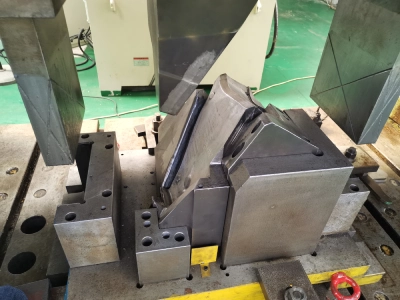
Die engineering correction in sheet metal bending processes represents the most direct and classical physical compensation method. By pre-forming a shape opposite to the anticipated springback (overbend) on the die working surface, the workpiece springs back to its target geometry upon unloading.
The core of this sheet metal bend springback control method lies in the coordinated design of the punch and die. Punch surface modifications typically involve reducing the angle (e.g., machining an 88° die for a 92° product) or increasing the tip radius.
Die design in sheet metal bending processes is more intricate: V-groove width selection must balance material flow (narrow grooves increase stretching and reduce springback) with bending force/surface quality; Optimizing the die shoulder radius and applying ultra-hard coatings (e.g., hard chrome or diamond-like coatings) significantly reduces friction coefficients, promotes smooth material flow, and minimizes asymmetric springback caused by uneven friction. For special cross-sections, specialized systems like gooseneck dies are required.
This method is suitable for medium-to-large volume sheet metal bending of standardized products, offering high stability. Key limitations include high tooling costs, extended lead times, and limited flexibility since each die typically targets specific material, thickness, and angle combinations. Tool wear also causes gradual compensation degradation.
Sheet Metal Bending Process Parameter Optimization—Dynamic Control of Pressure, Speed, and Dwell Time
This sheet metal bend springback control solution achieves online fine-tuning by actively modifying material stress relaxation and plastic deformation levels through real-time adjustment of critical dynamic parameters during the forming instant.
The core of sheet metal bending process parameter optimization is pressure control. Dwell time maintains pressure at the bottom of the stroke, inducing time-dependent creep in the material to relax elastic stresses—particularly effective for materials like aluminum alloys. Overbending involves slightly exceeding the theoretical bottom position of the ram, while coining applies extremely high pressure over a minimal area to induce localized plastic deformation, thereby “locking” the angle.
Speed curve management influences strain rate and thermal effects; slower bending speeds facilitate uniform material flow. Dynamic compensation (“deflection” function) of the multi-axis backgauge (R-axis) during bending actively pushes or pulls material to optimize die-to-material contact.
This method heavily relies on press brakes equipped with precision servo control systems and advanced CNC capabilities. Sheet metal bending process parameters require optimization via Design of Experiments (DOE) for each material-thickness combination, with results influenced by equipment condition and material batch variations.
Sheet Metal Bending Equipment and Sensor-Enabled Technology—High-Precision Adaptive Bending Based on Real-Time Data
This solution represents cutting-edge manufacturing practices. By integrating real-time measurement with closed-loop feedback control, the bending machine automatically senses and instantly corrects every sheet metal bend springback, achieving a closed-loop “sense-decide-act” process.
This system rests on three pillars: First, robust machine rigidity combined with active deflection compensation for the worktable and ram ensures uniform pressure distribution across the entire length of long workpieces.
Second, the core of this springback control method lies in real-time online measurement of the bend angle via high-resolution angle sensors (such as probes directly mounted on the die or non-contact laser sensors), with data fed back to the CNC system. Based on this, the CNC dynamically adjusts the ram’s bottom dead center position (Y-axis compensation) within milliseconds until the target sheet metal bend angle is achieved.
Finally, an intelligent sheet metal bend springback compensation library built within the CNC system can preload compensation curves from historical data models based on initial parameters like material type, thickness, and V-groove width, reducing setup time.
This method is the most effective solution for addressing high-mix, low-volume production demands, high precision requirements, and material variability. Its primary limitations lie in the high initial equipment investment and the demanding technical proficiency required of sheet metal bending process operators and maintenance personnel.
Finite Element Analysis (FEA) Simulation-Based Predictive Control and Continuous Sheet Metal Bending Process Optimization
This system-level solution achieves predictive control of sheet metal bend springback and continuous process optimization by creating and continuously calibrating a virtual digital feedback system spanning design, process planning, production, and inspection.
The process begins with finite element analysis (FEA) simulation during the design phase. Specialized software like AutoForm precisely predicts sheet metal bend springback, directly outputting compensated die surface data or robotic bending paths. Offline press brake programming software (e.g., BySoft, ESB) integrates these simulation results with empirical rules to perform full 3D process simulation and interference checks, generating reliable NC code.
The most critical phase is “data feedback and iteration”: readings from angle sensors during actual sheet metal bending processes and actual mechanical property data from material certificates are continuously fed back into simulation models and compensation databases. This enables predictive models to continuously self-learn and correct, with accuracy improving through production accumulation.
This sheet metal bend springback control method is suitable for industries demanding extremely consistent quality and rapid product iteration (e.g., automotive, aerospace). The primary challenges lie in requiring interdisciplinary team collaboration (process engineering, simulation, IT), complex hardware/software integration, and significant initial establishment costs and time investment.
Are you looking for reliable & cost-effective
China Sheet Metal Fabricators
More than 150,000 OEM metal fabrication products delivered to 5,000+ global buyers.
And benefit from it!
Selection of Sheet Metal Bend Springback Control Solutions
Understanding how suppliers select and integrate different sheet metal bend springback control solutions is more critical than simply inquiring whether they possess a particular technology. In real-world sheet metal bending processes, no single “best solution” exists. Rational selection relies on a clear decision matrix centered on key variables: production batch size and product lifecycle, variability in material mechanical properties, part geometric complexity, and target angle tolerance versus cost constraints.
For instance, in high-volume automotive sheet metal bending for standardized components, mold engineering correction optimized via finite element analysis (FEA) represents an economical and reliable choice. Conversely, for low-volume, high-variety cabinet sheet metal bending, leveraging highly flexible bending centers equipped with real-time angle closed-loop control and an optimized forming parameter library offers the superior path to rapid changeovers and consistent quality.
The key to selecting sheet metal bend springback control solutions lies in quantifying risks: yield strength variations in high-strength steel (HSS) necessitate dynamic compensation (Solution 3 or 4), while precision parts with stringent tolerances must incorporate simulation-based predictive control (Solution 5) into preliminary process validation.
Conclusion
In today’s precision manufacturing environment, effective management of sheet metal bend springback does not pursue complete elimination of this physical phenomenon. Instead, it involves systematically minimizing its impact to a predictable and compensatable range. This requires sheet metal bending manufacturers to move beyond relying on empirical compensation based on fixed parameters. Instead, they must establish an integrated engineering system combining materials science, simulation modeling, and real-time control.
If you require sheet metal bending services, contact us immediately! Supro is a professional sheet metal bending manufacturer. Leveraging advanced equipment, extensive manufacturing experience, and a specialized engineering team, we provide perfect sheet metal bending services to over 3,000 companies worldwide, offering genuine manufacturer quotes.
Supro possesses extensive expertise, technology, and advanced equipment, understanding the demands and standards for sheet metal bending parts across industries including agriculture, healthcare, automotive manufacturing, and aerospace. With 12 distinct sheet metal bending machines, Supro delivers one-stop sheet metal bending services across industries, ensuring high-quality products, expert customer support, and on-time delivery.
For any questions or concerns regarding our sheet metal bending services, contact us immediately. We will proactively meet all your project requirements!