
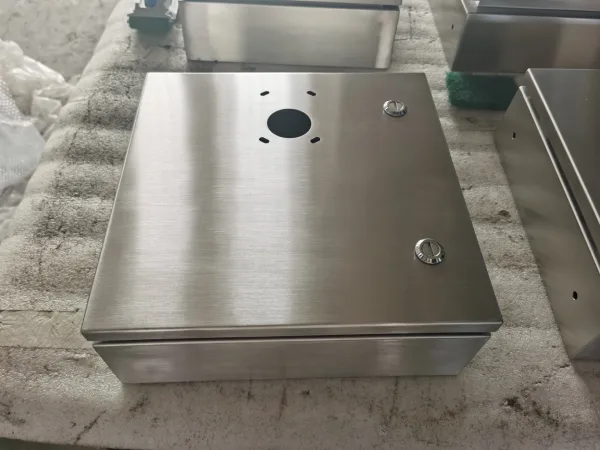
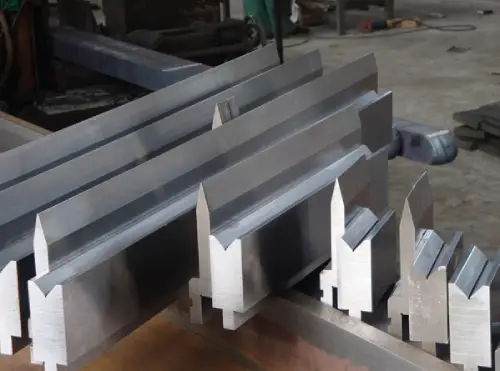
Faced with ever-shrinking delivery cycles, extreme tolerance requirements, and market demands for small-batch, high-customization production, the limitations of traditional sheet metal manufacturing processes are becoming increasingly apparent.
As a professional automated sheet metal fabrication manufacturer, Supro understands that the key to breaking through these barriers lies in integrating fragmented processing steps into a cohesive, adaptive production system. Modern automated sheet metal fabrication transcends mere equipment stacking. It leverages the Digital Thread to establish end-to-end data connectivity from design to delivery. Combined with flexible execution units and real-time decision algorithms, it builds a responsive, quality-consistent intelligent production ecosystem.
The core value of automated sheet metal fabrication lies in addressing two major challenges in high-end manufacturing: exceptional quality consistency and complex supply chain resilience. For instance, through closed-loop process control in laser cutting and adaptive angle compensation systems during bending, Supro maintains batch tolerances within ±0.1 millimeters. Simultaneously, automated production scheduling and material allocation reduce changeover time for multi-product orders by 70%.
This guide will reveal how automated sheet metal fabrication processes can achieve a leap in production efficiency and core competitiveness, exploring three dimensions: system architecture breakdown, key technological process optimization, and application scenarios.
Definition of Automated Sheet Metal Fabrication
In the professional manufacturing sector, automated sheet metal fabrication is not merely replacing human labor with robots. It represents an advanced production system driven by data and featuring highly integrated end-to-end processes. Its core definition lies in seamlessly connecting every stage—from CAD design and CAM programming to production execution and quality control—through a digital thread, ensuring design intent is translated into physical parts with zero loss.
The automated sheet metal fabrication process hinges on three levels of integration: First, vertical information integration enables automatic parsing and instruction issuance for orders, drawings, and machine code. Second, horizontal physical process linkage coordinates operations across units like laser cutting, robotic bending, joining, and surface treatment, with autonomous material flow achieved via AGVs/RGVs or robotic arms. Finally, adaptive control employs technologies like real-time bend angle compensation and closed-loop laser cutting process regulation to proactively ensure consistent quality of automated sheet metal fabrication parts.
As a specialized automated sheet metal fabrication manufacturer, Supro possesses not only advanced sheet metal processing equipment but also the engineering capability to integrate these elements into a stable, high-efficiency production system. This system directly forms a closed-loop by combining programming data, real-time sensor feedback, and process parameter adjustments. It enhances production capacity while ensuring exceptional quality consistency and production traceability, precisely addressing the challenges of modern manufacturing involving small batches and diverse product varieties.
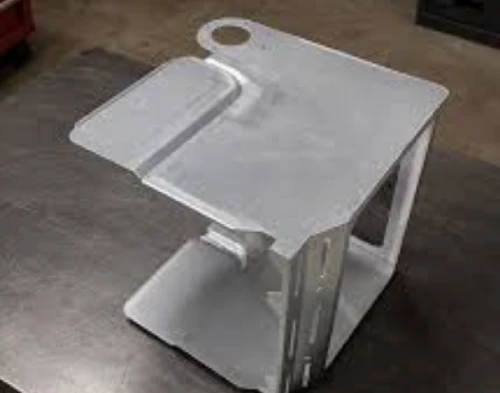
Advantages of Automated Sheet Metal Fabrication
First, it delivers unparalleled quality consistency and traceability. A mature automated sheet metal fabrication process employs closed-loop control systems—such as real-time sensor compensation for laser cutting and adaptive angle correction for robotic bending—to ensure tight tolerance band overlap. This maintains a stable process capability index (Cpk) above 1.33. All process parameters are automatically logged, enabling full digital traceability.
Second, automated sheet metal fabrication delivers predictable lead times and exceptional production resilience. By integrating a Manufacturing Execution System (MES), the entire production flow—from laser cutting and robotic bending to joining and assembly—achieves optimized scheduling and seamless coordination. This directly boosts Overall Equipment Effectiveness (OEE) to over 85% while significantly reducing delivery cycles.
Ultimately, these technological advantages converge into lower total cost of ownership. Automated sheet metal fabrication manufacturers reduce reliance on specialized skilled labor, decrease scrap rates and rework costs, and fundamentally minimize hidden costs and risks from quality fluctuations. Stable delivery performance also reduces the need for supply chain inventory buffers.
Only 4 steps
online custom metal fabrication parts
Contact our experts team and experience the efficiency and economic benefits of digital metal fabrication services.
Upload Design Files
STL , STEP (.stp), IGES (.igs), (.ZIP), or PDF.
Also be a sample or an idea
Quote & Design Analysis
Instant factory quotes and DfM reports, the most reasonable solution.
Manufacturing Begins
Digital processes can initiate order tasks within 24 hours.
On-Time Delivery
Keeping delivery promises, approved by 3000+ Global Company buyers.
Technical Process of Automated Sheet Metal Fabrication
The core value of a mature automated sheet metal fabrication process lies in transforming traditional discrete, labor-intensive operations into a cohesive, self-optimizing production system with transparent data. This process begins with the Digital Thread, ensuring design intent drives production equipment with zero loss.
At the physical execution level, automated sheet metal fabrication integrates laser cutting with real-time process adjustment capabilities, robotic bending with integrated angle measurement and adaptive compensation, and precisely program-controlled joining processes and surface treatment technologies.
Digital Thread
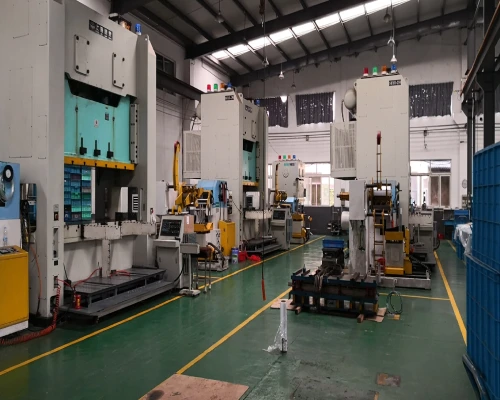
The automated sheet metal fabrication process originates from the Digital Thread. This refers to the fully digital, automated conversion from the customer’s design model to machine tool code. Automated sheet metal fabrication manufacturers utilize feature-based programming technology, enabling CAM systems to intelligently recognize design intent and automatically generate optimized cutting paths, bending sequences, and tooling selection plans.
Simultaneously, virtual commissioning technology fully simulates the entire production cell’s operation before physical production begins. This pre-validates the feasibility of the automated sheet metal fabrication process and mitigates collision risks. This digital front-end ensures “first-time-right” execution, fundamentally eliminating human programming errors and reducing process setup time by up to 80%. It lays the foundation for the precise and efficient execution of all subsequent physical operations.
Laser Cutting Process
Within automated sheet metal fabrication, laser cutting has evolved from an isolated operation into an intelligent “perception-decision-execution” closed-loop system. Modern high-power fiber laser cutting heads integrate multiple sensors to monitor cutting zone temperature, plasma state, and focal position in real time. This data feeds back to the control system, where algorithms dynamically fine-tune power, frequency, gas pressure, and cutting speed to compensate for material batch variations or mitigate thermal deformation effects.
For instance, when cutting plates of varying thicknesses or surface conditions, automated sheet metal fabrication systems automatically adjust piercing parameters and cutting waveforms. This ensures consistently smooth, perpendicular, and slag-free cut edges from the first to the last piece. This adaptive capability is central to achieving high material utilization, exceptional edge quality, and stable production, directly enhancing the precision and consistency of automated sheet metal fabrication parts.
Bending Process
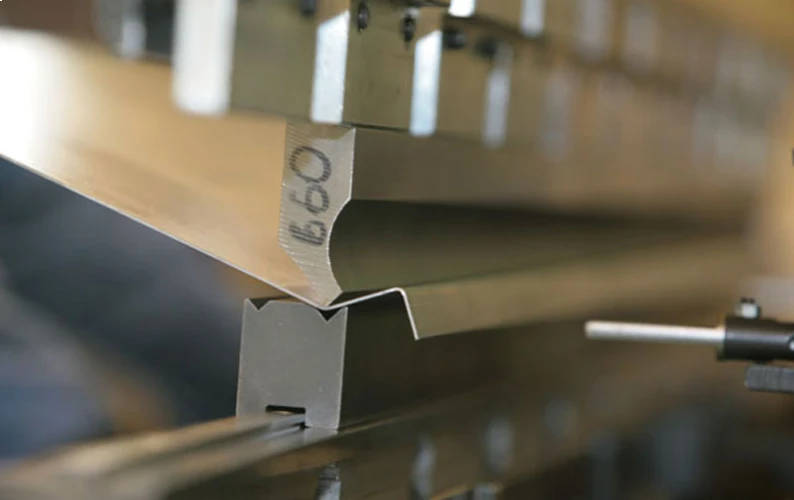
Bending represents one of the most technically complex stages in automated sheet metal fabrication, with its primary challenge being precise springback compensation. Advanced robotic bending cells overcome this challenge through a “sense and adapt” mechanism. During or immediately after the bending operation, non-contact laser measurement probes perform instantaneous, high-precision scans of the bend angle. Measured data is compared against target values, with deviation values instantly fed back to the bending robot or press brake control system.
The automated sheet metal fabrication system employs self-learning algorithms to automatically compensate and correct the press-in depth for subsequent bending operations. This operation, based on precise physical control of the data, ensures stable angular tolerances within ±0.5 degrees for complex multi-bend workpieces. This significantly reduces the need for subsequent correction, guaranteeing the geometric accuracy of batch-produced automated sheet metal fabrication parts.
Joining Technology
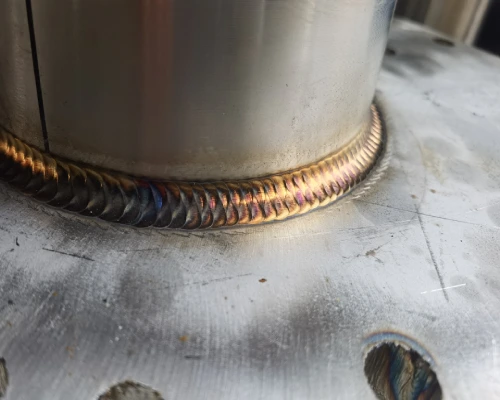
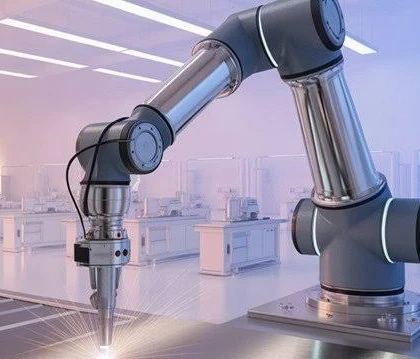
During the assembly and joining stages of automated sheet metal fabrication processes, robotic welding cells achieve millimeter-level repeatability in continuous welds through offline programming and path planning. This ensures consistent heat input for each automated sheet metal fabrication part, thereby minimizing deformation.
In riveting, screw fastening, and press-fitting operations, collaborative robots or specialized automated equipment are widely employed, typically equipped with force sensors. This automated sheet metal fabrication joining technology not only boosts production efficiency but also eliminates the unavoidable quality fluctuations inherent in manual operations. It significantly enhances the structural strength, sealing integrity, and reliability of the overall assembly, meeting the stringent demands of high-end application fields.
Integrated Surface Treatment
Within the complete automated sheet metal fabrication process, surface treatment is a critical step for elevating the final product’s quality and value. This encompasses automated processes such as deburring, grinding, and cleaning. For instance, after cutting or bending, automated sheet metal fabrication parts can be robotically picked and transferred to a workstation equipped with a floating grinding head for consistent edge finishing.
All process parameters—such as grinding pressure, rotational speed, and path—are program-controlled to ensure uniform material removal, preventing over-grinding or under-grinding common in manual operations. For high-end automated sheet metal fabrication parts, automated cleaning units can also be integrated to remove surface oils and particles.
This integrated treatment guarantees highly uniform substrate quality before final surface treatments like painting or plating. It is essential for achieving exceptional appearance and long-lasting corrosion resistance, reflecting the automated sheet metal fabrication manufacturer’s mastery over every process detail.
Quality Control
The automated sheet metal fabrication process fundamentally shifts quality control from “post-inspection” to “process-embedded.” Online measurement technologies, such as machine vision systems and 3D scanners, are deployed at critical stages to perform 100% automated inspection of hole positions, contours, and flatness. Crucially, all automated sheet metal fabrication process parameters (laser power, bending angles, welding currents, etc.) and quality data are collected in real-time and uploaded to a Statistical Process Control (SPC) system.
The automated sheet metal fabrication process system continuously monitors trends in this data. Upon detecting abnormal fluctuations—even before they exceed tolerance limits—it issues early warnings, enabling predictive quality control. This model ensures every defect is instantly identified and traced back to its root process. Consequently, automated sheet metal fabrication manufacturers can provide customers with comprehensive traceability data packages, significantly reducing the buyer’s quality risks and validation costs.
Looking for a reliable custom sheet metal fabrication companies?
Talk To Supro MFG Expert Team
Contact us for competitive ex-factory prices,
and a full range of technical support services.
Industry Applications of Automated Sheet Metal Fabrication
In high-mix, low-volume production sectors—such as specialty industrial equipment and precision instrument manufacturing—the primary challenges lie in frequent changeovers and complex process combinations. The strength of automated sheet metal fabrication processes lies in rapid changeovers driven by the digital thread.
Through offline programming and virtual commissioning, combined with rapid tooling change systems for robots and press brakes, batch changeover times can be compressed from hours to minutes while ensuring first-part-in-batch acceptance. This actively supports product iteration and customization demands.
For high-precision, high-volume production—such as new energy vehicle battery trays or server racks—the core requirements are extreme efficiency and product consistency. Here, the automated sheet metal fabrication process operates at predictable production cadences—from automated sorting and stacking of laser-cut parts, through continuous unmanned robotic bending operations, to 100% quality control via inline vision inspection.
This workflow elevates Overall Equipment Effectiveness (OEE) above 85% while ensuring tens of thousands of automated sheet metal fabrication parts maintain millimeter-level geometric tolerances.
For complex, high-value-added components—such as aerospace structures or medical devices—demands escalate to process traceability and absolute reliability. The automated sheet metal fabrication system meets this requirement through a fully closed-loop data process. Cutting parameters, bending compensation data, and welding records for each automated sheet metal fabrication part are captured and linked, forming a complete digital history.
This not only enables comprehensive quality traceability but also facilitates predictive control through Statistical Process Control (SPC). It ensures compliance with stringent industry certifications like AS9100 or ISO 13485, fundamentally safeguarding the performance and safety of end products.
Conclusion
In summary, the automated sheet metal fabrication process transforms the variables and uncertainties inherent in traditional manufacturing into highly predictable, traceable standardized outputs. From the digital thread to adaptive closed-loop control, it builds not merely a production line, but a manufacturing system capable of continuous optimization and quality assurance.
Supro is a specialized automated sheet metal fabrication manufacturer. Leveraging advanced equipment, extensive manufacturing experience, and a professional engineering team, we provide perfect automated sheet metal fabrication services to over 3,000 companies worldwide, along with genuine manufacturer quotes.
As an industry-leading automated sheet metal fabrication manufacturer, we efficiently deliver diverse products on schedule. From product design and rapid sheet metal prototype fabrication to mass production, we provide expert technical support and exceptional quality. We offer one-stop manufacturing solutions and highly cost-competitive product supply!