


The roll bending process is far from a simple sheet metal forming operation. It is a systematic manufacturing process that transforms flat plates into components with constant or variable curvature through precise control of elastic-plastic deformation. In sectors such as heavy equipment, pressure vessels, and aerospace, the realization of any design intent relies on a deep understanding and precise execution of sheet metal bending. Its core challenges lie in predicting and controlling springback caused by material nonlinearity, while ensuring consistent curvature along the entire workpiece length.
A predictable, repeatable, and efficient sheet metal roll bending process directly impacts project total cost, delivery cycle, and the structural integrity of the final product. Uncontrolled springback, excessive port straightness deviations, or surface defects all lead to secondary processing, material waste, and assembly delays. Therefore, elevating the roll bending process from an experience-dependent craft to a predictable engineering discipline grounded in materials science and process data is critical to supply chain reliability.
This guide systematically analyzes the variables influencing roll bending quality from an engineering principles perspective—from material properties to multi-pass progressive forming strategies and closed-loop roundness correction techniques. We will demonstrate how scientific roll bending process control transforms theoretical designs into components with precise geometries and superior mechanical properties, establishing reliable quality and cost advantages for your projects.
Definition of Roll Bending
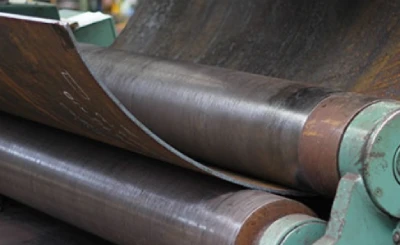
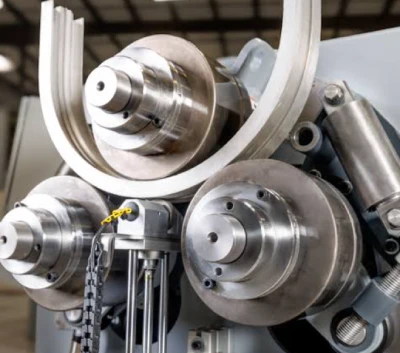
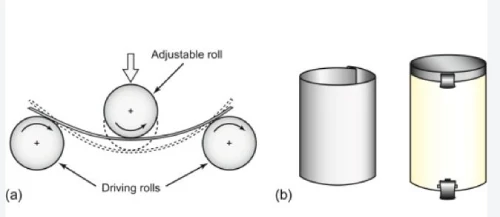
From an engineering mechanics perspective, roll bending is a continuous forming process that precisely controls a metal sheet beyond its yield point into the plastic deformation zone, ultimately achieving permanent curvature. Its essence lies in creating a continuously moving “three-point bending” system through the support of two lower rolls and the active downward pressure of an upper roll. Unlike single-point impact forming, the critical feature of sheet metal roll bending lies in the progressive and controllable accumulation and release of strain.
The coordinated control of the upper roll’s downward pressure (commonly termed “deflection”) and feed rate determines the extension and compression of material inside and outside the neutral layer, thereby precisely controlling the final radius of curvature. A mature roll bending process relies on deep understanding of material rheology curves, friction coefficients, and equipment rigidity. Mathematical models predict and compensate for springback, ensuring forming accuracy and consistency.
Core Advantages of Roll Bending
First, this process guarantees exceptional longitudinal straightness and curvature continuity. When manufacturing long-span components like conveyor rollers or architectural surfaces, roll bending avoids localized distortion, forming smooth, precise arcs that safeguard subsequent assembly accuracy and structural aesthetics. Secondly, sheet metal roll bending minimizes localized stress concentration and surface damage risks. It promotes more uniform fiber flow, prevents microcrack initiation, and better preserves the base material’s mechanical properties.
A mature roll bending process delivers high repeatability and scalability. Once roll bending process parameters—such as lower pressure, pass count, and roll speed—are optimized and validated for specific materials and dimensions, highly consistent batch production becomes achievable. This directly translates to more stable quality, lower scrap rates, and shorter delivery cycles, ultimately providing you with reliable total cost of ownership control.
The Role of Materials Science in the Roll Bending Process
In engineering practice, materials science serves as the fundamental basis for determining process parameters, predicting forming outcomes, and controlling final quality. Each sheet metal roll bending operation essentially guides specific metals to undergo controlled plastic flow along a predetermined path. The chemical composition, heat treatment condition, and microstructure of the material directly define its flow characteristics and limits.
Key Material Properties
The sheet metal roll bending process begins with an accurate interpretation of the material’s mechanical properties. Ignoring these attributes and relying solely on experience leads to unstable roll bending processes and inconsistent springback, thereby increasing calibration time and scrap rates. The material’s yield strength serves as the foundation for calculating the initial bending roll tonnage required. However, deeper material parameters determine forming accuracy and stability:
The strain hardening index (n-value) quantitatively describes the rate at which a material’s resistance to deformation increases during forming, directly influencing the distribution strategy of downward pressure during multi-pass roll bending. The plastic strain ratio (r-value) reveals the material’s anisotropy between in-plane and thickness-direction deformation, whose value directly impacts diameter control and port roundness after barrel forming.
Roll Bending Characteristics of Different Material Categories
Each material exhibits distinct forming behavior and challenges during roll bending due to its unique mechanical and metallurgical properties. Low-carbon steel, with its good ductility and moderate springback, is a common material for sheet metal bending. High-strength steels (e.g., ASTM A572 Grade 50 or higher) demand greater bending forces due to their extremely high yield strength and pronounced work-hardening tendency, with springback angles potentially exceeding twice those of low-carbon steel. The roll bending process must employ larger bend increments and may require intermediate stress relief steps to prevent micro-cracking before achieving final curvature.
Austenitic stainless steel exhibits high toughness and pronounced work hardening rates. Sheet metal roll bending requires a strategy of small increments and multiple passes, with close attention to roller surface finish to prevent scoring. Aluminum alloys possess an elastic modulus only one-third that of steel, resulting in more pronounced springback and sensitivity to surface indentation. This demands precise bending force control and well-maintained equipment.
Titanium alloys and nickel-based alloys are costly materials with an extremely narrow forming window at room temperature. They exhibit extremely high springback during roll bending. Hot roll bending (within a specific temperature range) is typically required to reduce flow stresses, increase ductility, and control springback. Strict monitoring of temperature uniformity is essential to avoid material property degradation or harmful phase transformations.
Only 4 steps
online custom metal fabrication parts
Contact our experts team and experience the efficiency and economic benefits of digital metal fabrication services.
Upload Design Files
STL , STEP (.stp), IGES (.igs), (.ZIP), or PDF.
Also be a sample or an idea
Quote & Design Analysis
Instant factory quotes and DfM reports, the most reasonable solution.
Manufacturing Begins
Digital processes can initiate order tasks within 24 hours.
On-Time Delivery
Keeping delivery promises, approved by 3000+ Global Company buyers.
Systematic Control of Roll Bending Process Parameters
Transforming theoretical designs into precise physical components hinges on the systematic control of process parameters. A professional sheet metal roll bending solution is characterized by its ability to integrate variables such as roll depth, feed rate, and pass count—previously independent settings—into a dynamically interactive, mutually tuned system.
Step-by-Step Control Flow of the Roll Bending Process
A predictable, high-precision sheet metal roll bending process is a step-by-step control system where each phase interlocks. This standardized workflow translates material data and mechanical calculations into precise geometric shapes. It eliminates the uncontrollable variables inherent in traditional methods reliant on operator experience, ensuring high consistency from the first part to mass production.
Pre-Process Calculations
Pre-process calculations form the theoretical foundation for achieving successful roll bending on the first attempt. This begins with precise input of material mechanical properties (such as yield strength, elastic modulus, n-value, and r-value). Combined with the target curvature radius and sheet thickness, key parameters are calculated via bending theory or finite element simulation: theoretical neutral layer position, blanking length, estimated springback, and multi-pass pressing sequence.
For instance, when roll bending high-strength steel sheet metal, calculations must account for its significant work-hardening effects and plan pressure distribution to prevent localized excessive thinning. The digital process card generated during this stage serves as the instruction source for all subsequent operations, establishing the foundation for precision and repeatability in the sheet metal roll bending process.
Equipment Preparation and Calibration
Before inputting roll bending process parameters into the equipment, the mechanical system must be verified as being in a baseline state. This includes calibrating the parallelism of the roll shafts on three-roll or four-roll bending machines using precision gauges, typically requiring an error tolerance of ≤0.05mm/m. Any misalignment directly causes taper or spiral defects in the rolled structural components. Simultaneously, calibrating the hydraulic system’s pressure and displacement sensors is critical. These sensors form the basis for converting theoretical downward pressure into precise physical motion, preventing batch-related issues caused by equipment conditions.
End Pre-bending
End pre-bending is the decisive step determining the quality of the longitudinal seam area in the cylinder body. On symmetrical three-roll plate bending machines, each end of the plate has a straight section approximately half the distance between the centers of the lower rolls that cannot be directly bent by the upper roll.
A professional sheet metal bending process employs dedicated pre-bending dies or utilizes the side roll assist function of four-roll equipment to pre-form both ends. The curvature radius of the pre-bend must be slightly smaller than the target radius to compensate for springback effects during subsequent synchronized roll bending. Improper execution of this step will cause the cylinder end port roundness to exceed tolerances, creating problems for subsequent welding.
Main Roll Bending
Main roll bending constitutes the core stage of multi-pass progressive forming. Rather than pressing to the target depth in a single operation, this process sequentially increases the downward force of the upper roll across multiple passes according to a pre-calculated sequence, accompanied by reciprocating feed of the workpiece.
For instance, the first pass may achieve 60% of the theoretical depth, with subsequent passes progressively reducing the increment. This roll bending strategy evenly distributes strain, effectively manages springback, and prevents defects like sharp edges. For materials sensitive to work hardening, such as stainless steel, multi-pass forming also reduces cracking risks.
Closed-Loop Roundness Correction
As the workpiece nears closure, the closed-loop roundness correction phase begins. At this stage, multi-point measurements using an inner or outer diameter gauge identify roundness deviations (e.g., ovality). Operators then apply minute localized pressure corrections based on measurement data.
On modern CNC equipment, sheet metal roll bending enables digital measurement and automatic compensation via laser scanners. Closed-loop rounding elevates geometric precision from millimeter to 0.01mm levels, ensuring roll-bent structural components meet stringent application requirements—such as energy storage battery housings and sealed electrical cabinets.
Analysis of Interactive Effects in Roll Bending Process Parameters
Process parameters do not operate independently but exist within a highly coupled system. Understanding their interactive effects is crucial for optimizing the roll bending process. Core variables include: upper roll downward pressure (ΔS), lower roll center distance (L), feed rate (V), and number of passes (N). For instance, in sheet metal bending, the downward force ΔS directly determines the bending moment, but its effect is modulated by the lower roll center distance L: a larger L requires a greater ΔS to achieve the same bending effect, while simultaneously increasing the straight edge length.
The feed rate V in roll bending impacts production efficiency and surface quality. Excessively high V may cause scratches when processing high-strength steel and slightly alters the material’s flow stress due to strain rate effects. The most complex interplay of roll bending process parameters occurs in the allocation of pass count N and ΔS per pass. For materials with significant springback, increasing N while reducing ΔS per pass extends processing time but enables more precise tracking of the material’s hardening curve. This achieves superior dimensional control and reduces residual stresses.
Looking for a reliable custom sheet metal fabrication companies?
Talk To Supro MFG Expert Team
Contact us for competitive ex-factory prices,
and a full range of technical support services.
Key Quality Indicators (KQI) for Roll Bending Process
KQI transcends simple dimensional compliance, representing a set of quantifiable engineering specifications and traceable production data. Geometric accuracy serves as the most intuitive and fundamental dimension for evaluating roll bending processes. Key metrics include: roundness/cylindricity, straightness of generatrix, consistency of target curvature radius, port straightness, and flatness.
Material integrity is the intrinsic guarantee of performance and reliability. A successful sheet metal roll bending operation must preserve or enhance the material’s inherent properties while altering its geometry. Relevant KQIs include: surface quality, thickness uniformity/thinning rate control, material defects, residual stress, and distortion levels.
Process and data form the foundation for predictability and continuous improvement in sheet metal bending. Relevant Key Quality Indicators include: first article acceptance rate, process capability index (Cpk), springback prediction accuracy, etc. Therefore, a rigorous KQI system shifts quality assurance for the roll bending process from the final inspection point to the entire process lifecycle. It objectively evaluates a roll bending manufacturer’s capability to transform drawings into high-performance, high-reliability components.
Conclusion
In summary, successful sheet metal roll bending in modern manufacturing has evolved from a craft heavily reliant on operator experience into a predictable engineering discipline grounded in materials science, mechanical modeling, and data-driven closed-loop control. If you require roll bending services, contact us immediately! Supro is a professional roll bending manufacturer. Leveraging advanced equipment, extensive manufacturing experience, and a specialized engineering team, we provide perfect bending services to over 3,000 companies worldwide, offering genuine manufacturer quotes.
We possess deep expertise, technology, and advanced equipment, understanding the demands and standards for sheet metal bent structural components across industries including agriculture, medical, automotive manufacturing, and aerospace. Supro operates 12 distinct sheet metal bending machines, delivering one-stop sheet metal bending services for any industry while ensuring high-quality products, professional customer service, and on-time delivery.
If you have any questions or concerns about our sheet metal bending services, contact us immediately. We will proactively meet all your project requirements!