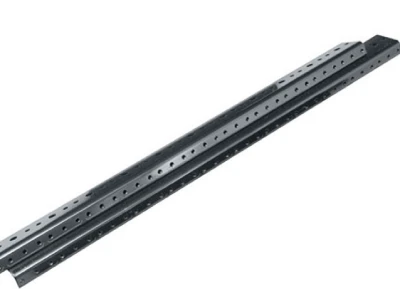

As enterprise data centers rapidly transition to high-density computing, the mechanical demands placed on infrastructure hardware have increased dramatically. Today, standard server rack rails are no longer merely simple mounting brackets, but critical load-bearing structural components.
When deploying 4U enterprise-class servers or heavy-duty UPS battery backup equipment, if the design yield strength of metal server rack rails is insufficient, deflection will inevitably occur under continuous static and dynamic stress. This sagging is rarely a design flaw—rather, it is a direct manufacturing defect.
For procurement professionals, purchasing substandard hardware can lead to jammed sliding mechanisms, extended maintenance downtime, and serious risks to expensive IT assets. Typically, these load-bearing failures occur when uncertified manufacturers reduce the specifications of custom server rack rails by substituting substandard 1.5-millimeter steel for the required 2.0-millimeter high-strength steel. As experts in custom sheet metal fabrication, our engineering team regularly analyzes and corrects these specific material compromises.
This article provides an in-depth analysis of the mechanical principles of yield stress and explains in detail why specifying certified SPCC steel is a key and reliable method for preventing deflection in precision server rack rails during heavy-load applications.
Mechanical Principles of Deflection in Server Rack Rails
Structural deflection occurs when the load from heavy IT equipment exceeds the inherent elastic limit of the metal. Evaluating any metal server rack rails requires analyzing the specific bending moments and stress distributions to determine when temporary deflection will evolve into irreversible structural failure.
Understanding the Difference Between Yield Strength and Tensile Strength
When analyzing material specifications, procurement teams often mistakenly prioritize tensile strength (UTS) over yield strength. However, tensile strength merely represents the stress required to cause complete fracture of the metal. In data center environments, precision server rack rails rarely fracture; instead, they typically undergo plastic deformation.
Yield strength defines the exact stress threshold at which a metal undergoes permanent bending and loses its original structural shape. If the applied load exceeds this elastic limit, the server rack rail will experience permanent sagging, causing the sliding mechanism to jam and resulting in the misalignment of expensive server enclosures.
For heavy-duty server rack rails, mechanical engineers must rigorously evaluate their yield point—rather than their breaking point—to ensure that the structural integrity of IT cabinets remains unaffected throughout their service life.
The Impact of High-Density IT Loads on Server Rack Rails
Modern 4U enterprise-class servers and bulky UPS battery backup units place enormous mechanical stress on the installation infrastructure. While static load testing evaluates the basic load-bearing capacity of server rack rail systems, the true engineering challenge lies in dynamic loads.
When technicians pull out high-density server enclosures for maintenance, a significant cantilever effect occurs. This action shifts the center of gravity forward, thereby concentrating bending moments exponentially on the front mounting brackets and the extended rails. If custom server rack rails have insufficient yield strength or inappropriate sheet metal thickness, this concentrated point load will cause the metal to yield downward.
To manufacture reliable metal server rack rails, it is essential to calculate these worst-case dynamic stress distributions—rather than relying solely on static weight—to prevent catastrophic sagging.
Primary Causes of Yield Failure in Server Rack Rail Systems
When custom server rack rails experience irreversible yield failure under load, the root cause is rarely environmental factors. Instead, these failures stem directly from critical manufacturing compromises: specifically, the specification of uncertified steel grades and the use of steel plates that are insufficient in thickness.
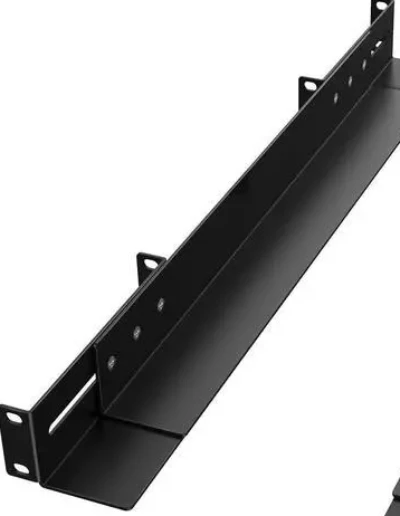
Substandard Steel Grades and Material Compromises
To significantly reduce manufacturing costs, unreliable suppliers often substitute certified industrial-grade steel with lower-grade commercial alloys. This covert material compromise severely compromises the structural integrity of precision server rack rails. Substandard steel grades typically suffer from inconsistent carbon content and uneven metallurgical properties, making the yield strength across the entire steel plate difficult to predict.
When subjected to the sustained weight of high-density IT enclosures, these areas of localized weakness become the exact points where metal server rack rails begin to undergo plastic deformation. For mission-critical infrastructure, engineers must never rely on speculative or unverified material specifications.
To prevent catastrophic failure, it is essential to ensure that every custom server rack rail is manufactured from certified SPCC or high-strength galvanized steel, thereby mathematically guaranteeing that its basic yield threshold is sufficient to withstand the rigors of a data center environment.
Insufficient Sheet Metal Thickness of Server Rack Rails
The actual thickness of sheet metal blanks is mathematically closely related to their bending strength. A common and critical manufacturing error is reducing sheet metal specifications to cut material costs. For example, replacing the required 2.0 mm (No. 14) steel sheet with a 1.5 mm (No. 16) alternative severely compromises the core stiffness of metal server rack rails.
According to structural engineering principles, as material thickness decreases, the stiffness of metal profiles—particularly their moment of inertia—decreases exponentially rather than linearly. Consequently, even a slight reduction in the thickness of precision server rack rails will result in a significant decrease in their overall load-bearing capacity. When supporting heavy UPS systems, this reduced cross-sectional area cannot safely distribute dynamic stresses.
To prevent sagging, strictly ensuring a minimum thickness of 2.0 mm is absolutely non-negotiable for any production batch of heavy-duty server rack rails.
Are you looking for reliable & cost-effective
China metal fabrication manufacturer
More than 150,000 OEM metal fabrication products delivered to 5,000+ global buyers.
And benefit from it!
Advanced Sheet Metal Solutions for Heavy-Duty Server Rack Rails
To mitigate yield failure issues, a two-pronged approach is required during the manufacturing process. By combining high-quality, certified alloys with optimized bending geometries, we meticulously design each custom server rack rail to maximize its structural moment of inertia, ensuring uncompromising rigidity even under extreme IT loads.
Selecting Premium Cold-Rolled Steel (SPCC) and Galvanized Steel for Server Rack Rails
At Supro MFG, we strictly use premium cold-rolled steel (SPCC) or high-strength galvanized steel to design and manufacture every heavy-duty server rack rail. Unlike hot-rolled steel, SPCC undergoes rigorous room-temperature processing, which not only refines the metal’s grain structure but also significantly increases its inherent yield strength through work hardening. This process ensures strict dimensional tolerances, which are critical for manufacturing reliable metal server rack rails that integrate seamlessly with complex chassis hardware.
For environments requiring exceptional corrosion resistance, galvanized steel provides outstanding structural durability while maintaining fundamental rigidity. By sourcing raw materials exclusively from certified steel mills, we ensure that the mechanical properties of every precision server rack rail remain consistent, effectively eliminating localized metallurgical weaknesses—which often lead to catastrophic sagging under high-density loads.
Optimizing Bending Radii and Structural Profiles for Server Rack Rails
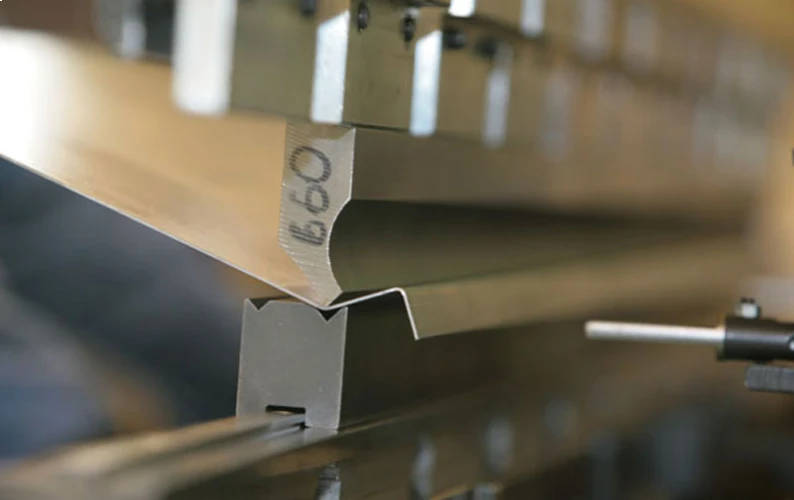
Material selection alone cannot completely prevent deflection; the geometric design determines the final stiffness of heavy-duty server rack rails. Our tooling engineers utilize advanced precision bending machines to optimize bend radii and form complex, multi-fold cross-sections, such as reinforced C-channels or flanged U-sections. This strategic folding process results in an exponential increase in the structural moment of inertia along the Z-axis, maximizing load-bearing capacity without unduly increasing material weight.
Furthermore, server rack rails that are precision-formed with precisely calculated bend radii prevent microcracks from forming along stress lines during manufacturing, thereby maintaining the metal’s internal yield strength.
By incorporating integrated stiffening ribs into the metal profiles, custom server rack rails can safely distribute the concentrated cantilever forces generated by extended 4U servers, ensuring zero downward deflection over many years of deployment.
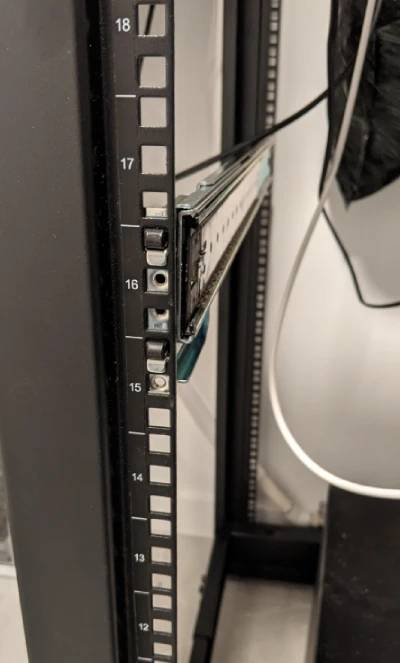
Rigorous Quality Assurance and Material Verification for Server Rack Rails
Exceptional engineering design must be backed by empirical validation. To ensure the yield strength of every precision server rack rail, our factory has implemented a closed-loop quality assurance process. This rigorous oversight process covers every stage, from the verification of incoming metal materials to final dynamic load testing.
The Critical Role of Material Test Certificates (MTCs)
In the global supply chain, visual inspection alone is insufficient to determine the metallurgical integrity of steel billets. For the production of each batch of custom server rack rails, requesting and verifying the Material Test Certificate (MTC) is a non-negotiable procurement standard. The MTC directly provides measured data from the steel mill, detailing the batch’s precise carbon content, tensile parameters, and—most importantly—the exact yield strength.
This document ensures that the metal material meets the required industry standard thresholds before any bending operations begin. By tracing the metallurgical history of the metal server rack rails, engineers can use mathematical calculations to eliminate the risk of premature sagging caused by substandard alloy quality.
For procurement professionals, the MTC provides essential liability protection, ensuring that the manufactured precision server rack rails can consistently support dense enterprise loads without structural failure.
Internal Load Testing and Dimensional Inspection of Server Rack Rails
Theoretical yield strength calculations must always be validated through rigorous physical testing. Prior to shipment, meticulously designed custom server rack rails undergo rigorous internal dynamic and static load simulation tests that accurately replicate high-density data center environments.
By applying a concentrated load equivalent to a fully extended 4U chassis, we measure precise deflection curves to ensure that the safe deformation of the metal material remains within the elastic limit at all times.
Furthermore, the manufacture of precision metal server rack rails requires meticulous dimensional inspection. Our technicians use a coordinate measuring machine (CMM) to verify bend radii, flange angles, and structural straightness, with tolerances accurate to the micrometer level. This rigorous dimensional control permanently prevents jamming in the sliding mechanisms.
Ultimately, these comprehensive load and dimensional validations ensure that every precision server rack rail shipped from our facility operates flawlessly in real-world applications, avoiding costly downtime in IT infrastructure caused by maintenance.
Partnering with Supro MFG for Custom Server Rack Rails
To address yield strength deficiencies, simply submitting CAD files to a standard machining shop is far from sufficient; this requires early collaboration with a specialized manufacturing partner.
At Supro MFG, our engineers conduct a comprehensive Design for Manufacturability (DFM) review before any steel is cut. We actively evaluate your load requirements, recommend precise SPCC sheet thickness specifications, and optimize bending dies to maximize the Z-axis moment of inertia. This forward-thinking engineering approach effectively prevents server rack rail systems from sagging in the field.
By integrating ISO-certified quality control, rigorous MTC validation, and precision bending, we bridge the gap between theoretical design and actual structural integrity. Partnering with a specialized manufacturer ensures that every heavy-duty server rack rail you deploy delivers uncompromising reliability and an engineering-optimized, long service life for your mission-critical IT infrastructure.
Conclusion
To prevent deflection in custom server rack rails, an uncompromising approach to metallurgy and structural engineering is ultimately essential. At Supro MFG, we completely eliminate yield failure through rigorous verification of Metal Test Certificates (MTCs), optimized bending processes, and precise load testing.
Supro is a specialized custom server rack rail manufacturer. Leveraging advanced equipment, extensive manufacturing experience, and a professional engineering team, we have provided flawless custom server rack rail services to over 3,000 companies worldwide and offer genuine manufacturer quotes.
We deliver a wide range of products efficiently and on time. From product design and rapid sheet metal prototype fabrication to mass production, we provide professional technical support and exceptional quality.
We offer one-stop manufacturing solutions and highly cost-competitive product supply! For inquiries regarding technical specifications, customized project solutions, or OEM partnerships, please contact Supro immediately. Our professional engineering team is always ready to provide you with tailored application solutions.