In the steel sheet stamping industry, cracking in DP600 high-strength steel remains a critical quality concern for engineers. Our previous article, “Analysis of Cracking Causes in DP600 Steel Sheet Stamping,” identified that over 72% of cracks originate from edge defects and material properties. This article takes a practical approach to explore how process optimization during steel stamping can mitigate these failure risks.
As a professional steel sheet stamping manufacturer, Supro’s production-line data indicates that over 60% of stamping cracks can be effectively prevented by adjusting stamping speed, optimizing lubrication strategies, and precisely controlling the feeding system. This paper systematically addresses the three most common cracking points, presenting a comprehensive solution—from optimizing servo press cycle times to implementing in-line vision inspection—to help you understand critical process control parameters. Whether you are evaluating the quality systems of steel sheet stamping services or seeking deeper insights into the forming limits of DP600 steel, this document provides verifiable technical references.
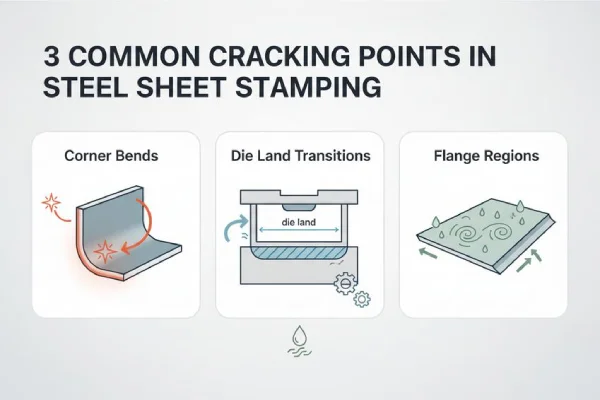
3 Common Cracking Points In Steel Sheet Stamping
In steel sheet stamping, cracks rarely show up out of nowhere. Most failures trace back to a few repeat trouble spots in sheet metal stamping lines. From tight corners to worn dies and dry flanges, steel, sheet, and stamping forces interact fast. Getting these under control keeps steel sheet stamping stable and cuts scrap in metal stamping production.
Corner Bends: Stress Concentration in Mechanical Press Operations
In steel sheet stamping, corner bends are classic weak links, especially with DP600 steel. The material’s high tensile strength increases springback, while its low elongation limits small-radius tensile deformation—pushing the forming process beyond the material’s forming limit curve (FLC). In die design, small punch radii exacerbate stress concentration; improper clearance control leads to edge overload. In mechanical stamping operations, excessive tonnage causes unpredictable strain rate increases, while minor misalignment exacerbates edge overload.
In high-volume steel sheet stamping, even a 0.5 mm radius change can mean the difference between clean bends and scrap piles. supro mfg tunes bend radius, press force, and lubrication together so steel stamping parts hold up under real production speeds.
Die Land Transitions: Progressive Stamping Wear Patterns
Trouble builds slowly in the die land area during progressive stamping.
Early stage:Minor tool wear at land edges.Clearance stays within tolerance.
Mid cycle:Uneven transitions form.Burr height increases.
Late cycle:Offset clearance changes material flow.Edge cracking appears in steel sheet stamping blanks.
Key control points in metal stamping lines:
Track wear depth.
Log burr growth.
Adjust process control windows.
When wear patterns shift, stamping defects multiply. supro mfg applies scheduled inspection intervals and regrinds to keep steel sheet stamping consistent across long runs.
Flange Regions: Lubrication and Material Flow Failures
Flange cracks in steel sheet stamping often stem from friction and flow. During drawing, insufficient lubrication generates localized heat and restricts material draw-in, forcing excessive thinning at flange edges. For DP600 material, this thinning concentrates strain until tearing occurs during final forming stages.
Effective control requires triple verification: inspecting coating integrity, validating die oil film thickness, and balancing draw depth with stamping speed.When stamping failures show up at flanges, it is usually not bad luck. It is friction math. Dial in lubrication and flow, and steel sheet stamping lines run smoother, with fewer cracks and less downtime.
online custom metal fabrication parts
Only 4 steps
Contact our experts team and experience the efficiency and economic benefits of digital metal fabrication services.
Upload Design Files
STL , STEP (.stp), IGES (.igs), (.ZIP), or PDF.
Also be a sample or an idea
Quote & Design Analysis
Instant factory quotes and DfM reports, the most reasonable solution.
Manufacturing Begins
Digital processes can initiate order tasks within 24 hours.
On-Time Delivery
Keeping delivery promises, approved by 3000+ Global Company buyers.
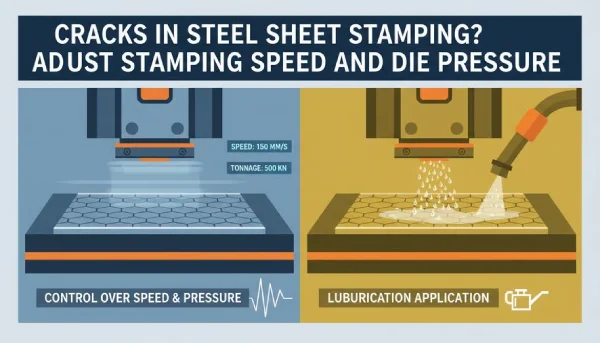
Frequent Cracking in Steel Sheet Stamping? Adjust Press Speed and Die Pressure
When part cracking repeatedly occurs during steel sheet stamping, the most direct corrective measures involve adjusting speed and pressure. Servo presses feature programmable pressure curves to reduce initial impact force during contact and maintain a stable deformation rate during peak deformation—directly controlling the strain rate that triggers edge fractures. Tonnage calibration ensures load matches actual material thickness, preventing both insufficient plastic deformation and edge overload.
Cycle Time Optimization on Servo Presses to Reduce Cracking
In steel sheet stamping, controlling Stamping Speed on a Servo Press changes everything. Research from Ohio State University confirms that optimizing servo press ram speed directly reduces fracture rates in advanced high-strength steels.
During steel sheet stamping, programming the servo curve to decelerate at initial contact maximizes impact mitigation while maintaining constant speed during peak deformation to control strain rate. For DP600 material, forming speeds require a 10-20% reduction compared to mild steel, with edge elongation monitored during tooling trials.
As a specialized steel sheet stamping manufacturer, we validate these parameters through production data—systematically slowing stamping cycles significantly reduces microcrack formation. This scientifically optimized speed approach ensures both production efficiency and the reliability of steel sheet stamping parts.
Press Tonnage Calibration: Balancing Tool Steel and Die Springs
Too much Press Tonnage during steel sheet stamping overloads Tool Steel and flattens Die Springs. Too little causes uneven Material Deformation.
Key balance points:
Match Stamping Force to sheet thickness.
Check spring compression height weekly.
Calibrate load sensors quarterly.
Small tweaks matter. In sheet metal stamping, edge stress builds fast. supro mfg runs digital tonnage mapping to keep steel sheet forming stable across long production runs.
Sheet Thickness (mm) | Recommended Tonnage (kN) | Spring Preload (mm) |
1.0 | 800–1000 | 3–4 |
1.5 | 1200–1500 | 4–5 |
2.0 | 1600–2000 | 5–6 |
Lubrication Strategies for Fine Blanking and Crack Prevention
In fine blanking and steel sheet stamping, Lubrication is not just about shine; it protects edges.
Die Lubricant Selection:Viscosity matched to speed.Additives for Wear Resistance.
Fine Blanking Control:Uniform film thickness.Reduced friction lowers tensile pull on cut edges.
Surface Finish Monitoring:Inspect burr height.Measure edge hardness after forming.
When friction drops, Crack Prevention improves. Steel sheet stamping runs smoother. Tool life stretches. At supro mfg, controlled lubrication systems keep every steel sheet stamping batch consistent, from prototype to mass production.
Are you looking for reliable & cost-effective
China Sheet Metal Fabricators
More than 150,000 OEM metal fabrication products delivered to 5,000+ global buyers.
And benefit from it!
Full Process Control and Inspection for Steel Sheet Stamping
In precision steel sheet stamping, process control extends beyond the press itself—it begins with coil feeding and continues through to final verification. When stamping DP600 steel, precise synchronization between the straightener, feeder, and die protection system is essential to prevent surface cracking. As a specialized steel sheet stamping manufacturer, Supro integrates real-time monitoring systems to ensure every stamped part meets tolerance requirements before entering mass production.

Coil Feeders and Straighteners: Pre-Feed Metal Flow Control
Cracks in steel sheet stamping often originate before the die closes—making coil handling the primary defense. For DP600 steel stamping, precise pre-feed control is essential: lateral deviation of the coil feeder must be maintained within ±0.5 mm to avoid edge stress, while calibrating coil tension between 8–12 kN prevents surface stretching or wrinkling. Production data confirms that crack risk increases significantly when sheet flatness deviation exceeds 1.2 mm/m.
In practice, we integrate real-time monitoring systems for material camber and consistency prior to high-speed production runs—ensuring every stamped part originates from optimally conditioned material. This front-end control is fundamental to guaranteeing the reliability of steel sheet stamping services.
Parameter | Recommended Range | Crack Risk Level |
Roll tension | 8–12 kN | Low |
Feed speed | 12–18 m/min | Medium |
Flatness deviation | ≤1.2 mm/m | High above limit |
Stripper Plate Maintenance to Avoid Surface Fissures
A worn Stripper plate is bad news for steel sheet stamping. Surface drag builds up, and tiny lines turn into Surface fissures fast.
Keep it practical:
Follow a strict Maintenance schedule
Measure Die clearance every shift
Check Wear and tear on guide pins
Maintain steady Lubrication flow
In high-speed steel stamping, even small plate wear changes pressure distribution. That uneven force stretches the steel sheet during release, leading to micro-cracks across the panel edge.

In-Line Visual Inspection and Tolerance Verification in High-Volume Runs
In mass steel sheet stamping, speed hides defects. Solid Visual inspection and tight Tolerance verification keep high-volume production from drifting off spec.
Inspection Layer:Camera-based Automated inspection.Laser edge scanning.Real-time Defect detection alerts
Process Control Layer:Live Process monitoring dashboard.Statistical drift alarms.Feedback loop to press control
Quality Gate:Final Quality control sampling.Dimensional comparison to CAD.Crack mapping database
Surface crack width limit: 0.05 mm
Edge fracture tolerance: ≤2% thickness
Panel warp: under 1.5 mm
When steel sheet, stamping pressure, and inspection data sync together, scrap drops sharply. supro mfg integrates automated inspection directly into steel sheet stamping lines, catching issues before a full pallet goes bad.
Looking for a reliable custom sheet metal fabrication companies?
Talk To Supro MFG Expert Team
Contact us for competitive ex-factory prices,
and a full range of technical support services.
FAQs about Steel Sheet Stamping
Why do DP600 steel sheets crack during steel sheet stamping?
Cracks often erupt at trimmed edges, especially in progressive stamping lines running at high cycle time. The tension builds step by step.
Progressive stamping → strain accumulation at each station
Transfer stamping → strain divided across stages, lower edge stress
Poor lubrication or worn punch and die → friction spikes, micro-tears
Excess press tonnage → sharp stress peaks near flanges
DP600’s dual grain structure (martensite + ferrite) work hardens fast. Tensile strength rises, ductility falls, and edge fractures appear where formability is already stretched thin.
What should buyers review in edge crack and defect data?
Edge cracks carry financial tension—scrap rates climb, schedules slip.
Key checkpoints during supplier audits:
Defect detection reports showing crack density along sheared edges
Tolerance verification for dimensional accuracy after bending or fine blanking
Evidence of laser trimming or fine blanking instead of rough mechanical cuts
Records of die maintenance and tool steel replacement cycles
When over 70% of failures cluster near edges, attention turns to shearing quality, material flow control, and die sets alignment. Good visual inspection alone is not enough; data from non-destructive testing tells the real story.
How do progressive and transfer presses affect scrap and reliability?
Progressive stamping suits high-volume cold rolled steel parts but demands tight die protection systems and lubrication control. Transfer stamping reduces localized stress in deep drawing of stainless steel or aluminum alloys, though handling must prevent surface marks.Behind every steel sheet stamping line, the tension lies between speed, formability, and the quiet discipline of maintenance.
Factor | Progressive Stamping | Transfer Presses |
Cycle time | High | Moderate |
Strain distribution | Accumulated | Separated |
Scrap reduction | Sensitive to tool wear | More stable |
Automation level | Coil feeders, straighteners | Part handling systems |
Summary
Supro is a professional steel sheet stamping manufacturer. Leveraging advanced equipment, extensive manufacturing experience, and a specialized engineering team, we provide perfect steel sheet stamping services to over 3,000 companies worldwide, offering genuine manufacturer quotes.
As a leading metal fabrication manufacturer, we efficiently deliver diverse products on schedule. From product design and rapid sheet metal prototype fabrication to mass production, we provide expert technical support and exceptional quality. We offer one-stop manufacturing solutions and highly cost-competitive product supply!