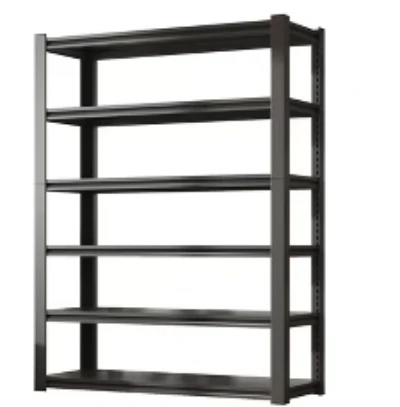


In warehousing and industrial facilities, the structural integrity of heavy duty shelves is directly linked to operational safety. However, a common yet often underestimated failure mode is the seepage of red rust from the interior of the uprights, lap joints, or bolted connections several months after installation.
This is far from merely a cosmetic issue. This phenomenon—known as exfiltrative rust—is a clear sign of crevice corrosion, indicating insufficient cathodic protection and localized electrochemical activity.
The root cause is often hidden in the fabrication process of heavy duty shelves—the Faraday cage effect caused by electrostatic powder coating leads to coating deficiencies in narrow areas, or the use of bare steel substrates without galvanized protection in humid environments. Understanding this failure mechanism is the first step in selecting a sheet metal manufacturing partner with in-depth process knowledge and the ability to implement proactive DFM (Design for Manufacturing) controls.
Analysis of the Causes of Red Rust Seepage at the Joints of heavy duty Shelves
The root cause of seepage-type rust at the joints of heavy duty metal shelving stems from the Faraday cage effect, which causes the powder coating to fail to provide shielding in narrow areas, thereby driving the macro-electrochemical corrosion process of the steel in the gaps.
The “Faraday Cage Effect” in the Surface Treatment of heavy duty Shelves
Electrostatic powder coating relies on a high-voltage electric field to drive charged powder particles to deposit onto grounded workpieces. However, in the narrow gaps, deep cavities, or overlapping areas of custom heavy duty shelves, the electric field distribution becomes severely distorted, forming shielded zones—a phenomenon known as the Faraday cage effect.
This physical phenomenon prevents charged powder particles from effectively penetrating and depositing on these concealed surfaces, resulting in coating defects or thicknesses far below specification requirements. These microscopic exposed points, unprotected by the coating, become vulnerable areas where corrosion initiates preferentially, directly compromising the integrity of the coating as a physical barrier.
Electrochemical Driven Corrosion in Humid Environments
When coating protection fails and the exposed steel is subjected to a humid environment, a complete electrochemical corrosion circuit is established within the gaps. The exposed areas act as anodes and undergo oxidation (Fe → Fe²⁺ + 2e⁻), while the surrounding steel with well-coated surfaces acts as a cathode due to its higher potential, forming a macroscopic corrosion cell.
Under the influence of the electrolyte (condensate or moisture), iron ions continuously leach from the anode zone and undergo hydrolysis to form acid, further accelerating the local corrosion rate. This self-catalytic process causes pitting at the seams of heavy duty shelves that penetrates deep into the base material and leads to the continuous outward seepage of red rust products.
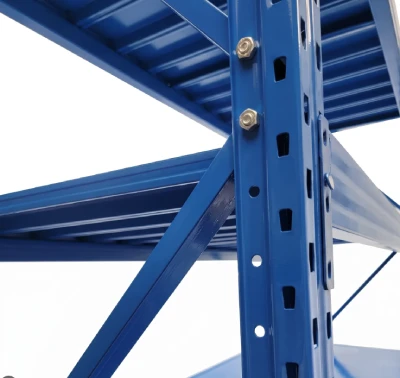
Design Oversights in Custom heavy duty Shelves: Neglected Ventilation and Drainage
Tubular columns, enclosed profiles, or tightly overlapping joints inherently create capillary gaps and enclosed cavities in the structure. If drainage and ventilation requirements are not considered during the design phase of heavy duty metal shelving, these areas will actively “breathe” and condense moisture during temperature cycles (such as diurnal temperature variations), causing the interior to remain in a state of high humidity saturation over the long term.
Standing water and trapped moisture cannot drain naturally and continue to serve as a source of electrolytes, causing the corrosion process to proceed uninterrupted. This design flaw significantly reduces the structure’s tolerance to its operating environment and is one of the key factors contributing to premature internal corrosion in heavy duty shelves, even under non-harsh conditions.
Solution: Systematic Interventions in the Materials, Manufacturing Processes, and Design of heavy duty Shelves
Controlling corrosion at the joints of heavy duty shelves requires systematic engineering interventions ranging from base material selection and coating process optimization to structural detail design; furthermore, these interventions must be integrated early in the manufacturing process.
Material Selection for heavy duty Shelves: Application of Pre-galvanized Steel
For heavy duty metal shelving subjected to long-term exposure to humid environments or periodic condensation, upgrading the base material from standard hot-rolled steel to pre-galvanized steel (such as G90/Z275 grade) is a fundamental corrosion prevention strategy.
The pre-galvanized coating provides cathodic protection for scratched or cut edges through a sacrificial anode mechanism, effectively inhibiting the anodic dissolution of exposed steel in crevices. This approach does not rely on perfect coverage of subsequent coatings; instead, it provides the structure with an independent, continuous metallic protective barrier, significantly extending service life under harsh operating conditions.
Optimized Control of the Powder Coating Process
Given the geometric complexity of custom heavy duty shelves, the powder coating process requires calibration of process parameters to overcome the Faraday cage effect. This includes adjusting the voltage, current, and atomization air pressure of the electrostatic spray gun to optimize the kinetic energy and mass-to-charge ratio of the powder particles, thereby enhancing their ability to penetrate deep cavities.
Supro’s production experience shows that manual touch-up spraying from multiple angles or the use of a reciprocating spray gun system specifically designed for complex cross-sections can significantly improve coating coverage in narrow areas.
Process validation requires destructive sampling to measure coating thickness and adhesion (cross-cut test) in hard-to-reach areas.
Corrosion-Resistant Design of Structural Details
Eliminating corrosion conditions at the design stage is the most cost-effective intervention. For the tubular uprights of Heavy Duty Shelves, drainage holes with a diameter of at least 6 mm should be provided at the bottom, and convection vents should be designed at the top or at the shelf positions to break up enclosed cavities and promote air circulation.
In addition, pre-applying sealant or using tape to isolate lap joints or bolted connections can effectively prevent moisture ingress caused by capillary action. These design details fundamentally reduce the geometric driving forces of crevice corrosion without significantly increasing manufacturing costs.
Only 4 steps
online custom metal fabrication parts
Contact our experts team and experience the efficiency and economic benefits of digital metal fabrication services.
Upload Design Files
STL , STEP (.stp), IGES (.igs), (.ZIP), or PDF.
Also be a sample or an idea
Quote & Design Analysis
Instant factory quotes and DfM reports, the most reasonable solution.
Manufacturing Begins
Digital processes can initiate order tasks within 24 hours.
On-Time Delivery
Keeping delivery promises, approved by 3000+ Global Company buyers.
Upfront Supply Chain Control for heavy duty Shelves: Supro MFG’s Engineering Practices
To eliminate corrosion risks in heavy duty metal shelving, material validation, process specifications, and design reviews must be integrated into the supply chain control process at an early stage, rather than relying on pre-shipment inspections.
Proactive Intervention During the Design Phase (DFM)
The corrosion resistance of custom heavy duty shelves should be incorporated into Design for Manufacturability (DFM) reviews as early as the CAD modeling stage. At project inception, Supro MFG’s engineering team systematically reviews drawings for gaps, dead corners, and enclosed cross-sections, and proactively recommends adding drainage holes or modifying joint configurations to mitigate the Faraday cage shielding effect.
At the same time, based on the temperature and humidity conditions of the application environment, they propose alternative solutions such as pre-galvanized substrates or specific coating systems. This upfront intervention transforms corrosion prevention from “passive inspection” to “proactive design,” reducing the risk of structural failure in custom heavy duty shelves at the source.
End-to-End Quality Traceability
Eliminating corrosion risks in heavy duty shelving relies on a complete data chain from the arrival of raw materials at the factory to the shipment of finished products. Based on the ISO 9001 system, Supro MFG retains Material Test Certificates (MTCs) for each batch of pre-galvanized steel sheets and records the coating weight.
During the powder coating process, we continuously monitor the curing oven temperature curve and film thickness, and conduct destructive sampling tests in hard-to-reach areas. All inspection records (including cross-cut adhesion test and salt spray test reports) are archived as traceable batch quality documentation, providing customers with a complete chain of evidence to ensure that the corrosion resistance of each product is verifiable and reproducible.
Conclusion
The seepage of red rust at the joints of Heavy Duty Shelves is not an isolated, accidental error in a single process step, but rather a systemic engineering defect resulting from the interaction of material selection, physical limitations of the coating process, and structural design.
The failure of coating shielding caused by the Faraday cage effect drives an autocatalytic process of crevice corrosion in humid environments, ultimately manifesting as premature failure within months of installation. Effectively preventing this issue requires integrating corrosion protection strategies into the design phase—providing inherent protection through pre-galvanized substrates, optimizing coverage in hard-to-reach areas through process calibration, and eliminating corrosive conditions through drainage and ventilation design.
Founded in 2004, Supro is a professional manufacturer of heavy duty shelving. With extensive manufacturing experience, a strong technical team, and comprehensive manufacturing resources, we have provided one-stop heavy duty shelving manufacturing solutions to more than 3,000 companies worldwide.
At Supro, we have a dedicated quality control team, experienced QC personnel, and scientific quality control processes to ensure that products undergo rigorous inspection, meet specified technical standards, and allow for the traceability of defective products at any time. These processes include: raw material inspection, mold inspection, equipment inspection, process sampling, packaging inspection, and final inspection. We conduct QA (Quality Assurance) to ensure products meet the necessary tolerances and quality standards.
We guarantee on-time delivery of all products. From product design and rapid prototype fabrication to mass production, we provide professional technical support and exceptional quality. For technical consultations, project design proposals, product specifications, or inquiries regarding OEM partnerships, please feel free to contact our engineering team at any time.