




An exceptional CNC sheet metal bending process is not merely a bending operation, but a predictable engineering system that begins with Design for Manufacturability (DFM), extends through precision programming, and is ultimately realized through rigorous process control. The core value of CNC sheet metal bending lies in systematically reducing Total Cost of Ownership (TCO) through a First-Time-Right manufacturing philosophy.
Technically, cost overruns and delivery delays often stem from inadequate design-stage estimation of material springback characteristics and bending sequence interference. A mature CNC sheet metal bending system relies on dynamic K-factor calculations, springback compensation models based on material yield strength, and precise mastery of die stress distribution. These factors directly determine the consistency, assembly accuracy, and long-term reliability of CNC sheet metal bending components.
This article systematically outlines the professional CNC sheet metal bending process flow—from Design for Manufacturability (DFM), process planning, and tooling selection to quality control—aiming to optimize component performance and reduce costs.
The Core Position of Precision CNC Sheet Metal Bending in Modern Manufacturing
The precision CNC sheet metal bending process has evolved from a supplementary forming technique into a strategic component within the modern value chain. Its pivotal role stems from its ability to seamlessly bridge digital design with physical high-precision forming.
Technical Definition and Scope of CNC Sheet Metal Bending
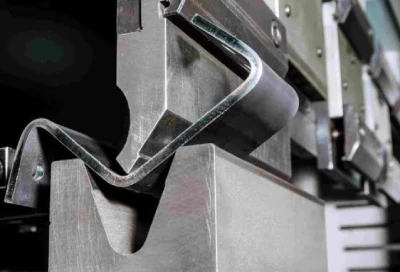
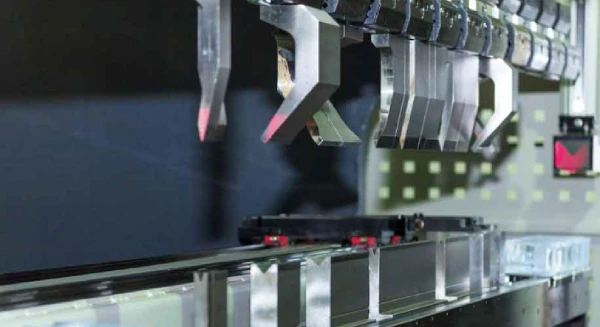
Professional CNC sheet metal bending is not merely a bending operation. It involves precise programming and synchronized control of the multi-axis movements of press brakes through computer numerical control systems. This process encompasses the downward stroke depth of punches, die selection, and the precise positioning of back gauges along the X, R, and Z axes. Key technical metrics for CNC sheet metal bending include repeat positioning accuracy (typically requiring better than ±0.025mm) and angular consistency.
This signifies that a CNC sheet metal bending manufacturer’s process capability directly determines whether components meet specified geometric tolerances and ensures dimensional stability in mass production. A mature sheet metal bending system translates design intent into repeatable bending instructions, serving as the critical manufacturing link between CAD models and qualified finished products.
From 2D Sheet to 3D Structure: The Value Evolution of CNC Sheet Metal Bending Processes
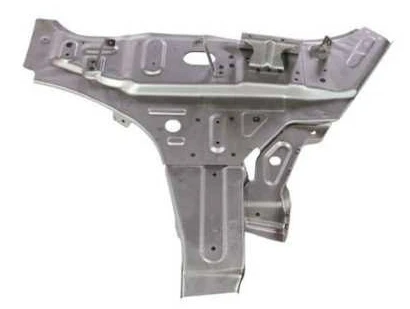
Traditional bending processes heavily relied on operator skill and specialized fixtures. The value evolution of modern CNC sheet metal bending lies in its ability to efficiently and precisely transform two-dimensional flat plates into complex three-dimensional load-bearing structures or aesthetic components. At the core of this evolution is “integrated data flow”: automatically extracting bend lines from 3D models, calculating developed patterns with springback compensation, and generating optimized bending sequences.
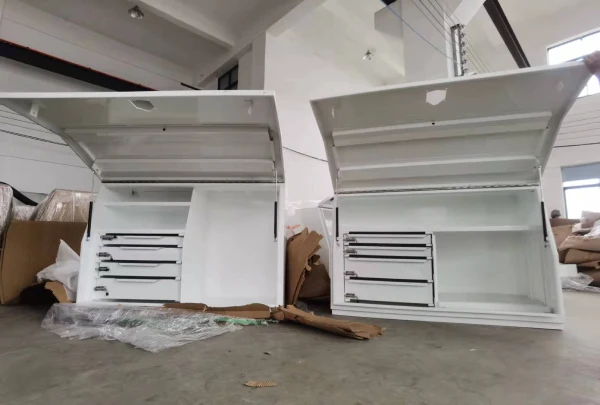
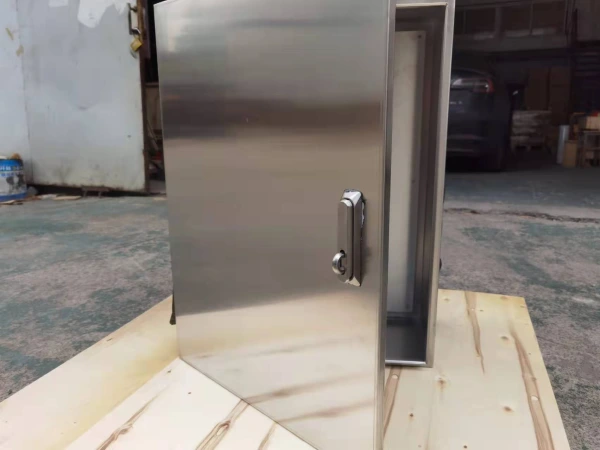
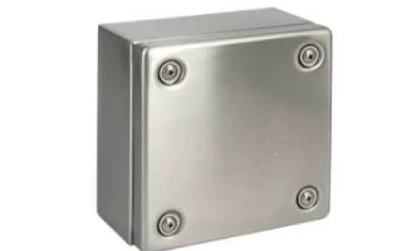
The value of this digitally driven process lies in significantly improving “first-pass yield,” reducing trial-and-error costs and delivery times. It makes customized, small-batch CNC sheet metal bending economically viable while ensuring consistency and reliability in strength, assembly compatibility, and appearance for critical components like cabinets, brackets, or enclosures.
Phase One: Design Optimization and Design for Manufacturability Analysis of CNC Sheet Metal Bending
The success of the CNC sheet metal bending process begins with deep collaboration during the design phase. Effective Design for Manufacturability (DFM) serves as the primary defense against cost overruns and schedule delays. This requires engineers to accurately predict the impact of material properties and geometric constraints on the final formed part during the design stage.
Correlation Between Material Properties and CNC Sheet Metal Bending Performance
In CNC sheet metal bending, material selection directly dictates process parameters and final forming quality. Key considerations lie in mechanical properties: yield strength determines required bending tonnage, while elongation and anisotropy influence minimum bend radius and springback magnitude.
Take common 304 stainless steel and 6061 aluminum alloy as examples: their differing strain hardening indices directly cause significant variations in sheet metal bending springback angles. As a professional sheet metal bending manufacturer, Supro sets bending parameters based on actual performance data from material certificates (not merely grade designations). This effectively controls uncertainties during plastic deformation across different materials, ensuring dimensional consistency.
Geometric Core Constraints of the CNC Sheet Metal Bending Process
A reliable CNC sheet metal bending process is built upon strict geometric design rules. These rules are not limitations but engineering guidelines ensuring manufacturability and structural integrity.
Core constraints include: The minimum inner bend radius must prevent excessive stretching of outer fibers that could cause cracking; the bend flange height must exceed the lower die opening width by a specified ratio to ensure adequate clamping force; adjacent bends require tool interference consideration, typically resolved by calculating shared bend lines or adding process notches.
For example, for CNC sheet metal bending of material thickness T, the minimum flange height is generally recommended to be no less than (V/2) + T, where V is the lower die opening width. Understanding and applying these rules proactively is crucial to avoiding costly design changes during production and ensuring timely project delivery.
Precision Allowance in CNC Sheet Metal Bending Processes: Engineering Compensation for Springback and Overbending
Springback represents the most critical precision challenge in CNC sheet metal bending, referring to the elastic recovery of material after unloading. Professional process control does not eliminate springback but involves its precise prediction and compensation. This relies on comprehensive analysis of material elastic modulus, yield strength, and bending radius, achieved through overbending technology.
Advanced CNC systems integrate angle sensors to monitor and fine-tune upper die travel in real-time during bending, enabling closed-loop control. A more fundamental strategy involves incorporating dynamically validated K-factors or Y-factors—rather than fixed empirical values—during the design unfolding calculation phase. This achieves precision allowance at the drawing stage. This engineering pre-compensation capability distinguishes ordinary machining from high-precision CNC sheet metal bending.
Are you looking for reliable & cost-effective
China metal fabrication manufacturer
More than 150,000 OEM metal fabrication products delivered to 5,000+ global buyers.
And benefit from it!
Phase Two: CNC Sheet Metal Bending Process Planning and Data Preparation
The process planning and data preparation phase serves as the pivotal stage determining the efficiency and precision of the entire CNC sheet metal bending process. This phase translates design intent into repeatable manufacturing instructions, with its core focus on establishing a data-driven, highly predictive workflow.
CNC Sheet Metal Bending Flat Pattern Calculation: Achieving Precise Unfolding Beyond K-Factor
Precise flat pattern calculations form the foundation for ensuring final component dimensions meet design tolerances. Professional CNC sheet metal bending process planning must transcend simplified methods relying on fixed K-factors (the ratio of the distance from the neutral layer to the bend inner surface to material thickness). For high-strength materials or complex multi-bend operations, empirical K-factors often lead to significant cumulative errors.
The key to CNC sheet metal bending flat pattern calculation lies in accurately predicting the neutral layer offset within the plastic deformation zone, which directly impacts the unfolded length. In actual sheet metal bending, Supro dynamically calculates the neutral layer position based on material thickness, bend radius, and grain orientation. Alternatively, it reverse-calibrates a dynamic bend allowance through bending trials to prevent cumulative tolerances.
Optimization Logic for CNC Sheet Metal Bending Sequences
Bending sequence planning directly impacts production efficiency, part quality, and operational safety. An optimized CNC sheet metal bending sequence follows core logic: minimizing workpiece repositioning and flipping while avoiding spatial interference between tools and formed sections. This typically means adhering to the principle of “bending internal features before external contours” and prioritizing bends that are difficult to clamp or position.
The optimization logic must also account for part stability during sheet metal bending, preventing positioning inaccuracies caused by shifts in the center of gravity. Effective CNC sheet metal bending process planning utilizes offline simulation software for virtual validation, proactively identifying potential interference risks. This eliminates production interruption hazards during the programming phase, enhancing Overall Equipment Effectiveness (OEE).
Programming Core: CNC Sheet Metal Bending Command Generation and Optimization
CNC command generation is the critical step converting CNC sheet metal bending process planning into machine-executable actions. Optimized programming involves precise parameter settings for each bend: calculating and setting exact tonnage based on material-die combinations to prevent underload or overload; planning the movement trajectories of the backgauge axes (X, R, Z) to minimize idle travel time; and defining appropriate slow-down points for different material thicknesses to enhance bending angle accuracy and protect die surfaces.
Efficient programming also integrates die library management, automatically selects optimal tools, and generates collaborative instructions supporting robotic loading/unloading. Program quality directly determines equipment utilization, changeover speed, and long-term stability of the sheet metal bending process.
Stage Three: Die Selection and Equipment Parameter Setup for CNC Sheet Metal Bending
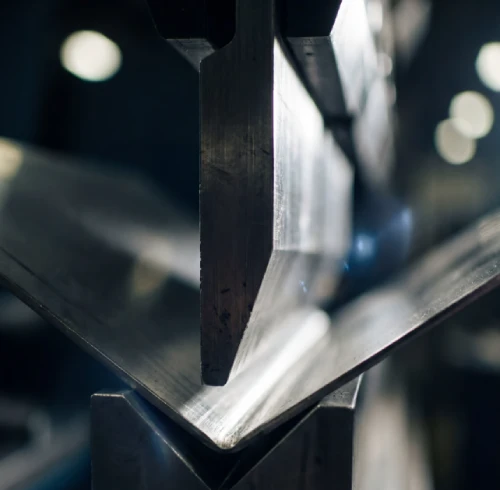
Die selection and equipment parameter setup constitute the critical execution phase in the CNC sheet metal bending process, transforming digital instructions into physical forming. The core objective of this stage is to precisely map validated process planning to specific machine tools and tooling systems, thereby achieving the designed geometric and dimensional tolerances.
CNC Sheet Metal Bending Die Systems: Balancing Precision and Flexibility
Selecting the die system represents a core decision in achieving the equilibrium between precision and cost-effectiveness within the CNC sheet metal bending process. The key lies in configuring the appropriate punch and die combination for specific material thicknesses, bend radii, and part geometries.
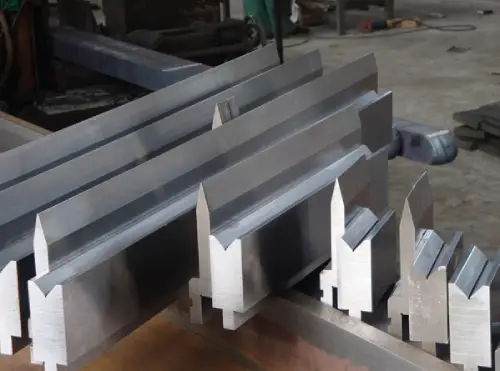
A professional sheet metal bending process mold strategy follows clear rules: The V-die opening width typically adheres to the empirical rule V=8T (where T is material thickness) to ensure sufficient forming space and control required tonnage; the punch tip radius directly determines the workpiece inside radius (IR).
The depth and modularity of a CNC sheet metal bending manufacturer‘s die library are critical. For instance, possessing a complete series ranging from 30° sharp-angle dies to gooseneck dies directly determines the capability to handle complex flanges or box structures. Efficient sheet metal bending units achieve an optimal balance between precision and production flexibility through intelligent die management systems, minimizing die changeover time.
Pressure Calculation and Tonnage Selection for CNC Sheet Metal Bending
Accurate pressure calculation is fundamental to preventing equipment overload, ensuring consistent bending angles, and protecting die life. The required bending force (tonnage) is not an estimate but a precise calculation based on material tensile strength (σb), bending length (L), sheet thickness (T), and lower die opening width (V). The universal formula is: P = (1.42 * σb * L * T²) / V.
A robust CNC sheet metal bending process demands rigorous calculation during process planning, incorporating approximately 20% safety margin to account for batch variations in material properties. Supro maintains detailed tonnage parameter tables for different material grades (e.g., AISI 1018 vs. 304 Stainless), ensuring stringent control of the CNC sheet metal bending process.
Tooling and Auxiliary Devices for CNC Sheet Metal Bending
To reliably form complex parts, professional CNC sheet metal bending processes typically rely on customized tooling and auxiliary devices. These are not standard dies but are designed to address specific process challenges, such as special lifters for forming closed sections, correction blocks to prevent springback, or specialized fixtures providing temporary support during multi-pass bending.
In automated production lines, well-designed micro-tabs and bridging structures enable parts to remain connected to the sheet metal body until final sheet metal bending completion, facilitating continuous robotic handling. The proficiency in applying these fixtures directly determines the process boundaries, assembly precision, and overall manufacturing costs of CNC sheet metal bending.
Looking for a reliable custom sheet metal fabrication companies?
Talk To Supro MFG Expert Team
Contact us for competitive ex-factory prices,
and a full range of technical support services.
Phase Four: CNC Sheet Metal Bending Production Process Control and Quality Assurance
Production process control and quality assurance are critical to ensuring CNC sheet metal bending process outputs meet design specifications. This phase centers on converting process stability into quantifiable quality data through standardized inspection procedures and real-time monitoring systems.
Standardized Process for CNC Sheet Metal Bending Part Verification
To guarantee the reliability of CNC sheet metal bending outputs, a data-driven standardized First Article Inspection (FAI) process must be established. This process strictly follows inspection plans (AS9102 format or equivalent documents) based solely on 3D models, performing full-dimensional measurements of Critical Characteristics.
This includes, but is not limited to: verifying overall contours and hole positions using laser scanners or high-precision coordinate measuring machines (CMMs); and precisely measuring CNC sheet metal bending angles and post-springback compensation values using dedicated angle gauges or offline projectors.
Online Process Monitoring and Adjustment for CNC Sheet Metal Bending
The CNC sheet metal bending process relies on real-time online monitoring and dynamic adjustment capabilities to counteract material property fluctuations and environmental variables. Modern CNC bending machines achieve closed-loop control through integrated angle sensors and pressure feedback systems.
During each bending cycle, the system continuously monitors deviations between actual angles and programmed targets, automatically fine-tuning the lower die’s downward position (crown adjustment) or applying compensatory pressure hold to ensure angular consistency. For long workpieces, monitoring multi-point pressure distribution enables indirect assessment of sheet thickness uniformity.
Causes and Countermeasures for Common CNC Sheet Metal Bending Defects
Systematically identifying and resolving common defects is central to continuously improving the CNC sheet metal bending process. Excessive springback, a typical defect, often stems from material yield strength exceeding preset values or excessively wide lower die openings. Countermeasures include updating programs with strength compensation algorithms or switching to narrower V-shaped lower dies.
Surface scratches may result from insufficient mold surface finish or excessive feed rates during CNC sheet metal bending. Solutions involve specifying mold surface roughness standards (Ra values) and optimizing axis motion speed curves.
Warpage deformation is frequently caused by uneven internal stress release due to improper bending sequence, necessitating sequence optimization through finite element analysis (FEA).
In practice, supro has established a defect knowledge base incorporating root cause analysis (RCA) and corrective actions (CA), ensuring stable execution of the sheet metal bending process.
Conclusion
The ultimate goal of establishing a robust CNC sheet metal bending manufacturing system is not merely to produce qualified parts, but to build a predictable, repeatable production ecosystem with continuous improvement capabilities. The core of this system lies in seamlessly integrating four stages—design optimization, process planning, tooling engineering, and process control—to form a closed-loop data flow.
If you require sheet metal bending services, contact us immediately! Supro is a professional CNC sheet metal bending manufacturer. Leveraging advanced equipment, extensive manufacturing experience, and a specialized engineering team, we deliver flawless sheet metal bending services to over 3,000 companies worldwide, backed by genuine manufacturer pricing.
As an advanced CNC sheet metal bending manufacturer, we possess deep expertise, technology, and cutting-edge equipment. We understand the demands and standards for sheet metal bending components across industries including agriculture, healthcare, automotive manufacturing, and aerospace. Supro operates 12 distinct bending machines, delivering one-stop sheet metal bending services across industries while ensuring high-quality products, expert customer support, and on-time delivery.
If you have any questions or concerns about our CNC sheet metal bending services, contact us immediately. We will proactively meet all your project requirements!