In manufacturing sectors such as automotive, high-end electronics, and new energy, progressive stamping has evolved into a critical system engineering solution. It addresses the challenges posed by increasingly complex part geometries, rising material strengths, and persistent cost pressures.
This technology not only enables efficient production but also achieves a precise balance among design intent, material potential, and manufacturing costs. As a technology integrating multiple operations—such as blanking, bending, and drawing—within a single progressive stamping die, the core of this process lies in transforming metal coil directly into thousands of highly consistent precision parts through precise strip feeding and coordinated station design.
For professional procurement personnel, a deep understanding of the progressive stamping process enables more accurate assessment of suppliers’ engineering depth and production reliability, thereby building more resilient, cost-effective supply chains. This article analyzes from a practitioner’s perspective how progressive die stamping transforms a coil of metal strip into thousands of consistent, high-quality parts through integrated die design and process control, helping you seize core competitive advantages in complex procurement decisions.
Core Principles of Progressive Stamping
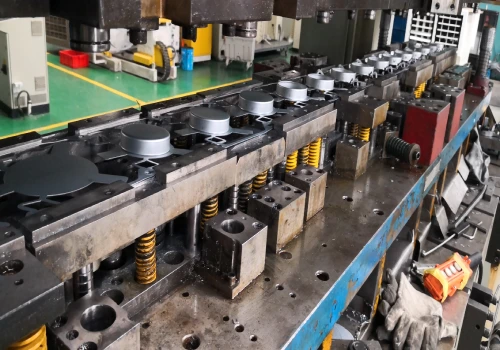
The essence of progressive metal stamping lies in integrating multiple discrete stamping operations into a single, continuous automated production unit. Its core principle transcends simple process stacking; instead, it employs a precision progressive stamping die to simultaneously perform all operations—including blanking, forming, and bending—at different stations as the metal strip advances through the feeding system with precise step-by-step movement. Each press stroke produces a complete part, fundamentally differing from traditional single-die production.
Moreover, the progressive stamping process directly determines production cycle times, material utilization (achieved through optimized nesting), and dimensional consistency of progressive precision metal stampings. This highly integrated progressive metal stamping solution treats dies, materials, and process control as an inseparable system, forming the engineering foundation for achieving exceptional quality, predictable costs, and stable delivery schedules.
Advantages of Progressive Stamping
Compared to single-station production, a well-designed progressive metal stamping solution utilizes highly integrated dies to simultaneously complete multiple operations within a single stamping cycle. This approach delivers three decisive advantages: First, it delivers exceptional overall cost efficiency. By integrating multiple operations within a single die, the progressive stamping process virtually eliminates time losses and secondary errors caused by part handling and repositioning between individual operations, significantly boosting Overall Equipment Effectiveness (OEE). Simultaneously, precise strip layout design maximizes material utilization, directly reducing raw material costs.
Second, the progressive stamping process ensures unparalleled quality consistency and traceability. Parts are formed in a single, controlled die system in one operation, fundamentally reducing quality fluctuations caused by process transitions. This endows each progressive precision metal stamping with high repeatability, laying the foundation for subsequent automated assembly while fully meeting stringent Statistical Process Control (SPC) and product traceability requirements.
Finally, progressive metal stamping exhibits exceptional compatibility with automation. The complete production flow—from coil to finished product—facilitates seamless integration of robotic loading/unloading, in-line inspection, and data collection systems, providing an ideal foundation for achieving stable, unmanned mass production.
Progressive Stamping Die
In the progressive stamping process, the die is far from a passive tool—it serves as the core and central hub of the entire manufacturing operation. Essentially a highly integrated precision mechanical system, its design complexity and manufacturing quality directly determine the upper limits of process efficiency, quality stability, and total lifecycle cost. The value of an exceptional progressive stamping die lies in its ability to translate complex part geometries, variable material properties, and high-speed, stable production cycles into a reliable, predictable physical motion sequence.
Structural Analysis of Progressive Stamping Dies
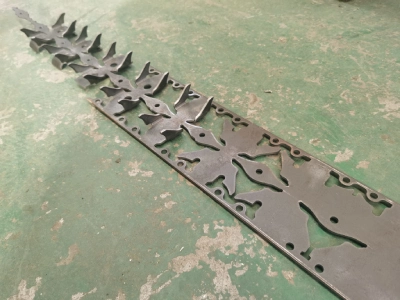
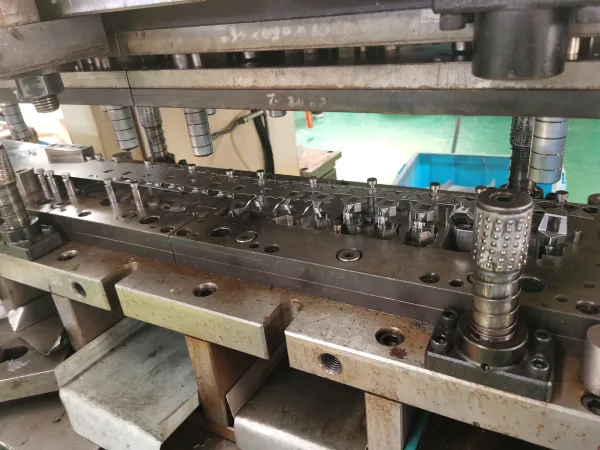
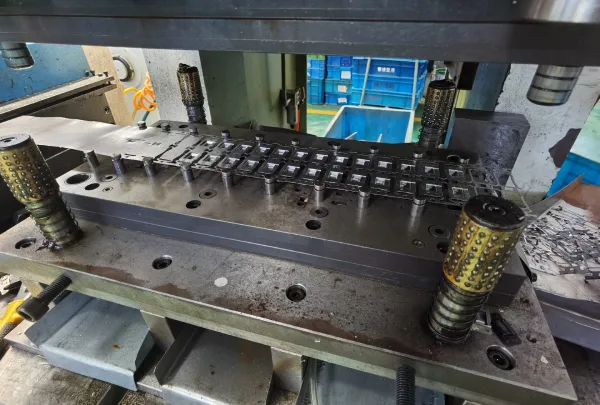
The core architecture of a high-precision progressive stamping die is based on a multi-layer die plate system. High-precision guide pins and ball bearing bushings form a rigid motion guidance framework, serving as the physical foundation for maintaining micron-level alignment accuracy between upper and lower dies during high-speed stamping.
Within this framework, functional modules are arranged according to process sequence: the alignment pin mechanism activates first after each feed to precisely correct strip position—the initial checkpoint for dimensional accuracy of progressive stamping parts. Carbide inserts in the blanking unit ensure clean cut surfaces, while bending and forming stations rely on die clearance and ejection mechanisms to control material flow and springback.
Supro, a specialized progressive stamping manufacturer, employs modular design by treating wear-prone punches and forming inserts as independent standard components. This approach not only drastically reduces downtime during maintenance but also enables progressive stamping dies to adapt to future product design changes, thereby safeguarding the purchaser’s long-term asset investment.
Design for Manufacturing and Assembly
High-quality progressive stamping dies originate from thorough consideration of manufacturing and assembly during the design phase. Design for Manufacturing and Assembly (DFMA) principles require die engineers to resolve potential production issues at the drawing board stage. This means progressive stamping die designs prioritize standardized components and interfaces to streamline the supply chain and reduce custom machining time.
For instance, decomposing complex shaped punches into several blocks manufactured via standard wire-cutting processes reduces machining complexity and costs while facilitating localized replacement and maintenance. Concurrently, progressive stamping die design must provide clear, unambiguous assembly references and operational clearances, while incorporating necessary lifting and safety devices.
Are you looking for reliable & cost-effective
China metal fabrication manufacturer
More than 150,000 OEM metal fabrication products delivered to 5,000+ global buyers.
And benefit from it!
Progressive Stamping Process
A mature progressive stamping process begins with in-depth digital planning, verifying feasibility through simulation technology and establishing precise process parameter windows. At the physical execution level, it manifests as a highly coordinated production flow that seamlessly integrates raw materials, precision dies, automated equipment, and real-time monitoring. Its core objective is to achieve the optimal balance of quality, production efficiency, and cost control for progressive precision metal stampings across millions of stamping cycles.
Process Planning for Progressive Stamping
Process planning serves as the critical bridge between product design and stable mass production. Its depth and rigor directly determine a project’s total cost, quality level, and delivery risks. This phase extends far beyond simple parameter setting. It begins with in-depth manufacturability validation, using advanced CAE software to simulate the entire progressive stamping process, predicting and eliminating potential forming defects. It further encompasses the scientific matching of material properties and lubricants to ensure smooth progressive metal stamping and extended die life.
Ultimately, the core output of planning is establishing a robust, data-driven core process window. This provides clear parameter boundaries and monitoring benchmarks for presses, feeding systems, and dies. Thus, thorough process planning fundamentally minimizes uncertainties in subsequent production and serves as the foundation for progressive stamping manufacturers to deliver risk-controlled manufacturing solutions to customers.
Feasibility Validation of Progressive Stamping Processes
During the initial planning phase of progressive stamping processes, mold design and process feasibility undergo integrated validation through digital engineering. We employ advanced CAE forming simulation software to conduct virtual testing of the entire progressive stamping sequence. This precisely simulates material flow, predicts potential defects such as cracking, wrinkling, or excessive springback, and enables mold design optimization and refinement prior to physical fabrication.
Material Selection and Lubrication Strategy
Material selection and lubrication strategy form the core of scientific planning, directly impacting the performance and production costs of progressive stamping parts. We precisely select metal grades, conditions, and tolerances based on part functional requirements (e.g., strength, conductivity) and subsequent processes (e.g., welding, painting).
Concurrently, we develop matching lubrication schemes, choosing appropriate lubricant types (e.g., oil-based, synthetic) and application methods. Scientific lubrication effectively controls friction coefficients, reduces progressive stamping die wear, and improves material flow. It is crucial for ensuring the stability of the progressive stamping process and the surface quality of parts.
Establishing the Core Process Window
Establishing a robust “core process window” is key to translating theoretical design into repeatable production. This involves defining and setting optimal values and permissible fluctuation ranges for critical parameters such as press tonnage, slide speed curve, feeding accuracy, and counterweight pressure.
This validated window serves as the benchmark for achieving consistent quality in subsequent mass production of progressive precision metal stampings. In progressive stamping processes, real-time monitoring data must fall within this window to ensure process control. Supro provides customers with clear process window documentation, enabling transparent quality management and meeting SPC requirements.
Progressive Stamping Production Line Operation: From Coil to Finished Product
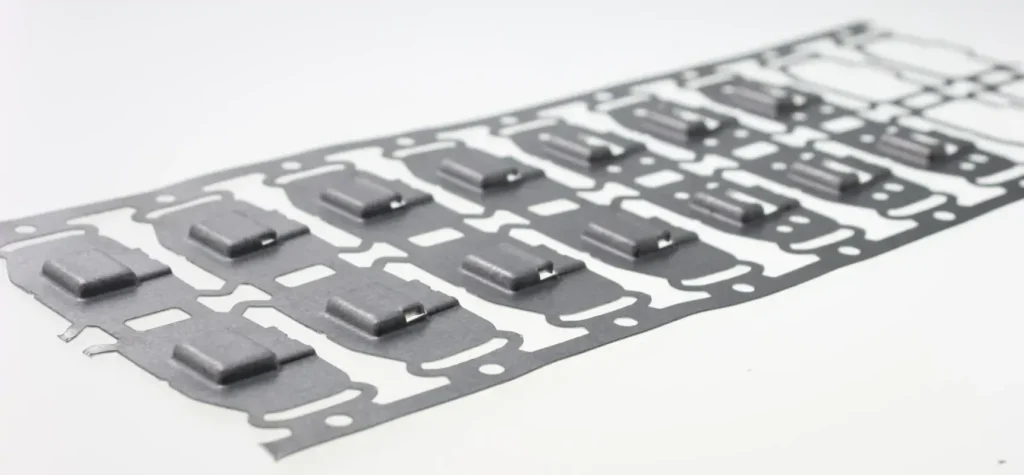
The production line begins with metal coils, which are precisely fed into the progressive stamping die through uncoiling, straightening, and a high-precision servo feeding system. This feeding accuracy represents the first technical threshold for ensuring part consistency. Subsequently, within the multi-station die, each stamping cycle synchronously completes multiple operations—such as blanking, bending, and drawing—progressively forming the material with precision during dynamic processing. Finally, finished parts and scrap are automatically separated and processed, creating a continuous, closed production flow.
Loading and Feeding System
The stable operation of the production line begins with a highly automated material handling and feeding system. This system comprises an uncoiler, a straightener, and a high-precision servo feeder. Servo motors drive the feed rollers to push the metal strip into the progressive stamping die inlet at a pre-set constant pitch.
Its repeat positioning accuracy must typically be controlled within ±0.02 millimeters, serving as the first safeguard to minimize cumulative part errors. Stable and reliable feeding forms the cornerstone of an efficient, trouble-free progressive stamping process, directly impacting production continuity and Overall Equipment Effectiveness (OEE).
Multi-Station Coordinated Stamping Cycle
Within the progressive stamping die, the multi-station coordinated stamping cycle constitutes the core process. During each press stroke, operations such as blanking, bending, and drawing are synchronously completed at different stations distributed throughout the die.
The die’s guidance system (e.g., ball guide pins) ensures precise upper-lower die closure at high speeds, while built-in alignment pins perform final micro-adjustments to the strip just before stamping. This integration of multiple operations into a single cycle is fundamental to achieving the exceptional productivity and part consistency of progressive metal stamping. Each stroke produces a complete part, enabling unparalleled mass production capability.
Finished Part Separation and Scrap Handling
At the final station, finished parts are separated from the strip skeleton via blanking or cutting. Efficient scrap handling systems are critical: continuous mesh or sheet scrap is severed by dedicated cutters and automatically conveyed and collected via pipelines or conveyors.
This ensures a clean and safe work area, preventing progressive stamping die damage or production interruptions caused by scrap accumulation. In progressive stamping processes, smooth separation and discharge pathways not only enhance efficiency but also reflect the maturity of production line design, minimizing unplanned downtime.
Online Quality Monitoring in Progressive Stamping Processes
In progressive stamping processes, the core of quality assurance has shifted from post-production screening to real-time process monitoring. The online quality monitoring system signifies a fundamental transition from “detecting defects” to “preventing defect occurrence.” Moreover, the monitoring system is not merely a standalone device application but an integrated closed-loop control network combining sensor technology, data acquisition, and real-time analysis.
Application of Process Monitoring Technology
Online monitoring begins with direct sensing of the production process. The key lies in integrating a tonnage monitor onto the press, continuously recording the force-displacement curve for each progressive metal stamping operation.
Any abnormal fluctuations—such as increased punching force due to progressive stamping die wear or peak values caused by foreign material—are instantly identified and flagged. Simultaneously, high-resolution industrial cameras capture rapid images of progressive stamping parts after critical stations, automatically detecting surface defects like burrs, scratches, or missed punches.
Implementation of Statistical Process Control (SPC)
Process monitoring generates vast amounts of data, and statistical process control serves as the core tool for transforming this data into preventive decision-making.
By periodically sampling critical dimensions (e.g., hole diameter, bending angle) and plotting the data on SPC control charts (e.g., Xbar-R charts), we can visually assess whether the progressive metal stamping production process is under statistical control. More importantly, calculating process capability indices enables quantitative assessment of the progressive stamping process’s ability to consistently produce conforming parts, providing customers with objective, data-driven quality assurance.
Data-Driven Adaptive Adjustments
The ultimate goal of online monitoring is to establish a closed-loop “perception-analysis-execution” system. Based on SPC trends and tonnage monitoring data, the system intelligently identifies parameter drift in the progressive stamping process.
For instance, when monitoring detects a gradual increase in blanking force due to progressive die edge wear, the system can automatically trigger preventive maintenance alerts or prompt engineers to fine-tune press settings to compensate for the change. This data-driven adaptive adjustment elevates quality control from reactive correction to proactive prediction and real-time compensation, significantly enhancing the stability and flexibility of progressive metal stamping production while substantially reducing the risk of unplanned downtime and quality-related costs.
Post-Processing, Inspection, and Packaging of Progressive Stamping Processes
Post-processing begins with refining the part’s basic functionality, such as removing microscopic burrs generated during blanking through vibratory finishing or chemical deburring. This is critical for ensuring smooth assembly, operational safety, and compliance with cosmetic standards. Subsequently, progressive precision metal stampings may undergo precision cleaning to remove process oils, or receive surface treatments like plating, passivation, or coating to meet corrosion resistance, conductivity, or decorative requirements.
Subsequent final quality inspection is a critical step. This relies not only on traditional gauges but also on coordinate measuring machines or automated optical inspection systems for full-dimension or high-frequency sampling of key dimensions on progressive precision metal stampings. All data is electronically recorded and linked to production batches, forming a complete traceability file.
Finally, customized packaging based on error-proofing principles—utilizing dedicated dividers or blister trays—ensures progressive stamping parts remain undamaged during transit. Clear labeling of part numbers, batches, and traceability codes enables error-free handover from production line to customer assembly line.
Conclusion
In summary, progressive metal stamping is an economical and efficient process for manufacturing diverse sheet metal components. If you require progressive die stamping services, contact Supro immediately for assistance.
Supro, a progressive stamping manufacturer based in China, leverages exceptional precision stamping technology and manufacturing capabilities to produce standard/custom metal stampings and high-precision components.
Our 2,500-square-meter precision stamping facility houses 80 sets of presses ranging from 6 tons to 1,000 tons, capable of processing materials from 0.005 inches to 5 inches thick and manufacturing stamped parts up to 24 inches wide. Supro ships over 5 million metal stamped parts annually to global buyers, maintaining a 1,000-ton annual production capacity. If you require progressive die stamping services, contact us immediately!