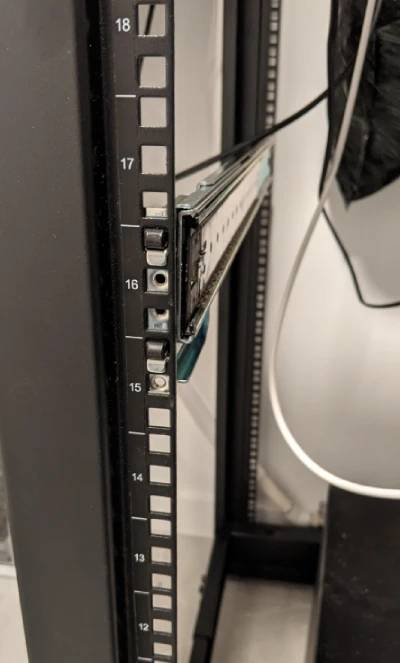

In high-density data center infrastructure, dimensional accuracy of server rack rails is absolutely non-negotiable. If it is discovered during on-site deployment that 1U or 2U servers cannot align with the mounting holes, this would be a costly mistake. This specific U-Space alignment deviation—which directly violates the EIA-310-E standard—typically stems from microscopic manufacturing deviations that create a chain reaction along the vertical length of the profile.
When relying on precision server rack rails to support critical IT equipment, even minor cumulative pitch errors during continuous stamping can render the rack unusable, leading to stripped threads and uneven load distribution.
To address this issue, basic sheet metal fabrication must be elevated to the level of precision micro-tolerance engineering. This article provides an in-depth analysis of the root causes of U-Space positioning deviations, particularly material stretching deformation and die pitch errors. Furthermore, it details how advanced CNC servo feeding technology and optical First Article Inspection (FAI) protocols ensure that every custom server rack rail meets stringent geometric accuracy requirements, thereby enabling seamless and standards-compliant hardware integration.
The Critical Role of the EIA-310 Standard in Server Rack Rail Production
In terms of hardware procurement, the EIA-310 standard is not merely a guideline but a strict geometric benchmark. Strict adherence to these dimensional tolerances during the server rack rail manufacturing process ensures universal hardware compatibility, thereby preventing serious installation failures during data center deployment.
Definition of the 1.75-Inch U Space Increment
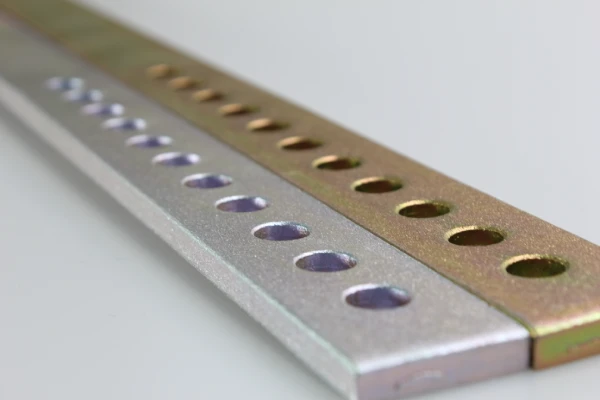
According to the EIA-310-E specification, the vertical height of a single rack unit (1U) is strictly defined as 1.75 inches (44.45 mm). For any precision server rack rails, this dimension determines the precise spacing between mounting holes. The standard hole pattern within a 1U space typically follows a precisely repeating sequence of 5/8 inch, 5/8 inch, and 1/2 inch.
As a precision sheet metal manufacturer, we understand that achieving this geometry depends not only on punching but also on consistently maintaining precise centerline-to-centerline distances. If a server rack rail deviates by even a fraction of a millimeter at a single spacing, this minute error is amplified exponentially in standard 42U or 48U rack structures.
Maintaining this strict 1.75-inch increment requires meticulous, incremental die design, as the entire physical architecture of modern IT infrastructure relies heavily on this fundamental parameter.
Consequences of Dimensional Deviations in Server Rack Rails for Data Centers
Once dimensional tolerances are compromised, the impact on data center operations is immediate and costly. Poorly manufactured metal server rack rails with misaligned U-spacing will inevitably lead to serious stacking tolerance issues.
During deployment, integration technicians will find that heavier 1U or 2U chassis cannot be properly aligned with the designated mounting points. This forces installers to misalign cage nuts and screws or force the installation, thereby compromising the mechanical integrity of the cabinet. Furthermore, misaligned server rack rails result in uneven weight distribution across the IT cabinet, creating localized stress points on the metal chassis.
For procurement managers, this translates to deployment delays, increased on-site labor costs, and potential hardware damage. In high-density environments, precision manufacturing serves as a critical safeguard against these cascading structural failures.
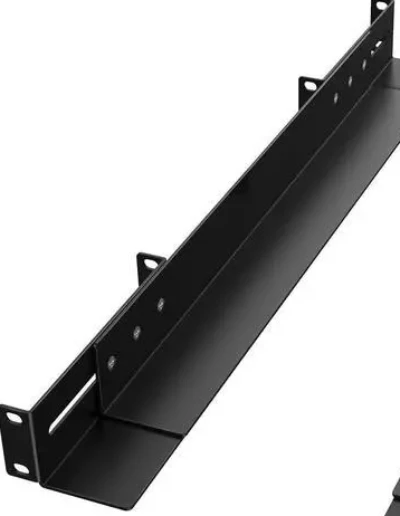
The Fundamental Technical Cause of U-Space Misalignment in Server Rack Rails
U-space alignment deviations are rarely random defects; they are a systemic mechanical failure. As a professional server rack rail manufacturer, we attribute dimensional deviations to the physical principles of high-speed manufacturing—specifically, dynamic tooling stresses and cumulative material deformation.
Cumulative Pitch Error in Continuous Stamping Dies
In high-volume production, metal server rack rails are typically manufactured using continuous stamping dies. In this process, the most common root cause of U-space misalignment is cumulative pitch error.
During high-speed stamping cycles, the steel strip passes through multiple stamping stations in segments. If the feeding mechanism or guide pins exhibit even a 0.05-millimeter deviation per stroke, this minute tolerance will continuously accumulate. By the time the punch reaches the end of the entire 42U server rack rail, these minor deviations accumulate into severe alignment failures that exceed the strict thresholds specified by the EIA-310 standard.
When evaluating newly procured server rack rails, procurement teams often find that while the top holes are perfectly aligned, the bottom holes are severely misaligned. To thoroughly resolve this issue, strict die maintenance and closed-loop feeding control are required to ensure absolute pitch feeding accuracy.
Elongation and Tensile Deformation of Server Rack Rail Materials
In addition to die precision, the physical properties of the raw material largely determine the final dimensional accuracy. When thick-gauge cold-rolled steel passes through an automated stamping production line, it is subjected to immense mechanical tensile forces. This sustained tension causes material elongation and localized tensile deformation.
If the metal’s yield strength fluctuates, or if the decoiler generates excessive resistance, the steel strip will undergo immediate microscopic stretching immediately after the U-shaped holes are punched. Once the finished metal server rack rails are cut and the mechanical tension is released, the metal will spring back slightly, resulting in permanent deformation of the final centerline spacing. For system integrators, server rack rails with elongation defects can cause jamming during installation.
Therefore, to produce precision server rack rails that meet specifications, strict incoming material inspections must be conducted, and a precision tension-controlled uncoiling mechanism must be employed.
Only 4 steps
online custom metal fabrication parts
Contact our experts team and experience the efficiency and economic benefits of digital metal fabrication services.
Upload Design Files
STL , STEP (.stp), IGES (.igs), (.ZIP), or PDF.
Also be a sample or an idea
Quote & Design Analysis
Instant factory quotes and DfM reports, the most reasonable solution.
Manufacturing Begins
Digital processes can initiate order tasks within 24 hours.
On-Time Delivery
Keeping delivery promises, approved by 3000+ Global Company buyers.
Advanced Sheet Metal Solutions for Precision Server Rack Rails
To overcome these mechanical limitations, it is essential to upgrade traditional stamping processes to precision engineering. By integrating closed-loop CNC servo-driven feeders and optimizing high-strength dies, we ensure that every custom server rack rail achieves micron-level pitch accuracy, eliminating cumulative dimensional errors at the source.
Micrometer-Level Pitch Control via CNC Servo-Driven Feeders
To eliminate cumulative pitch errors, Supro MFG has abandoned traditional mechanical feeders in favor of a highly advanced CNC servo-driven system. Precision server rack rails require precise centerline alignment, which mechanical gears simply cannot maintain during prolonged production runs. Our closed-loop CNC servo feeder provides micrometer-level pitch control, dynamically adjusting the feed length during each cycle with micrometer-level precision.
As soon as an optical sensor detects even the slightest deviation, the servo system immediately compensates for it before the next punching cycle begins. This ensures that whether you are producing a 12U or a full 48U server rack rail, the U-spacing increments remain perfectly aligned from top to bottom.
Choosing custom server rack rails manufactured with this closed-loop technology means you’ll never experience jamming during installation, and they fully comply with the 1.75-inch EIA-310 standard.
Die Design Optimization in the Server Rack Rail Manufacturing Process
To mitigate tensile deformation during high-speed stamping, a highly specialized die structure is required. When manufacturing heavy-duty server rack rails from high-strength cold-rolled steel, we design progressive dies by optimizing the clamping force of the strip-holding plates. This critical die improvement securely clamps the metal strip during the stamping stage, effectively preventing localized material slippage and micro-elongation.
Additionally, we use precisely calibrated guide pins and strictly controlled die clearances to ensure absolute stability of the sheet metal at all stations.
When custom server rack rails are designed using these advanced die improvement solutions, warping of the U-space geometry caused by material relaxation after stamping is completely eliminated. This allows them to seamlessly support heavy 2U or 4U server chassis without structural deformation, thereby effectively reducing the total cost of ownership.
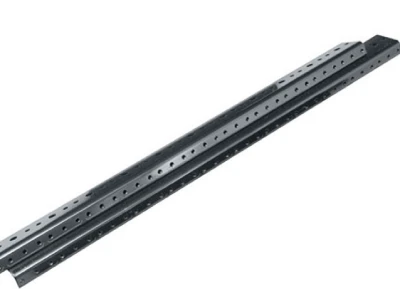
Rigorous Quality Assurance for Server Rack Rails: Verifying Compliance with the EIA-310 Standard
Precision manufacturing must be verified through actual measurement data. To ensure strict compliance with the EIA-310 standard, every precision server rack rail undergoes rigorous metrological testing. By employing advanced optical inspection and statistical process control, we transform dimensional accuracy from a promise into a verifiable fact.
Optical Inspection System in First Article Inspection (FAI) of Server Rack Rails
In precision sheet metal fabrication, First Article Inspection (FAI) is a critical inspection step prior to the start of high-speed mass production. To ensure absolute compliance with the EIA-310 standard, we deploy a high-precision, calibrated 2.5D optical measurement system to scan the entire geometric profile of the first metal server rack rail. Unlike traditional manual calipers, non-contact optical inspection simultaneously captures the precise centerline distances across all U-spaces.
This verifies that cumulative spacing errors are strictly controlled within the micrometer-level tolerances required for seamless integration into data centers. If the optical scan detects even the slightest alignment deviation, incremental tooling adjustments are immediately implemented.
By executing these advanced metrology protocols during the FAI phase, procurement managers can be confident that every custom server rack rail entering full-scale production is mechanically flawless, capable of effortlessly supporting heavy IT enclosures, and completely eliminating the risks associated with on-site deployment.
Statistical Process Control (SPC) in High-Volume Server Rack Rail Manufacturing
Ensuring the dimensional accuracy of the first-article sample is just the beginning; maintaining this accuracy consistently across tens of thousands of products requires robust statistical process control (SPC).
During high-volume stamping operations, our quality engineers continuously monitor the dimensional stability of each precision server rack rail using dynamic SPC control charts. By meticulously tracking the process capability index (CPK) for U-Space hole spacing, we can detect even minor die wear or material displacement before they develop into actual physical defects.
This data-driven sampling process ensures that the 100,000th metal server rack rail has exactly the same EIA-310 geometric accuracy as the first unit.
Partner with Supro MFG for Custom Server Rack Rails
At Supro MFG, we meticulously design every precision server rack rail to eliminate cumulative spacing errors and ensure perfect compliance with the EIA-310 standard.
For procurement teams seeking reliable high-volume production, we offer comprehensive Design for Manufacturability (DFM) analysis and rapid prototyping services. Submit your CAD specifications today and let our sheet metal experts ensure your custom server rack rails project achieves absolute dimensional accuracy and optimal total cost of ownership.