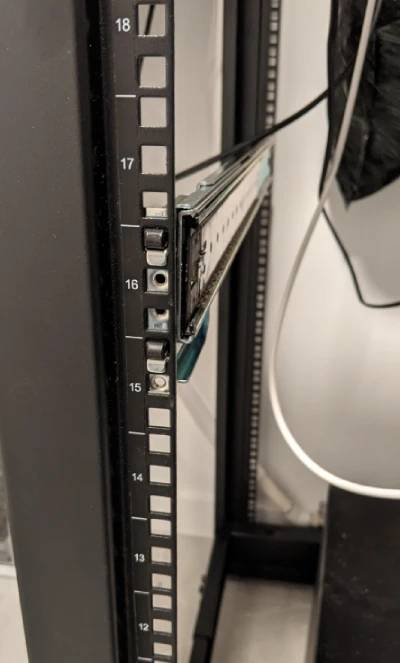


In high-density data center deployments, hardware assembly efficiency depends entirely on the precision and accuracy of sheet metal tolerances. Selecting a reliable server rack rail is not only about structural load-bearing capacity but, more importantly, dimensional repeatability.
During the assembly of IT infrastructure racks, failed cage nut installation has long been a persistent and costly bottleneck. When standard 3/8-inch (9.5-millimeter) square mounting holes develop a deviation of just 0.1 millimeter due to unmonitored die wear, field technicians immediately face significant assembly delays.
The detachment of cage nuts or the failure to securely engage spring clips stems from micro-deformations generated during the precision stamping process. Stamping defects—such as excessive edge curling, burrs in fracture zones, and non-perpendicular hole walls—often occur when the clearance between the punch and die is miscalculated or the stripping force is insufficient. Manufacturing zero-defect precision server rack rails in high-volume production is far from a simple machining task. It requires advanced metallurgical control and rigorous predictive die maintenance.
This article provides an in-depth analysis of the mechanical principles behind square hole deformation and details the precise die strategies required to eliminate assembly failures in server rack rail systems.
Mechanical Principles Behind the Tolerances of Square Holes in Server Rack Rails
The dimensional accuracy of metal server rack rails depends entirely on the control of shear stress during the stamping process. To maintain these square hole tolerances, a precise balance must be achieved between the material’s yield strength and the die clearance to prevent plastic deformation before final fracture occurs.
Server Rack Rails Must Comply with the EIA-310 Standard
Every precision server rack rail must strictly comply with the EIA-310 standard, which defines the general structural specifications for data center cabinets. For square mounting holes, this standard typically specifies a precise dimension of 0.375 inches (9.5 mm) on each side.
However, true compliance involves more than simply punching holes to nominal dimensions; it also requires maintaining strict micro-tolerances (typically within ±0.1 mm) across the entire vertical span of the rack rails. When manufacturing 42U server rack rails, cumulative spacing errors are completely unacceptable. If the standard distance between rack units (1.75 inches) is compromised due to material stretching during continuous punching cycles, equipment alignment will inevitably fail.
As an experienced server rack rail manufacturer, Supro employs rigorous CMM verification to ensure that your custom rack rails not only meet EIA-310 dimensional requirements on paper but also provide perfect universal compatibility on the assembly floor.
Impact of Server Rack Rail Dimensional Deviations on Assembly
Even minor deviations in hole geometry can severely affect the operational functionality of metal server rack rails. If a square hole is just a fraction of a millimeter too small, the spring-loaded latch of a standard M6 cage nut cannot fully deploy and will fail to securely engage with the back of the metal panel. Conversely, holes that are too large or have severely curled edges—typically caused by improper clearance between the punch and die—will significantly reduce the locking surface area.
Under the extreme dead weight of enterprise-class servers, this lack of structural engagement can lead to catastrophic detachment of the cage nuts. High-quality server rack rail systems require perfectly vertical hole walls and minimal burrs.
By strictly controlling the ratio of polishing to shearing during the stamping process, we eliminate these dimensional deviations, ensuring both quick, tool-free installation of the cage nuts and maintaining optimal load-bearing integrity.
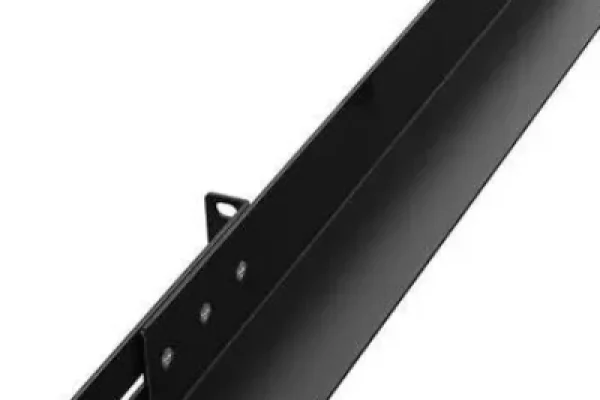
Causes of Cage Nut Installation Failure in Server Rack Rail Systems
Installation failures of cage nuts in custom server rack rails are rarely due to material defects; the root cause lies in issues with the stamping process. Unmonitored die clearances, premature punch wear, and insufficient stripping force can all directly lead to a decrease in the critical “polish-to-fracture ratio” of the square holes.
Excessive Punch-to-Die Clearance During Server Rack Rail Manufacturing
In high-volume production, calibrating the optimal punch-to-die clearance is critical. When the clearance exceeds the ideal range of 8% to 12% of the material thickness, shearing performance drops sharply. Instead of producing a clean, crisp cut, the sheet metal undergoes severe plastic bending before fracturing, resulting in an enlarged flange area and significant burrs on the discharge side.
For precision server rack rails, excessive clearance reduces the vertical polished area—that is, the flat load-bearing surface on the hole walls. Consequently, the spring-loaded tabs of standard EIA cage nuts cannot engage securely, as the sharp inner edges required for mechanical locking are missing.
We rigorously calculate the clearance based on the tensile strength of specific materials to prevent these catastrophic geometric deformations in custom server rack rails during the stamping process.
Premature Die Wear and Metal Dragging
The continuous processing of high-strength structural steel poses a severe challenge to die life. If the sharp angle of the punch becomes rounded due to premature abrasive wear, the cutting action transforms into metal dragging. When a dulled punch is forced through the base material, it pulls the material downward, causing the square hole walls to taper or bend inward.
When such tapered holes appear in metal server rack rails, installing cage nuts becomes nearly impossible; the latches either jam prematurely or fail to pass through completely.
As a professional server rack rail manufacturer, Supro understands that high-quality dimensional accuracy must never be compromised by declining die performance. By strictly monitoring the number of strokes and analyzing the microstructure of the cutting edge under a microscope, we effectively prevent die dullness and eliminate the hidden phenomenon of metal drag that compromises square hole tolerances.
Insufficient Ejection Force
A frequently overlooked factor in manufacturing flawless mounting interfaces is the mechanical action that occurs immediately after the punch penetrates the steel sheet. As the punch retracts, the stripper plate must apply significant and uniform downward pressure to keep the sheet metal flat. If the stripping force is insufficient or unevenly distributed, the material will briefly buckle and jam the retracting punch. This violent upward suction force causes micro-twisting and dimensional distortion around the freshly cut square edge.
Distorted metal server rack rails, due to localized flatness irregularities, will inevitably prevent the installation of cage nuts. To address this issue, our die engineering design incorporates heavy-duty nitrogen gas springs into the die assembly, ensuring the application of overwhelming and stable peeling pressure. This isolates the hole from the retraction force, guaranteeing the absolute planar integrity of precision server rack rails.
Only 4 steps
online custom metal fabrication parts
Contact our experts team and experience the efficiency and economic benefits of digital metal fabrication services.
Upload Design Files
STL , STEP (.stp), IGES (.igs), (.ZIP), or PDF.
Also be a sample or an idea
Quote & Design Analysis
Instant factory quotes and DfM reports, the most reasonable solution.
Manufacturing Begins
Digital processes can initiate order tasks within 24 hours.
On-Time Delivery
Keeping delivery promises, approved by 3000+ Global Company buyers.
Advanced Die Strategies for Defect-Free Stamping of Server Rack Rails
To completely eliminate installation defects in cage nuts for metal server rack rails, the manufacturing process must be upgraded. By integrating engineered metallurgical punch coatings with data-driven predictive maintenance, we have permanently stabilized the tolerances of square holes during high-volume stamping cycles.
Adoption of TiN-Coated High-Speed Steel Punches in Server Rack Rail Manufacturing
To ensure dimensional stability of custom server rack rails during continuous production, it is necessary to upgrade from standard D2 tool steel to high-quality high-speed steel (HSS). However, HSS alone cannot withstand the extreme friction generated during high-speed square hole stamping.
We incorporated TiN (titanium nitride) PVD-coated punches into our die design. The TiN coating significantly reduces the surface coefficient of friction and achieves a microhardness exceeding 80 HRc. This metallurgical barrier effectively prevents galling—the hidden cold welding phenomenon between the steel substrate and the punch sidewall. By eliminating material adhesion and abrasive wear, the cutting edge remains razor-sharp throughout extended production runs.
When stamping server rack rails, this advanced coating technology ensures that the hole walls are perfectly vertical. As a result, every rack rail that comes off our production line precisely maintains the required geometry, enabling fast and foolproof cage nut installation.
Implementing Predictive Die Maintenance
Relying solely on reactive die maintenance—that is, sharpening tools only after edge defects are detected—is a disastrous manufacturing strategy. At Supro MFG, we implement a rigorous, data-driven predictive maintenance program.
By utilizing integrated stroke counters and benchmark metallurgical analysis of tool wear, we determine precise sharpening intervals long before punch performance declines. We do not wait until precision server rack rails fail pass/fail gauge inspections to take action; instead, we remove the dies from the press for microscopic-level surface reconditioning while the Process Capability Index (Cpk) remains well above 1.63.
This proactive die management completely eliminates the risk of gradual tolerance drift. For procurement personnel, this means that every metal server rack rail in high-volume production features perfectly square hole geometry with complete consistency, ensuring zero downtime during assembly at IT deployment sites.
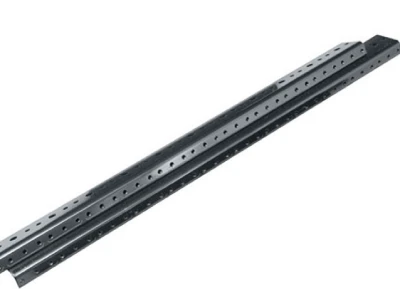
Quality Control in High-Volume Server Rack Rail Production
A perfect die alone does not guarantee batch consistency. In high-volume production, every precision server rack rail is subject to strict statistical process control (SPC). By integrating continuous online measurement technology, we verify the tight tolerances of the square holes across thousands of consecutive stamping cycles.
Process Inspection and Go/No-Go Gauge Testing
At Supro MFG, we implement rigorous First Article Inspection (FAI), followed by proactive in-process monitoring. For each batch of custom server rack rails, our quality engineers perform inspections directly at the press using custom-machined go/no-go gauges. Operators perform mandatory manual inspections at preset stroke intervals to verify the tolerances of the 9.5-millimeter square holes.
The “go” gauge confirms that the hole diameter is not smaller than the allowed range, ensuring that the cage nuts can be inserted smoothly; the “no-go” gauge ensures that the hole diameter does not exceed the maximum limit, preventing the spring clips from coming loose.
This real-time physical verification mechanism instantly detects thermal expansion or minor wear of the die. By promptly identifying dimensional drift on the production floor, we ensure that every precision server rack rail that leaves our factory integrates perfectly into your infrastructure, preventing on-site assembly failures.
CMM Verification of Square Hole Position Tolerance for Server Rack Rails
Although the dimensions of individual holes are critical, the cumulative spacing error across the entire 42U or 48U server rack rail is the key factor determining the success of the overall assembly. Stamping a continuous array of square holes can cause material stretching and residual stress, which in turn can lead to positional drift.
To address this issue, we use an advanced coordinate measuring machine (CMM) for verification. We take random samples from the production line and compare them against strict Geometric Dimensioning and Tolerancing (GD&T) specifications. The CMM verifies the actual position of each mounting interface, ensuring that the 1.75-inch U-space increment from top to bottom remains absolutely constant. Even the slightest spacing deviation in metal server rack rails can cause bulky chassis rails to jam or fail to align properly.
Our CMM inspection protocol provides the measured data required to adjust servo feed rates, thereby ensuring perfect alignment in high-density data center deployments.
Conclusion
Resolving cage nut installation failures in server rack rail systems is by no means a field assembly issue, but rather a fundamental challenge in stamping and die manufacturing. Strict control of the clearance between the punch and the die, combined with effective suppression of edge curling, ensures the geometric integrity of each mounting interface. For data center infrastructure, these micron-level tolerances directly determine efficiency at the macro level.
At Supro MFG, all our stamping dies are designed and manufactured in-house, thereby eliminating the root causes of dimensional drift and cage nut assembly failures. By strictly controlling the clearance between the punch and die and implementing proactive die maintenance, we guarantee that every precision server rack rail perfectly complies with the EIA-310 standard.
From precision metal stamping to final powder coating and Coordinate Measuring Machine (CMM) verification, we offer true end-to-end manufacturing services. Partner with Supro MFG on your next server rack rails project to ensure a 100% on-site assembly yield and zero deployment downtime.