
In the field of modern precision manufacturing, CNC turning has become one of the key machining processes due to its high precision and quality. It is widely used in numerous industries such as the automotive industry, aerospace, and medical devices. So, what exactly is CNC turning? How does it work? What are its advantages and disadvantages? What types of parts is it suitable for machining?
Next, this article will delve into the relevant knowledge of CNC turning, answer the above questions, and provide a comprehensive analysis of CNC turning technology.
Definition of CNC Turning
CNC turning is a precision subtractive manufacturing process controlled by a computer numerical control system. It is primarily used to produce rotary parts with a common axis of symmetry, such as cylindrical, conical, threaded, grooved, and various curved surfaces.
CNC: This is the core of the process. Operators first use computer-aided manufacturing software to create a set of digital instructions (known as G-code). This instruction set controls all machine tool movements, including: spindle rotation speed, tool path and feed rate, and cutting depth. This automation eliminates the reliance on operator skill found in traditional manual lathes, ensuring extremely high precision and consistency.
Turning: This process secures the workpiece (raw material) in the chuck of the spindle and spins it at high speed. A stationary cutting tool is then precisely moved against the rotating workpiece, removing excess material to achieve the desired shape and dimensions.
How CNC Turning Works
CNC turning is a highly automated process whose workflow can be clearly divided into three main stages: preparation, programming, and execution.
Preparation and Programming
The entire CNC turning process begins with a three-dimensional digital model of the part, typically created using computer-aided design (CAD) software.
Engineers or programmers use computer-aided manufacturing software or manually write the machining program. This program consists of a sequence of G-code/M-code instructions that precisely tell the machine tool: what speed the spindle should rotate at, where the tool should move, how fast the tool should move, the depth of cut, and when to turn the coolant on or off.
Machine Setup
Clamping the Workpiece: Securely mount the raw material (typically bar stock or forgings) onto the chuck of the machine tool’s spindle. The chuck grips the workpiece and drives its rotation.
Tool Installation: Mount the appropriate cutting tools onto the turret. The turret of modern CNC lathes can accommodate multiple different tools, enabling the machine to automatically switch tools during machining without manual intervention.
Automated Machining Execution
Once setup is complete and the machine is started, it automatically performs the following operations:
Spindle Rotation: The chuck begins high-speed rotation while holding the workpiece.
Tool Positioning: The turret moves the selected tool to the starting position specified by the program.
Cutting and Forming: Following program instructions, the tool contacts the rotating workpiece along a preset path, precisely removing excess material.
Common CNC turning operations include:
- External cylindrical turning: Cutting the workpiece’s outer surface to reduce its diameter.
- Face Turning: Cutting the workpiece’s end face to make it flat and define its length.
- Boring: Enlarging or finishing pre-existing holes in the workpiece.
- Grooving/Cutting-off: Cutting grooves into the workpiece or severing it from a bar stock.
- Thread turning: Cutting threads into the workpiece.
Throughout the CNC turning process, coolant is continuously sprayed onto the cutting area to cool the tool and workpiece, lubricate the cutting process, and flush away metal chips. Once all operations in the program are completed, the spindle stops rotating and the machined part is removed. The next round of loading and machining can then commence.
Why Choose Supro MFG’s Custom Metal Fabrication Services
Real ex-factory price:
Provide the most cost-effective cost solution for manufacturing and assembling products, expanding product competitiveness.
Professional technical team:
a technical team specializing in custom shell manufacturing for more than 30 years.
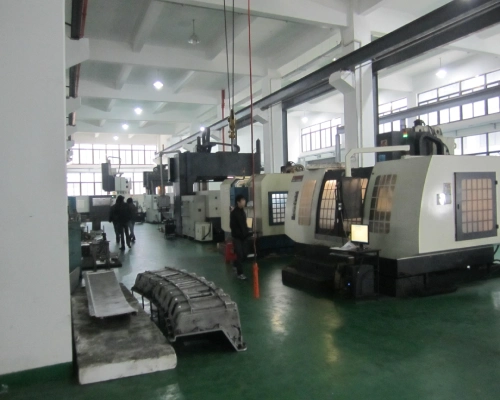
Advanced Manufacturing Equipment: Industry-leading custom metal enclosure manufacturer with in-house sheet metal, die casting, precision machining workshops, and surface coating workshops.
ISO 9001-2015 Manufacturer:
ISO 9001-2015, PPAP III level, RoHS, NEMA, CE and other certified production standards.
24H*7 online English technical support: The professional English team responds quickly to users’ technical questions online at any time.
One-stop manufacturing solution:
help users from product design, prototype, batch manufacturing, surface treatment, assembly and packaging, transportation and a series of value-added services.
Authoritative testing capabilities:
With in-house mechanics and chemistry laboratories, it can quickly monitor manufacturing process quality control to ensure the delivery of high-quality products.
Intellectual Property Protection(NDA):
Accept to sign NDA documents to ensure that customers‘ product information is protected.
Commitment to On-Time Delivery:
Door-to-door delivery in customizable secure packaging after complying with the delivery details agreed with the customer.

Parts Suitable for CNC Turning Processes
The core characteristic of CNC turning is that the workpiece rotates while the cutting tool moves to perform machining. This makes it most suitable for producing rotary parts.
Shaft-Type Parts
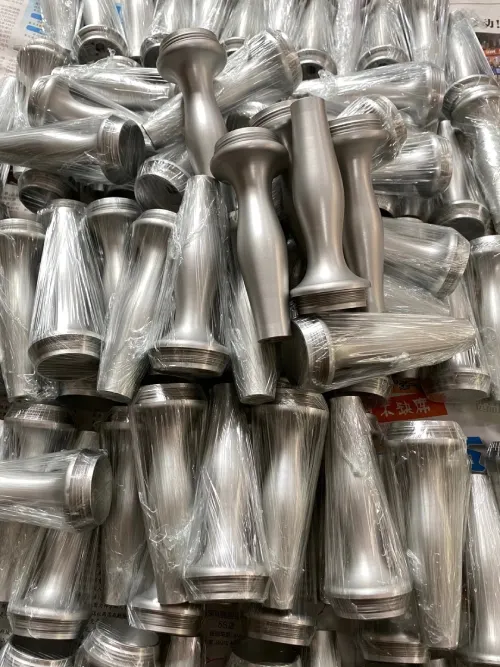
These represent the most typical CNC turning parts. They typically feature multiple cylindrical sections of varying diameters, potentially incorporating grooves, tapered surfaces, or threads. Examples include drive shafts, motor shafts, mandrels, and lead screws.
Disc/Ring/Ring-Shaped Parts
These components usually possess a central bore, such as gear blanks, bearing rings, flanges, and pistons.
Threaded Parts
CNC turning is the preferred method for machining high-precision internal and external threads. Examples include screws, bolts, nuts, threaded fittings, etc.
Cylindrical/Cavity Parts
These CNC turning parts often feature complex internal cavities requiring boring operations. Examples include hydraulic cylinders, cylinder liners, bushings, molds, etc.
Other Applications
Kitchenware: Handle pins for cookware, bases for frying pans.
Sports Equipment: Golf club heads, metal joints for baseball bats.
Medical Devices: Metal handles for surgical instruments, bases for implants.
Automotive: Wheel hubs, brake drums, transmission gear blanks.
online custom metal fabrication parts
Only 4 steps
Contact our experts team and experience the efficiency and economic benefits of digital metal fabrication services.
Upload Design Files
STL , STEP (.stp), IGES (.igs), (.ZIP), or PDF.
Also be a sample or an idea
Quote & Design Analysis
Instant factory quotes and DfM reports, the most reasonable solution.
Manufacturing Begins
Digital processes can initiate order tasks within 24 hours.
On-Time Delivery
Keeping delivery promises, approved by 3000+ Global Company buyers.
Advantages and Disadvantages of CNC Turning
Advantages of CNC Turning
Exceptional Precision and Repeatability: Precision CNC turning is controlled by digital programs, virtually eliminating human error. Once a program is validated, it can mass-produce thousands of identical CNC turning parts with minimal tolerances (typically ±0.025 mm or even tighter).
Exceptional Production Efficiency: Automated machining enables continuous 24-hour operation. Combined with automatic feeders, it facilitates extended production runs, boosting overall output.
Superior Surface Finish: By selecting appropriate tools, cutting parameters, and coolants, CNC turning achieves exceptionally smooth surfaces directly, reducing the need for and cost of subsequent finishing operations.
Ability to Process Complex Profiles: While excelling at machining revoluting solids, modern CNC lathes can easily program and machine various intricate contours such as parabolas, hyperbolas, and complex thread profiles.
Wide Material Compatibility: Capable of machining numerous engineering materials, including various metals (e.g., aluminum, steel, brass, titanium alloys), plastics, and composites.
Disadvantages of CNC Turning
Geometric Limitations: CNC turning is primarily suited for rotary parts. It has limited capability for processing complex three-dimensional surfaces, asymmetrical components, or box-type parts.
High Initial Investment: CNC lathes, supporting tooling systems, and CAM programming software carry significant costs.
Programming and Setup Time: For simple or single-piece production, the time required for programming and machine setup is lengthy, resulting in relatively high per-unit costs for small-batch production.
Specialized Knowledge and Skill Requirements: CNC turning demands high-level programmers/engineers to handle process planning, program writing, and process parameter optimization.
Are you looking for reliable & cost-effective
China Sheet Metal Fabricators
More than 150,000 OEM metal fabrication products delivered to 5,000+ global buyers.
And benefit from it!
CNC Milling and Turning
CNC milling and turning are the two most fundamental and essential processes in CNC machining. Understanding their differences, characteristics, and how they work together is key to mastering modern precision manufacturing technology.
CNC Turning: The workpiece rotates while a stationary tool moves in straight or angled paths. Excels at producing rotary parts such as shafts, rods, sleeves, discs, and threads.
CNC Milling: The tool rotates while the stationary workpiece moves on the worktable (along X, Y, Z axes or more). Excels at producing non-rotational parts like flat surfaces, cavities, cams, grooves, and complex 3D contours.
Collaborative Operations
In modern manufacturing, CNC milling and turning often collaborate through process sequencing or integrated turning-milling machines to meet complex part machining demands. Turning-milling machining centers integrate a turning spindle and milling head on a single machine. This enables:
Single-setup processing: Parts require only one clamping to sequentially or simultaneously complete turning, milling, drilling, tapping, and other operations.
Exceptional precision: Eliminates cumulative errors caused by repeated setup across multiple machines.
Significantly enhanced efficiency: Reduces part transfer, setup, and clamping time between different machines.
Manufacturing complex parts: Easily machines eccentric holes, side features, flat surfaces, and curved surfaces on rotary parts, achieving complete processing with “one part, one machine, one setup.”
Conclusion
In summary, CNC turning has become an indispensable technological pillar in modern manufacturing due to its advantages of high precision, efficiency, flexibility, and product consistency. If you require CNC turning services, contact us immediately!
Supro is a CNC turning machining supplier from China, equipped with 80 3-axis, 4-axis, and 5-axis CNC machines. We offer over 120 types of metal and plastic materials, with all production processes completed in-house. We provide professional CNC fabrication services and online technical support. Whether you require rapid prototyping or bulk production of metal/plastic parts, we deliver comprehensive manufacturing solutions!