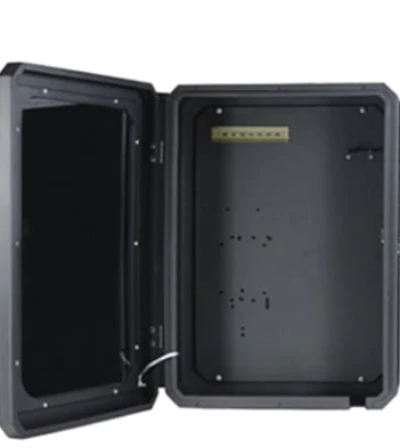

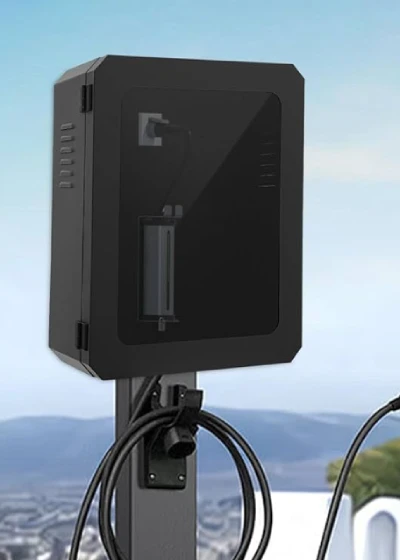
Electric vehicle charging infrastructure operates outdoors, requires minimal routine maintenance, and must withstand exposure to rain, wind-blown water spray, melting snow, and high-pressure washing. Enclosures rated to NEMA 3R/4X or IP65 are specified to withstand these environmental conditions—NEMA 4X requires resistance to water jets and corrosive environments, while IP65 requires resistance to a water jet with a flow rate of 12.5 L/min from a 6.3-millimeter nozzle at a height of 2.5 to 3 meters.
However, in actual operation, a large number of EV charging station housings develop leaks shortly after being put into service, leading to ground fault trips, corrosion of electronic components, and even system shutdowns. The problem rarely stems from inadequate specifications but rather from the manufacturing process of EV charging station housings: intermittent spot welding at corners, porosity and incomplete penetration in welds, and incorrect calculations of gasket compression ratios—all of which create pathways for moisture intrusion, leading to ground faults, corrosion, and system shutdowns.
To provide truly weatherproof custom EV charging station housings, merely meeting the protection rating on paper is insufficient—this requires process engineering to comprehensively address welding integrity, structural design, and sealing performance as an integrated system.
Root Cause Analysis: Failure Locations in EV Charging Station Housings
Water leakage failures in custom EV charging station housings are rarely caused by inadequate design specifications; rather, they are often rooted in manufacturing process defects. In outdoor environments, the housings are subjected to rain, temperature cycling, and vibration loads, making welds and sealing interfaces the weakest links.
Intermittent spot welding at corner joints leaves unfused gaps; internal defects such as porosity, slag inclusions, and lack of fusion create microscopic leakage pathways within the welds; and calculation errors in the compression of sealing strips result in a loss of effective sealing pressure at the door flange interface.
Any one of these three types of defects can lead to the failure of the NEMA 4X or IP65 protection rating during the long-term operation of the EV charging station housing, causing ground faults and equipment damage. Therefore, accurately identifying the root causes of failure is a prerequisite for developing effective preventive measures.
Intermittent Spot Welding at Corner Joints of EV Charging Station Housings
Intermittent spot welding at corner joints—typically consisting of short, spaced-out weld segments ranging from one to two inches in length—is designed for temporary fixation rather than permanent sealing. For NEMA 4X enclosures, manufacturing standards explicitly require that continuous welds be ground smooth. Intermittent welding leaves unfused gaps at the joints, which become direct leakage paths under hydrostatic pressure.
Under thermal cycling and vibration—which are common in outdoor electric vehicle charging facilities—these gaps can expand into cracks that penetrate the wall. Waterproof custom EV charging station housings require fully closed welds; any interruption in the weld will compromise the housing’s ability to achieve its rated protection level.
Porosity, Slag Inclusions, and Lack of Penetration
Porosity, slag inclusions, and lack of penetration are subsurface defects that are invisible to the naked eye. Slag inclusions—where non-metallic residues from the electrode coating or flux become trapped in the weld metal—are typically caused by improper electrode angle, excessive travel speed, insufficient welding current, or failure to thoroughly remove slag between passes.
Pores form a network of voids that act as capillary channels for moisture penetration. Root lack of fusion occurs when the weld metal fails to reach the root of the joint, leaving a continuous unfused interface.
If a custom EV charging station housing is required to obtain NEMA 4X or IP65 certification, such defects are absolutely unacceptable.
Errors in Gasket Compression Ratio Calculations
Errors in gasket compression ratio calculations constitute a systemic design flaw that directly affects the sealing performance of custom EV charging station housings. Industry experience indicates that polyurethane foam gaskets achieve an effective seal when the cured foam is compressed by approximately 30% to 60%. Compression below this range results in interface gaps; excessive compression leads to compression set—that is, permanent deformation with a loss of resilience.
The ideal compression target is approximately 40%, with an effective range of 10% to 50%. For the manufacturing of EV charging station housings, precise compression calculations must account for flange stiffness, closing torque, and gasket hardness (adjustable between 15 Shore OO and 40 Shore A)—each variable affects the effective sealing pressure at the door interface.
Are you looking for reliable & cost-effective
China Sheet Metal Fabricators
More than 150,000 OEM metal fabrication products delivered to 5,000+ global buyers.
And benefit from it!
Engineering Solutions for Waterproofing EV Charging Station Housings
Resolving water infiltration issues in EV charging station enclosures requires a systematic engineering approach that addresses each failure mode identified through root cause analysis.
This solution framework integrates three interdependent technical areas: the use of robotic CMT continuous seam welding technology to eliminate seam discontinuities; the use of an integrated rain gutter geometry to divert water flow away from the sealing interface; and the use of FIPG polyurethane foam gaskets with precisely controlled compression ratios.
These measures work together to transform the weather resistance of custom EV charging station housings from a quality variable into a certainty of engineering design.
Robotic CMT Continuous Seam Welding for Core Wetted Areas
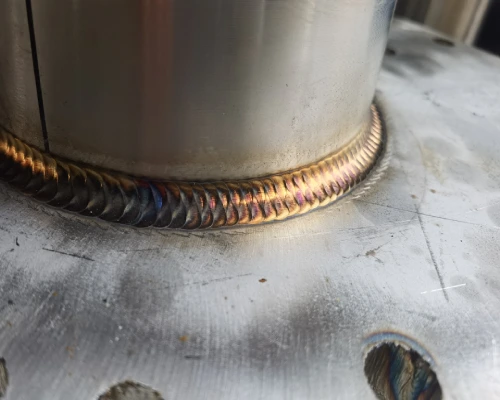
All liquid-contacting areas of the EV charging station housing are specified to use robotic CMT (Cold Metal Transfer) continuous seam welding. Unlike traditional MIG welding, CMT employs wire reciprocation at frequencies up to 170 Hz—the wire retracts during short circuits—reducing heat input by approximately 33% compared to a standard submerged arc transfer process.
For thin sheets less than 1.5 millimeters thick, this means minimal distortion while maintaining full penetration. Spatter is reduced by 99%, eliminating the need for post-weld cleaning and preserving the corrosion-resistant surface coating.
This robotic system ensures repeatability of welding parameters—such as travel speed, wire feed rate, and arc length—across every production unit. For custom EV charging station housings requiring NEMA 4X certification, continuous, ground-smooth welds are essential; CMT technology enables this specification to be achieved at mass-production scale while avoiding the warping issues commonly associated with manual TIG welding of thin-walled enclosures.
Integrated Rain Gutter Design on Door Flange Edges
An integrated rain gutter—that is, an external return flange formed along the door’s perimeter—provides passive drainage management for the EV charging station housing. This geometry diverts wind-driven rain and runoff away from the gasket interface before hydrostatic pressure builds up.
Unlike solutions that rely solely on seals to block moisture, this rain gutter reduces both the volume and velocity of water reaching the sealing surfaces. This design feature is particularly critical for NEMA 3R and 4X-compliant custom EV charging station housing applications, as these enclosures are exposed to rain, sleet, snow, and high-pressure water jets.
The return flange is formed directly during the bending process, eliminating the need for secondary assembly and removing potential leakage paths at the interface between the door and the frame. When combined with appropriate gasket compression force, the rain gutter ensures that the sealing system only needs to withstand residual moisture rather than full hydrostatic pressure—a fundamental principle of weatherproof EV charging station housing design.
FIPG Polyurethane Foam Gaskets with Controllable Compression Ratio
The FIPG (Field-In-Place Foaming Gasket) polyurethane system is applied directly to the flanges of EV charging station housings using automated dispensing equipment. This two-component system—polyol resin (Component A) and MDI isocyanate curing agent (Component B)—reacts and foams directly on the substrate, forming a seamless, closed-cell foam gasket with precise contour geometry. Hardness can be adjusted between 15 Shore OO and 40 Shore A, with a compression load deflection range of 5 kPa to 200 kPa at a 25% compression rate.
The sealing function is achieved at a compression ratio of 30% to 60% of the cured foam cross-section; for custom EV charging station housing door interfaces, the target compression ratio is approximately 40%, with a functional range of 10% to 50%—sufficient to accommodate flange tolerances without causing compression set.
The rebound capacity exceeds 97%, ensuring long-term sealing performance under thermal cycling conditions ranging from -40°C to +80°C. Unlike molded rubber gaskets, FIPG eliminates spliced joints and adhesive bonding processes, thereby eliminating two common failure points in outdoor EV charging station housing seals.
Only 4 steps
online custom metal fabrication parts
Contact our experts team and experience the efficiency and economic benefits of digital metal fabrication services.
Upload Design Files
STL , STEP (.stp), IGES (.igs), (.ZIP), or PDF.
Also be a sample or an idea
Quote & Design Analysis
Instant factory quotes and DfM reports, the most reasonable solution.
Manufacturing Begins
Digital processes can initiate order tasks within 24 hours.
On-Time Delivery
Keeping delivery promises, approved by 3000+ Global Company buyers.
EV Charging Station Housing Manufacturing Process Control and Quality Assurance
EV charging station housing design specifications can only be translated into reliable field performance through strict process control and verifiable quality assurance.
For welded seams, the acceptance criteria for porosity and subsurface defects in the AWS D1.1 standard clearly define which conditions constitute non-conformity; custom EV charging station housings meeting the IP65 rating are tested for compliance using a water jet test conducted with a 6.3-millimeter nozzle at a distance of 3 meters and a flow rate of 12.5 L/min.
Methods such as pressure-indicating film or laser displacement measurement must be used to verify that the gasket compression falls within the specified range of 30%–50%.
For weatherproof EV charging station housings, quality is never a given—it must be measured, recorded, and audited at every key control point.
Welding Procedure Qualification and Non-Destructive Testing
Welding procedure qualification conducted in accordance with the AWS D1.1 standard is intended to confirm that the selected welding parameters—current, voltage, travel speed, and shielding gas—are capable of producing joints that meet the specified acceptance criteria.
For custom EV charging station housings, qualification testing includes visual inspection, macro-etch inspection, and guided bend testing; If a bend test specimen exhibits an open defect exceeding 1/8 inch or a cumulative defect exceeding 3/8 inch, it is deemed nonconforming. Subsequently, production welds must undergo non-destructive testing (NDT) verification: penetrant testing (PT) detects surface defects in fillet welds and corner joints; helium mass spectrometer leak testing or pressure decay testing is used to verify the seal integrity of IP65-rated EV charging station housings.
Every weld in the custom EV charging station housing must be traceable to an approved welding procedure specification (WPS), and inspection records must be retained for audit purposes.
Gasket Compression Verification for EV Charging Station Housing
Gasket compression verification ensures that the FIPG polyurethane seal achieves the specified compression range of 30%–50% across the entire door interface. A pressure-indicating film (PIF) placed between the mating flanges provides a permanent visual record of the compression magnitude and distribution. The film’s color depth changes proportionally with the amount of pressure applied, enabling engineers to identify low-load areas where flange stiffness needs to be corrected or the gasket profile adjusted.
Additionally, a laser displacement sensor measures the reduction in the height of the cured foam cross-section before and after closure, taking measurements at multiple points around the door perimeter to verify uniformity.
For EV charging station housings, compression verification must account for sheet metal flatness, hinge alignment, and variations in latch force—each of which affects effective sealing pressure.
As a specialized manufacturer of EV charging station housings, Supro documents the compression verification for every production batch, providing the traceability buyers need when auditing supplier quality systems.
Looking for a reliable custom sheet metal fabrication companies?
Talk To Supro MFG Expert Team
Contact us for competitive ex-factory prices,
and a full range of technical support services.
Conclusion
Achieving a weatherproof EV charging station housing does not rely on excessively high rated parameters, but rather on strict control of weld integrity, seal geometry, and compression verification.
Robotic CMT continuous welding eliminates joint discontinuities and thermal deformation; validated FIPG polyurethane gaskets with a compression ratio of 30%–50% provide stable sealing pressure at the door interfaces; and an integrated rain gutter reduces hydrostatic pressure before water reaches the sealing surfaces. Together, these measures transform the EV charging station housing from a potential point of failure into a field-proven, reliable asset.
Design choices can only truly ensure reliability when supported by welding process qualification and batch-level compression test records. For buyers, a specification-compliant custom EV charging station housing must not only meet NEMA 4X or IP65 standards on paper but also have each interface verified through verifiable records.
Supro is a professional custom EV charging station housing manufacturer. Leveraging advanced equipment, extensive manufacturing experience, and a professional engineering team, we provide perfect custom EV charging station housing solutions to more than 3,000 companies worldwide, along with genuine manufacturer quotes.
We deliver a wide range of products efficiently and on time, providing professional technical support and exceptional quality from product design and rapid sheet metal prototype fabrication through to mass production. Furthermore, we offer one-stop manufacturing solutions and highly cost-competitive product supply!
For inquiries regarding technical specifications, customized project solutions, or business cooperation, please contact Supro immediately. Our professional engineering team is always ready to provide you with a tailored application solution.