
As a high-strength, low-ductility alloy, 6061-T6 must strictly adhere to its mechanical limits during bending—unlike softer conditions, improper handling can cause fracture before yielding. Successfully bending 6061 aluminum requires mastering three critical variables: a minimum bend radius typically no less than three times the material thickness; Precise springback compensation based on its elastic modulus; and Strict control over the grain orientation of extruded profiles.
At Supro Mfg, our aluminum bending technology integrates CNC press brakes with real-time angle verification systems, ensuring repeatable machining precision for structural components and aerospace applications. Whether you require prototyping or production-level aluminum bending services, understanding how heat treatment and die selection impact formability is crucial.
This article provides a detailed breakdown of the technical essentials of 6061 T6 aluminum bending—from stress relief methods to crack prevention—ensuring your procurement decisions are based on engineering evidence, not guesswork. Contact our sales engineering team to discuss your project requirements.
Key Considerations for Aluminum Bending
When bending 6061 T6 aluminum, success hinges on controlling three critical variables to prevent cracking and ensure dimensional stability.
First, ensure precise bending radii and select appropriate dies to avoid material failure such as cracking in high-strength aluminum.
Second, die selection determines accuracy. CNC bending machines, mandrels, and custom dies are core elements for achieving precise bends and maintaining dimensional accuracy.
Third is material integrity. Always consider factors like grain orientation, stress relief, and heat treatment to ensure the structural quality of the aluminum remains unaffected during bending.
As an experienced aluminum bending manufacturer, Supro MFG incorporates these principles into every project. Our bending technology integrates real-time angle verification with a proven springback compensation mechanism, ensuring 6061 T6 aluminum bending fully meets your exacting specifications.
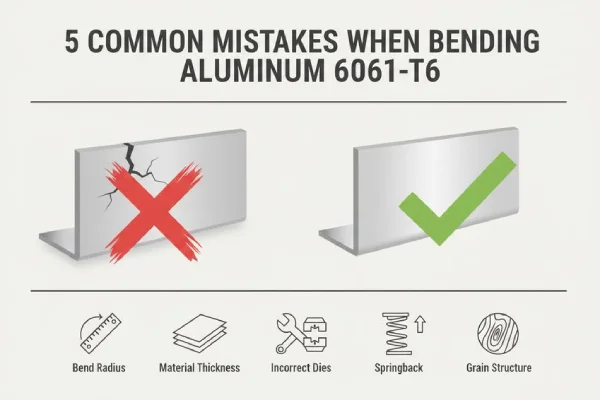
5 Common Mistakes When Bending Aluminum 6061-T6
Bending 6061 T6 aluminum demands precise control—minor setup errors can quickly translate into costly scrap. From ignoring minimum bend radii to misjudging the grain orientation of extrusions, these five common mistakes directly impact the cost and lead time of the aluminum bending process.
Ignoring Minimum Bend Radius in High-Strength Aluminum and Causing Crack Formation
When bending aluminum in 6061-T6 alloy, the minimum bend radius is not a suggestion—it’s survival.
Why cracks start:Outer fibers stretch beyond ductility limits.Tensile stress exceeds safe range.Micro-fractures grow into visible crack formation
What happens next:↓ Structural reliability.↑ Risk of material failure.Rework during the bending process
For tight aluminum bending jobs:Check alloy temper. T6 is strong but less forgiving.Match inside radius to at least 3× material thickness for safer forming aluminum.Inspect edges before bending aluminum sheets.
Overlooking Material Thickness and Ductility Limits in Sheet Aluminum Bending
Thickness drives everything in aluminum bending.
Too thin? It wrinkles.Too thick? It resists forming aluminum cleanly.
Key pressure points:Material thickness directly shifts required tonnage.Exceeding ductility limits causes edge tearing.Inconsistent deformation ruins surface finish on sheet aluminum parts.
Quick shop-floor checklist:Confirm actual gauge, not nominal spec.Review aluminum alloy temper data.Adjust V-die width to balance deformation.
In the aluminum bending process, even a 0.2-millimeter deviation can affect angle repeatability. Therefore, Supr Manufacturing conducts a double verification of incoming sheet metal before aluminum forming.
Using Incorrect Bending Dies on Press Brakes for 6061-T6 Aluminum Alloys
The choice of mold directly determines the precision of aluminum bending.
Tooling mismatch issues:Wrong bending dies cause uneven pressure.Sharp punches leave marks on 6061-T6 aluminum.Oversized V-dies reduce bending accuracy.
Press brake considerations:Proper press brakes tonnage calibration.Surface-treated dies for aluminum fabrication.Angle verification after first bend.
Punch tip radius:Too small → stress spikes;Too large → angle drift.
Die opening:Narrow → cracking risk;Wide → unstable bending aluminum angles.
A stable aluminum bending process requires precise alignment of the punch and die each time.
Failing to Account for Springback Compensation Due to High Elastic Modulus
Springback is the hidden troublemaker in the aluminum bending process.
Because of the elastic modulus of 6061-T6, parts open up after release. Without springback compensation, your bending angle misses spec.
Below is a simplified reference for aluminum bending behavior:
Thickness (mm) | Target Angle (°) | Overbend Angle (°) | Springback (°) | Notes |
2.0 | 90 | 94 | 4 | Standard air bend |
3.0 | 90 | 96 | 6 | Higher elastic recovery |
4.0 | 90 | 97 | 7 | Increased force required |
5.0 | 90 | 98 | 8 | Monitor tooling stress |
6.0 | 90 | 100 | 10 | Test bend required |
Neglecting Grain Structure Direction During Tube Bending of Extruded Aluminum
Extruded parts exhibit directional strength. Neglecting this characteristic will lead to serious issues in the aluminum bending process.
Understanding grain structure:Parallel bending → smoother deformation.Perpendicular bending → higher cracking risk
In tube bending of extruded aluminum:Tight radii amplify anisotropic behavior.Mandrel setup must match material orientation
Detailed bending logic
Material orientation check:Review mill markings、Confirm extrusion direction.
Setup alignment:Align bend plane with favorable grain flow
Performance outcome:Improved bending performance、Lower scrap in forming aluminum tubes.
When bending aluminum tubing for frames or supports, grain direction isn’t trivia—it’s the difference between clean curves and split seams.
online custom metal fabrication parts
Only 4 steps
Contact our experts team and experience the efficiency and economic benefits of digital metal fabrication services.
Upload Design Files
STL , STEP (.stp), IGES (.igs), (.ZIP), or PDF.
Also be a sample or an idea
Quote & Design Analysis
Instant factory quotes and DfM reports, the most reasonable solution.
Manufacturing Begins
Digital processes can initiate order tasks within 24 hours.
On-Time Delivery
Keeping delivery promises, approved by 3000+ Global Company buyers.
Crack Prevention: Stress Relief Before Aluminum Bending
Cracks occurring during 6061 T6 aluminum bending often stem from residual latent stresses left over from extrusion or prior processing. Performing appropriate stress relief treatment before the aluminum bending process restores material ductility, preventing surface fractures when achieving the required bend radius. As a professional aluminum bending manufacturer, Supro MFG eliminates stresses through controlled heat treatment cycles while monitoring work-hardening effects that could compromise material integrity.
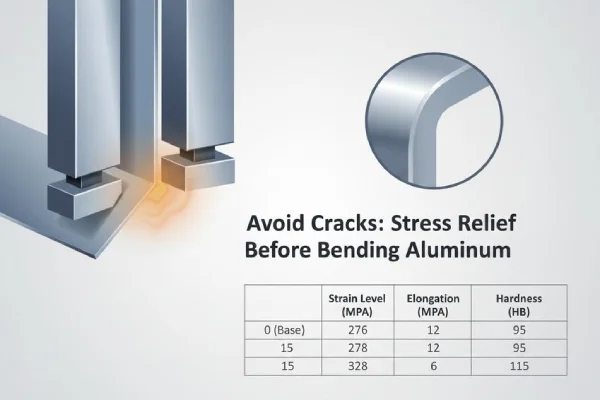
Heat Treatment and Stress Relief for High-Strength Aluminum Before Press Brake Bending
In the aluminum bending process, internal stress is an invisible destroyer. Through proper heat treatment and stress relief, this stress can be effectively reduced before the punch contacts the sheet metal.
Key goals before press brake bending:Lower residual stress.Improve ductility.Protect core material properties
Pre-treatment evaluation:Check alloy grade of the aluminum alloy.Confirm temper condition (T6, T651, etc.).Review prior machining history
Controlled thermal cycle:Apply annealing where required.Maintain uniform furnace temperature.Cool at regulated rates to prevent distortion
Post-treatment validation:Hardness testing.Surface inspection.Trial bend sample
At supro mfg, controlled thermal prep is standard practice before heavy aluminum bending jobs. It keeps high-strength aluminum predictable instead of brittle.
“Advanced aluminum applications in aerospace continue to demand tighter thermal processing control to reduce structural fatigue risk,” notes the 2025 International Aluminum Institute market outlook.
Work Hardening Effects in 6061-T6 Aluminum Alloys During Tube Bending Operations
Tube processing changes the game. During aluminum tube bending, work hardening effects manifest rapidly, particularly in 6061-T6 aluminum alloys.
As plastic strain increases, plastic deformation elevates yield strength but reduces ductility. This benefits stiffness enhancement but hinders achieving small-radius bends.
What this means in real shop talk:
Tight radius + high strain = crack risk
Repeated bending aluminum cycles increase material fatigue
Overworking tubes without intermediate anneal invites fracture
Smart operators monitor springback and adjust tooling. Good aluminum forming isn’t guesswork; it’s measured.
Strain Level (%) | Yield Strength (MPa) | Elongation (%) | Hardness (HB) |
0 (Base) | 276 | 12 | 95 |
5 | 295 | 10 | 100 |
10 | 310 | 8 | 107 |
15 | 328 | 6 | 115 |
Maintaining Material Integrity and Crack Detection in Aircraft Grade Aluminum Bends
In aerospace, sloppy work is not tolerated. Aircraft grade aluminum demands strict control of material integrity after bending aluminum components.
Inspection stack typically includes:
Surface-Level Checks:Visual inspection under magnification.Identification of surface defects.Measurement of final bending radius
Subsurface Evaluation:Dye penetrant non-destructive testing.Ultrasonic scan for internal fractures.Eddy current validation
Documentation & Traceability:Batch heat record.Bend force log.Inspector sign-off
Good aluminum forming isn’t just about shaping metal. It’s about proving the bend is clean inside and out. That’s why supro mfg integrates inspection directly into its aluminum bending workflow, keeping every bend ready for long-term structural reliability.
Are you looking for reliable & cost-effective
China Sheet Metal Fabricators
More than 150,000 OEM metal fabrication products delivered to 5,000+ global buyers.
And benefit from it!
Heat-Assisted Bending vs. Cold Forming of Aluminum
The choice between heat-assisted forming and cold forming for bending 6061 T6 aluminum depends on project priorities. Heat-assisted bending reduces the alloy's yield strength, enabling smaller bend radii for thick extrusions in aerospace applications. Cold forming preserves material mechanical properties, delivering consistent dimensional accuracy for automotive structural components. Both aluminum bending processes require specialized tooling and springback compensation measures. As an experienced aluminum bending manufacturer, Supro MFG evaluates material conditions and tolerance requirements to recommend the optimal bending solution for 6061 aluminum components.
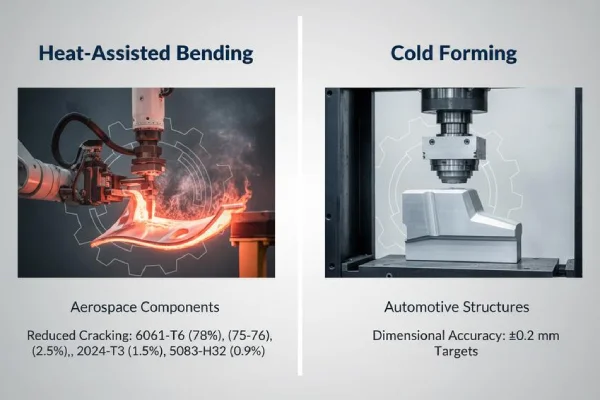
Heat-Assisted Bending for Thick Extruded Aluminum in Aerospace Components
When bending aluminum that’s thick and structural, heat changes the game. In aerospace builds, cracking during aluminum bending isn’t an option.
Material Preparation:Assess Thick aluminum profile geometry.Confirm alloy grade of Extruded aluminum.Review prior Annealing history and temper.
Controlled Heating Phase:Apply calibrated Temperature control (typically 250–400°C depending on alloy).Monitor reduction in yield strength and shift in Forming limits.Maintain uniform heat band to prevent uneven aluminum forming
Bending and Stabilization:Execute radius forming while ductility peaks.Cool gradually to retain structural integrity for Aerospace components.Inspect micro-fracture zones
The heat-assisted bending process enables aluminum to achieve tighter bends in wing ribs and fuselage frames. Supro Mfg employs this method to ensure high strength is maintained during 6061 T6 aluminum bending while preventing cracking.
Alloy Grade | Heating Temp (°C) | Min Bend Radius (x Thickness) | Crack Rate (%) |
6061-T6 | 300 | 3.5x | 1.8 |
7075-T6 | 350 | 4.0x | 2.5 |
2024-T3 | 320 | 3.0x | 1.5 |
5083-H32 | 280 | 2.5x | 0.9 |
Cold Forming Techniques for Dimensional Accuracy in Automotive Structures
Cold aluminum bending keeps the metal tough and the finish clean. No heat haze. No oxide scaling. Just precision.
Tooling and Setup:Hardened Tooling to counter high spring forces.Compensation angles to manage Springback.Real-time measurement for Dimensional accuracy
Material Behavior:Monitor Strain hardening during deformation.Adjust press force based on Material properties.Maintain grain direction alignment in Automotive structures
Production Control:Validate repeatability across high-volume runs.Compare aluminum bending angles against CAD tolerances.Record deviation under ±0.2 mm targets
Cold forming works best when the goal is repeatability. For chassis rails and cross members, bending aluminum without heat keeps tensile strength intact. Aluminum forming in this mode suits automated lines, where speed matters.
supro mfg often recommends cold aluminum bending for parts that demand cosmetic quality and tight fit-up. In short, heat helps when flexibility is king; cold wins when precision rules.
Get instant ex-factory price quotation.
If you only have an idea or an old sample,Let us know.
with photo or video and get our quotation and manufacturing solutions.
- Product design drawings or 3D model files.
- Material standards and appearance requirements.
- Product quantity demand.
- Industry standards in the application field.
- Functional requirements
Contact Us
If you require aluminum bending services, contact us immediately! Supro is a professional aluminum bending manufacturer. Leveraging advanced equipment, extensive manufacturing experience, and a specialized engineering team, we provide perfect aluminum bending services to over 3,000 companies worldwide, offering genuine manufacturer pricing.
At Supro, we possess extensive expertise, technology, and advanced equipment, understanding the requirements and standards for sheet metal bending parts across industries including agriculture, healthcare, automotive manufacturing, aerospace, and more. With 12 distinct sheet metal bending machines, Supro delivers one-stop sheet metal bending services for any industry, ensuring high-quality products, professional customer service, and on-time delivery.
If you have any questions or concerns about our aluminum bending services, contact us immediately. We will proactively meet all your project requirements!