
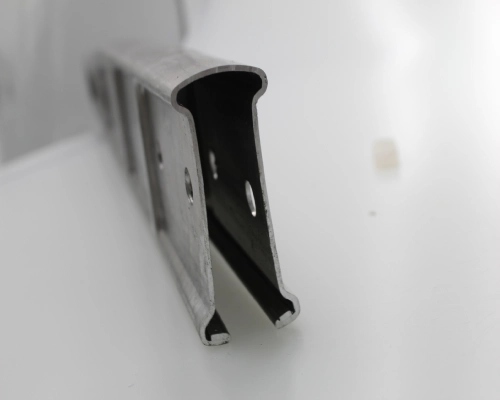

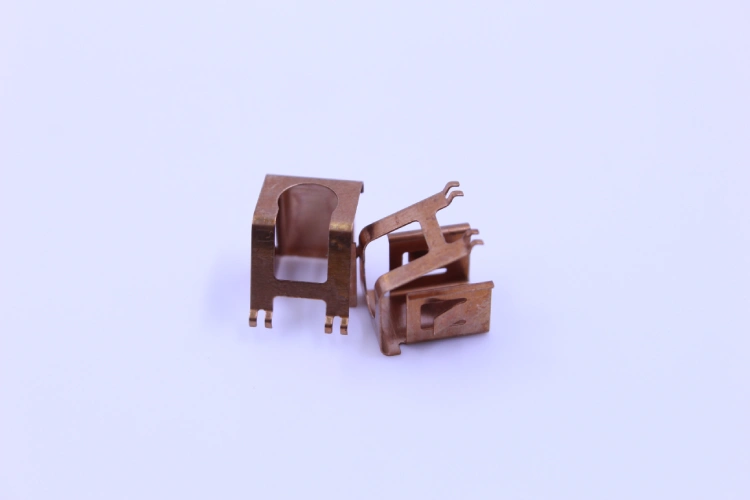
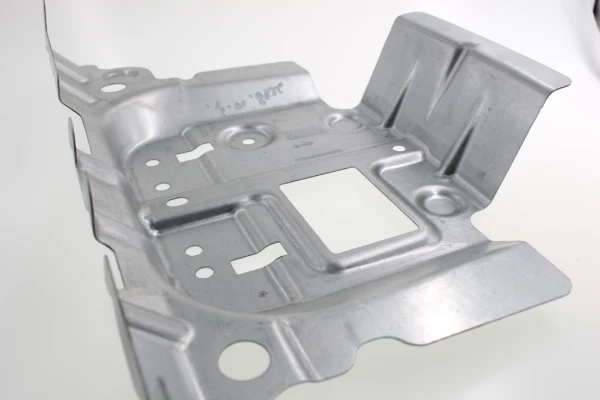
In the field of metal forming, the choice between deep draw stamping and progressive die stamping directly determines a part’s cost structure, quality consistency, and mass production feasibility. Both processes rely on high-tonnage presses to perform plastic forming on sheet metal, but each is suited for distinctly different part geometries and production objectives.
Deep draw metal stamping excels at manufacturing seamless hollow shapes, with a limiting draw ratio typically ranging from 1.8 to 2.3; this capability can be extended to over 3.0 through multi-stage sequences; Progressive die stamping, on the other hand, achieves positional tolerances as tight as ±0.001 inch (0.025 mm) between features through continuous forming in a multi-station sequence within a single die set, with mass production speeds reaching over 1,200 strokes per minute.
For procurement engineers, a thorough understanding of the fundamental differences between the two processes in terms of geometric capabilities, dimensional tolerances, and production batch sizes is essential for making sound investment decisions during the project development cycle.
This article will explore the technical differences, capabilities, and economic trade-offs between the deep draw stamping process and progressive stamping, and provide a framework for process selection based on part geometry, tolerance requirements, and expected production volume.
Understanding Deep Draw Stamping
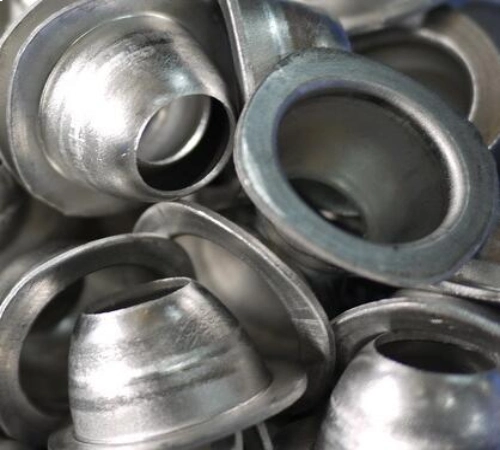
Deep draw metal stamping is a sheet metal forming process in which a punch applies compressive force to the center of a flat metal blank, generating tensile and compressive stresses as the material is drawn into the die cavity to form a hollow part. When the depth of the forming cavity exceeds the diameter of the punch, this process is referred to as “deep drawing” to distinguish it from shallow drawing processes.
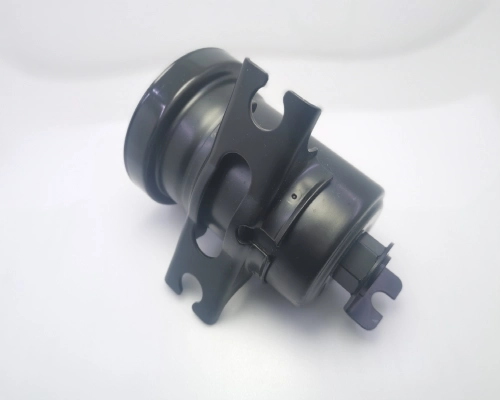
Mechanics and Parameters of the Deep Draw Stamping Process
During the custom deep draw stamping process, the blank holder applies a controlled clamping force to the flange area to prevent wrinkling, while the punch descends at a controlled rate, drawing the material radially inward and downward into the die. Draw ratios (blank diameter divided by punch diameter) quantify the severity of the forming operation; the limiting draw ratio for a single-pass operation is typically 1.8 to 2.3, while multi-pass sequences can extend this capability to 3.0 or higher.
Production rates on mechanical presses generally range from 15 to 40 pieces per minute, supporting large-scale manufacturing programs while maintaining consistent dimensional repeatability. Process parameters for deep draw metal stamping—including blank holder force (BHF), die clearance, fillet radius, and punch speed—must be precisely calibrated based on material properties (anisotropy coefficient and work hardening index). Any deviation in these parameters may result in defects such as wrinkling, tearing, or excessive thinning of deep draw stamped parts.
Applications and Material Suitability of Deep Draw Stamping
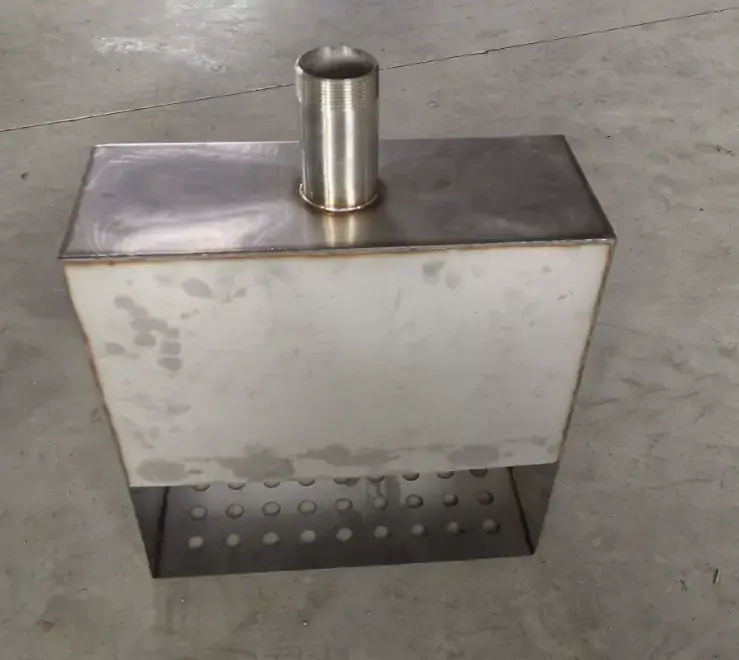
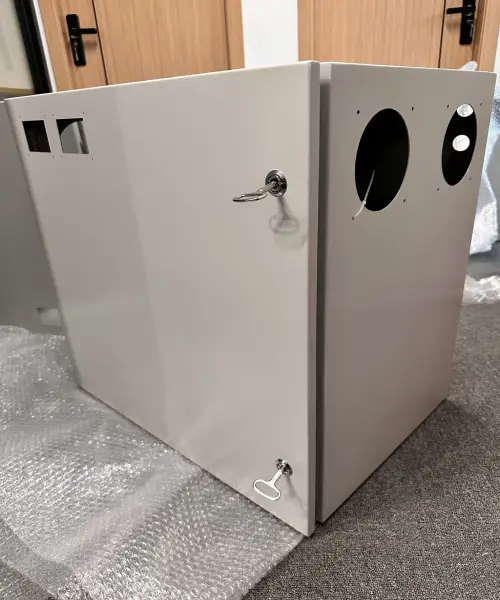
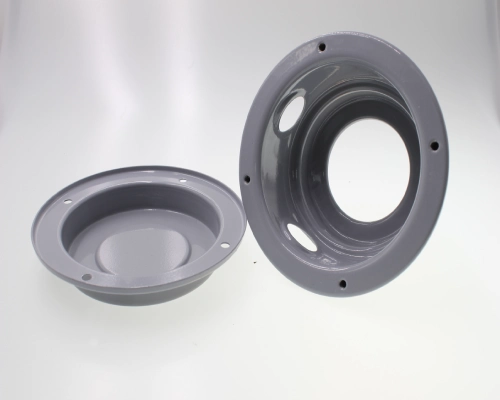
Deep draw metal stamping serves industries where seamless hollow structures and structural integrity are critical—including the automotive, aerospace, home appliance, electronics, and industrial manufacturing sectors. Typical applications include housings and enclosures, fluid transfer components, industrial system casings and covers, as well as structural parts exposed to pressure or vibration.
Deep draw stamping technology can process a wide range of materials, from low-carbon steel and aluminum alloys to stainless steel and copper-based alloys, with each material selected based on its ductility and formability. The cold forming process preserves the metal’s grain structure and produces a work-hardening effect, increasing the tensile strength of the formed parts by 10% to 30%.
In the automotive industry, custom deep draw stamping is used for fuel tanks, muffler housings, and body structural components; in the aerospace sector, it is used for engine cowlings, hydraulic cylinder bodies, and precision instrument housings. Materials with high ductility and low yield strength—such as low-carbon steel and aluminum alloys—perform best under cold deep draw stamping conditions.
Advantages and Limitations of Deep Draw Stamping Technology
The core advantage of deep draw stamping lies in its ability to produce seamless, monolithic hollow parts without the need for welding or fasteners, thereby eliminating structural weak points in assemblies. The cold forming process preserves the grain structure and induces work hardening, resulting in a 10% to 30% increase in tensile strength. Material waste is minimal, and secondary processing is often reduced.
However, the limitations of the deep draw stamping process are equally significant. Die costs are high and complex, as deep draw stamping dies require precise geometric design and surface treatment. Once a die is released, the cost of implementing design changes is extremely high. Drawing depth, fillet radii, and flange features are limited by the material’s ductility.
Common defects in deep draw metal stamping include wrinkling caused by insufficient blank holder force (BHF), tearing caused by excessive tension, springback, and wall thinning. Surface defects such as drawing lines may require die polishing to meet aesthetic requirements for visible parts. Material flow and the draw ratio must be strictly controlled, particularly as the number of forming passes increases—once the process is pushed beyond its limits, problems such as thinning, springback, and die wear can quickly arise.
Understanding Progressive Die Stamping
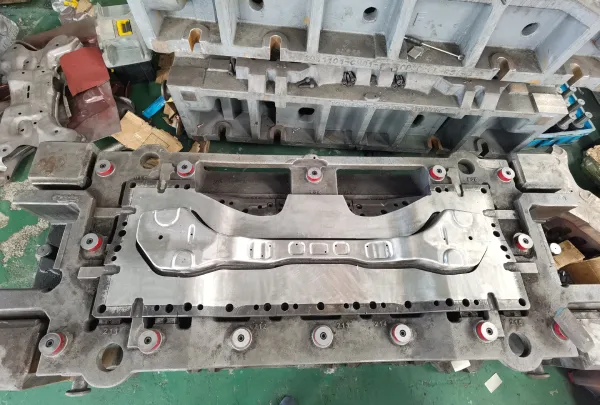
Progressive die stamping is a metal forming process in which a metal strip (typically from a coil) is progressively formed into a finished part as it passes through a series of stations in a single die set. Each station performs a specific operation, such as punching, bending, coining, or blanking, and the metal strip advances with each press stroke until the final station separates the finished part from the carrier strip.
Process Principles and Capabilities
Progressive die stamping involves feeding metal coil stock into a single die set in a step-by-step manner. With each press stroke, the material sequentially passes through multiple stations, with each station performing a specific operation such as punching, bending, coining, forming, or cutting. The part remains attached to the carrier strip throughout the entire process. Pilot pins ensure precise step-by-step positioning, maintaining the relative positional error between features within ±0.001 inches (0.025 mm).
Press speeds typically range from 30 to 120 strokes per minute, with high-speed configurations reaching 400 to 1,200 strokes per minute, making this process suitable for large-scale production environments. However, this process has inherent limitations regarding draw depth—when the forming depth exceeds approximately 1.5 times the part’s diameter, the carrier strip cannot supply sufficient material to the die cavity, which can easily lead to tearing and concentricity deviation. In such cases, it is necessary to switch to deep draw stamping technology to meet the requirements for deeper cavities.
Applications and Suitable Materials for Progressive Die Stamping
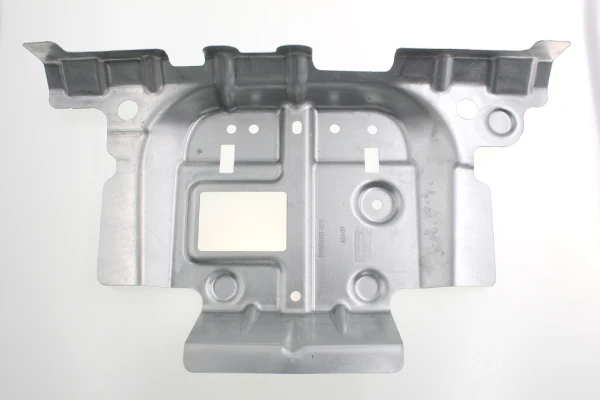
Progressive die stamping is widely used in the automotive, electronics, aerospace, and consumer electronics industries. Typical parts include brackets, latches, fasteners, electrical terminals, connectors, heat shields, and multi-feature stamped assemblies.
This process is compatible with a wide range of materials, including low-carbon steel, stainless steel, aluminum and aluminum alloys, brass, copper, and various coated strips, with thicknesses typically ranging from 0.005 inches to 0.125 inches (0.13 mm to 3.2 mm).
For high-volume, high-precision flat or shallow-drawn parts, progressive die stamping offers significant cost advantages; however, when parts require seamless deep drawn structures (such as sensor housings or oil pump casings), and the material flow direction and depth requirements exceed the capabilities of a progressive die, the design team should evaluate the deep draw stamping process as an alternative to avoid mass production failures caused by process mismatches.
Advantages and Limitations
The most prominent advantage of progressive die stamping lies in production efficiency—integrating multiple operations into a single die eliminates the need for part handling and repositioning between individual operations, while automated operation significantly reduces labor costs. Furthermore, the carrier strip ensures that all features share a unified reference, resulting in extremely high dimensional consistency.
Its limitations, however, cannot be overlooked: die investment costs are high, and the costs and lead times associated with design changes far exceed those of single-operation dies; more critically, this process cannot handle deep drawn parts with a depth-to-diameter ratio exceeding 0.5 to 1.5, as material flow is constrained by the strip connection method. Procurement engineers must clarify the part’s depth requirements early in the project to avoid the risk of costly die rework later on.
Are you looking for reliable & cost-effective
China metal fabrication manufacturer
More than 150,000 OEM metal fabrication products delivered to 5,000+ global buyers.
And benefit from it!
Direct Comparison Between Deep Draw Stamping and Progressive Die Stamping
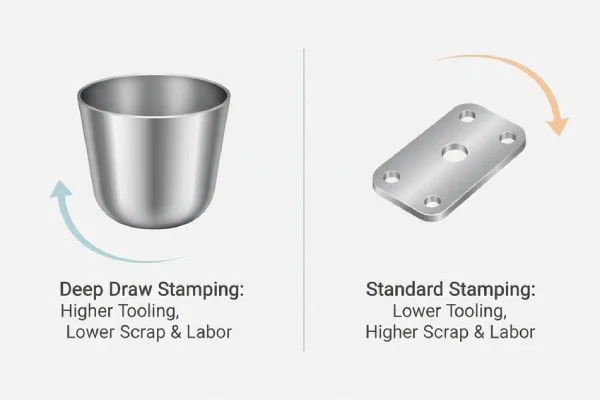
Deep draw stamping and progressive die stamping differ fundamentally in their processes: the former transforms a flat blank into a seamless hollow shape through a single or multiple drawing operations, while the latter relies on a multi-station sequence to progressively complete blanking, bending, and forming on a continuous strip of material. The differences between the two in terms of geometric capabilities, dimensional tolerances, production cycle times, and cost structures directly determine the scope of parts for which each is suitable.
Dimensions of Comparison | ||
Maximum Drawing Ratio (Single Pass) | 1.8–2.3 | Not applicable (depth is typically ≤ 0.5 times the diameter) |
Multi-pass drawing capability | The draw ratio can reach 3.0 or higher | It generally cannot exceed 1.5 times the diameter. |
Positional Tolerances Between Features | Moderate, depending on the geometric complexity | As low as ±0.001 inches (0.025 mm) |
Production Speed | 15–40 pieces per minute | 60–1,200 strokes per minute (up to 1,500 SPM at high speed) |
Applicable Depth-to-Diameter Ratio | >0.5, especially >1.0 | <0.5 |
Typical Parts | Housings, casings, cup-shaped parts, containers | Brackets, Clips, Terminals, Connectors |
Mold Costs | High | High (Multi-Station Integrated) |
Geometric Capabilities
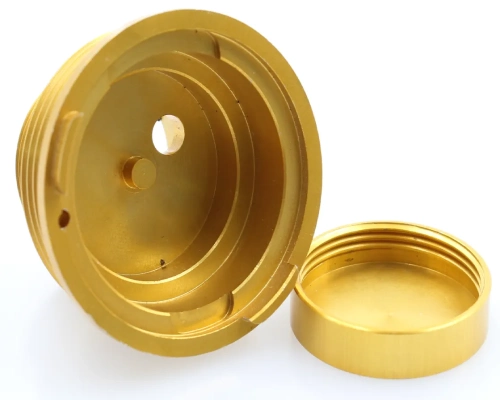
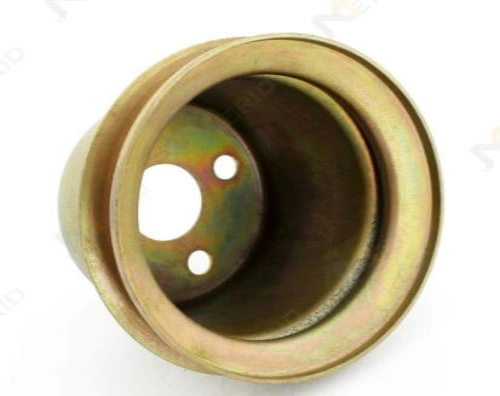
Part geometry is a decisive factor in process selection. deep draw metal stamping is specifically designed for hollow shapes where the depth exceeds the diameter—the punch pushes a flat blank into the die cavity, forming cup-shaped, can-shaped, and shell-shaped parts through multiple incremental draw reductions. Typical deep draw stamping parts include housings, covers, fluid transfer components, and pressure vessels.
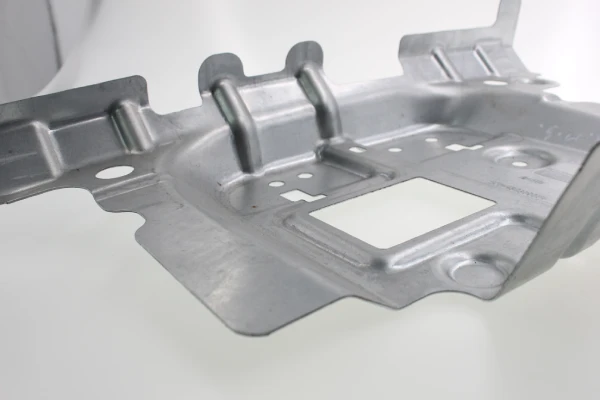
In contrast, progressive die stamping relies on a carrier strip to secure the part to the strip as it passes through each station; the restriction on material flow imposed by the strip means that the risk of tearing increases sharply when the depth exceeds approximately 1.5 times the part’s diameter. Progressive die stamping is suitable for flat or shallow-drawn parts such as brackets, clips, terminals, and connectors; when the part depth is less than half its diameter, progressive die stamping is the more efficient choice.
Dimensional Tolerances
Deep draw stamping and progressive die stamping serve different quality objectives in terms of tolerance capabilities.
Positional tolerances between features in progressive die stamping can be as low as ±0.001 inches (approximately 0.025 mm), because the part remains attached to the carrier strip throughout the entire process, and all operations share a unified reference. In high-speed progressive die stamping configurations, some precision stamping operations can achieve accuracy levels ranging from ±0.01 mm to ±0.02 mm.
Deep draw stamping technology, on the other hand, prioritizes ensuring uniform wall thickness and seamless structural integrity rather than the precise positioning of planar features. The typical tolerance range for the deep draw stamping process is ±0.05 mm to ±0.08 mm. Although the overall accuracy does not match the positioning accuracy of progressive die stamping, wall thickness consistency is far more critical than positional accuracy between features for parts that require structural strength and sealing performance.
Purchasing engineers should weigh tolerance requirements based on the functional needs of the part—whether positional accuracy or structural integrity is the primary consideration.
Production Volume and Cost Structure
Both deep draw stamping and progressive die stamping require significant initial tooling investment, but their economic break-even points differ markedly. Progressive die metal stamping operates at speeds ranging from 60 to 1,200 strokes per minute, with high-speed configurations capable of exceeding 1,500 strokes per minute. When annual production exceeds 10,000 to 50,000 units, the cost of progressive die stamping can break even through amortization at scale; projects with annual production below 5,000 units struggle to recoup the die investment.
Custom deep draw stamping also benefits from economies of scale; however, due to longer cycle times (15 to 40 strokes per minute, compared to 1,200 strokes per minute for progressive die stamping), there is a significant difference in the unit cost curve. deep draw stamping dies typically cost more than conventional forming dies because they require precise geometric design and surface treatment. However, for deep drawn parts with an annual production volume of 5,000 units or more, deep draw stamping technology is the only reliable manufacturing method.
Material Utilization
Material utilization directly affects raw material costs and environmental impact. In deep draw stamping, the blank is fully consumed in the forming of the part, resulting in minimal material waste; through staggered layout, material utilization can be increased from 70% to over 85%. Advanced optimization calculations can further reduce scrap by 7% to 9%.
Progressive die metal stamping achieves a material utilization rate of 65% to 85% through optimized strip layout and part nesting. However, carrier strips, alignment holes, and station spacing inevitably result in 15% to 35% engineering scrap.
Overall, custom deep draw stamping holds a slight advantage in material utilization—the blank is fully converted into the part—while the strip-connection structure of progressive die stamping means scrap cannot be completely eliminated. For high-cost materials (such as stainless steel or copper alloys), this difference can significantly impact overall manufacturing costs.
Process Selection Framework for Deep Draw Stamping vs. Progressive Die Stamping
The process selection between deep draw metal stamping and progressive die metal stamping is by no means a simple cost comparison—geometric conditions determine feasibility, while production volume determines economic viability.
A common misconception among procurement teams is to use production volume as the sole screening criterion, overlooking a fundamental fact: regardless of the quantity required, hollow fluid containers cannot be produced using a progressive die; similarly, even with very low production volumes, shallow-cavity brackets should not be manufactured using a deep draw stamping die.
The correct decision-making logic is to use the depth-to-diameter ratio as the primary screening criterion, and then evaluate the return on investment cycle based on annual production volume.
Decision-Making Factors | Select deep draw stamping | Select progressive die stamping |
Depth-to-Diameter Ratio | Greater than 0.5, especially greater than 1.0 | Less than approximately 0.5 |
Typical Parts | Housings, Covers, Cup-Shaped Parts, Tanks, Casing | Brackets, Clips, Terminals, Connectors |
Recommended Annual Production Volume | Medium to high (cost-competitive for 3,000–5,000 units or more) | High (typically 50,000 or more) |
Key Quality Requirements | Seamless structural integrity, leak-proof wall thickness, wall thickness uniformity | Positional Accuracy and Flatness Between Features |
Feature Complexity | Simple Axially Symmetric Shapes | Characteristics of porous, winding, and kinked structures |

When to Specify Deep Draw Stamping
When a part’s depth exceeds half its diameter—and especially when it exceeds the diameter—the deep draw stamping process is the only reliable manufacturing method. Typical applications include battery casings, sensor housings, fluid containers, industrial system enclosures, and pressure vessels—parts that require seamless side walls, uniform wall thickness, and structural integrity.
The punch pushes the flat blank into the die cavity through multiple progressive drawing operations, forming cup- or box-shaped parts. When annual production exceeds 3,000 to 5,000 units, the cost of the deep draw stamping die can break even through amortization at scale. For parts with a depth-to-diameter ratio exceeding 1.0, progressive dies cannot supply sufficient material to the die cavity due to carrier strip limitations, resulting in a sharp increase in the risk of tearing and concentricity deviation. Deep draw metal stamping is suitable for axially symmetric parts with relatively few features.
When to Specify Progressive Die Stamping
When a part’s depth is less than half its diameter, progressive die stamping is the more efficient choice. Typical parts include brackets, latches, terminals, connectors, and multi-feature stamped assemblies. Metal coil stock is progressively processed through a multi-station die to perform blanking, bending, coining, and forming, with each stroke producing a finished part. For annual production volumes exceeding 50,000 pieces, the high-speed operation of progressive die metal stamping (30 to 1,200 strokes per minute) allows die costs to be fully amortized, resulting in a unit cost significantly lower than that of other processes.
Position tolerances between features in a progressive die can be as tight as ±0.001 inch (0.025 mm), as the parts remain attached to the carrier strip and all operations share a unified reference. For flat or shallow-drawn parts, automated operation eliminates handling between processes, significantly reducing labor costs.
Key Considerations
The primary factor in process selection is part geometry—the depth-to-diameter ratio determines feasibility, not production volume. Material selection is equally critical: highly ductile materials (low-carbon steel, aluminum alloys) perform exceptionally well in deep draw metal stamping, while progressive die stamping is compatible with a wider range of material types and thicknesses.
Tolerance requirements also influence the decision—if positional accuracy is the primary design consideration, progressive die stamping is the preferred choice; if uniform wall thickness and seamless construction are core requirements, custom deep draw stamping offers greater advantages.
Additionally, secondary processing needs must be evaluated: the deep draw stamping process can reduce welding and assembly by forming parts in a single operation, while progressive die stamping can integrate operations such as punching and tapping within the die.
The cost of design changes should not be overlooked—die modifications for both processes are expensive, so clearly defining requirements early in the project is crucial.
Looking for a reliable custom sheet metal fabrication companies?
Talk To Supro MFG Expert Team
Contact us for competitive ex-factory prices,
and a full range of technical support services.
Conclusion
The choice between deep draw stamping and progressive die stamping does not depend on which process is superior, but rather on which process better meets the specific geometric shape, tolerances, and production requirements of the part. Custom deep draw stamping excels at producing seamless hollow parts with structural integrity, while progressive die stamping enables high-speed, high-precision production of flat or shallow parts with multiple features.
For manufacturers and procurement teams evaluating custom metal stamping solutions, the decision-making framework is clear: first consider the geometry, then the production volume, and finally evaluate the cost structure. Selecting the correct process during the design phase can prevent costly losses resulting from mismatched dies and ensure production stability throughout the project lifecycle.
Supro MFG specializes in custom precision sheet metal fabrication, providing comprehensive deep draw stamping and progressive die stamping solutions to OEM customers worldwide. Please contact our engineering team to discuss your specific component requirements.