

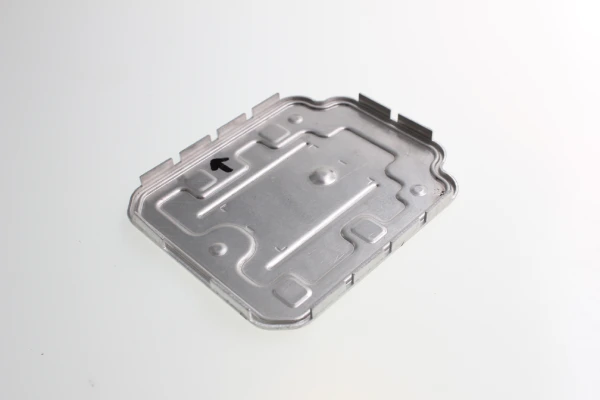
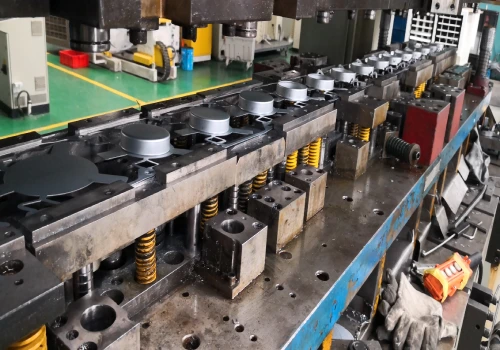
In the deep draw stamping process, springback remains a major obstacle affecting the dimensional accuracy of formed parts. When the punch is unloaded after plastic deformation, the elastic component of the accumulated strain causes the material to partially return to its original geometry. This phenomenon stems from the non-uniform distribution of residual stresses across the thickness of the sheet metal; this non-uniformity generates bending moments, causing the workpiece to deform upon unloading.
The magnitude of springback depends on the ratio of the material’s yield strength to its elastic modulus—advanced high-strength steels and aluminum alloys exhibit a stronger tendency toward springback, making compensation more complex in demanding deep draw stamping applications. In the automotive, aerospace, and medical sectors, tolerances are measured in micrometers—uncontrolled springback can directly lead to assembly failures, increased scrap rates, and reduced product reliability.
Addressing this challenge requires a systematic compensation framework that integrates finite element simulation for springback prediction, reverse compensation of die surface geometry, and process parameter optimization.
This paper explores the intrinsic mechanical principles of springback in deep draw metal stamping and proposes a systematic compensation strategy framework to achieve dimensional accuracy.
Mechanical Principles of Springback in Deep Draw Stamping
The springback phenomenon in the deep draw stamping process stems from the uneven distribution of residual stress across the thickness of the sheet metal, which generates bending moments and causes the workpiece to deform upon unloading.
Elastic Springback and Residual Stress Distribution
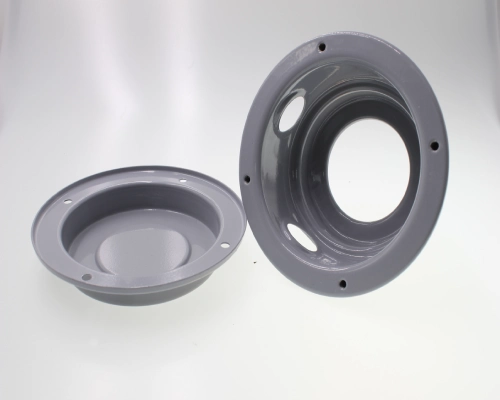
Springback in deep draw metal stamping stems from the elastic component of the total strain accumulated during the plastic deformation process. When the die is removed and the punch load is released, the non-uniform residual stresses distributed across the thickness of the sheet metal generate a bending moment, causing the workpiece to partially return to its original geometric shape.
Research conducted on deep drawn cup bodies using synchrotron X-ray diffraction measurements has confirmed that both axial and tangential residual stresses exhibit nonlinear gradient distributions across the thickness direction. This stress disparity across the thickness—manifested as significant stress differences between the sidewall surface and the back surface of the workpiece—is the primary driving force behind the springback phenomenon.
The extent of elastic recovery fundamentally depends on the ratio of the material’s yield strength to its elastic modulus; Due to their higher strength-to-stiffness ratio, advanced high-strength steels and aluminum alloys exhibit a relatively stronger tendency toward springback. Therefore, while springback cannot be completely eliminated, it must be systematically predicted and compensated for by modifying the geometry of the deep draw stamping die and optimizing process parameters.
Regional Variations in Springback
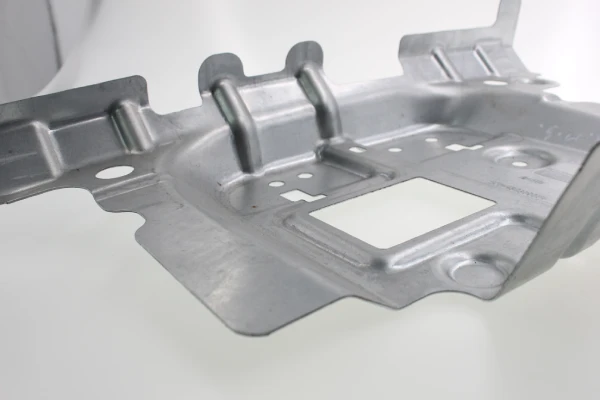
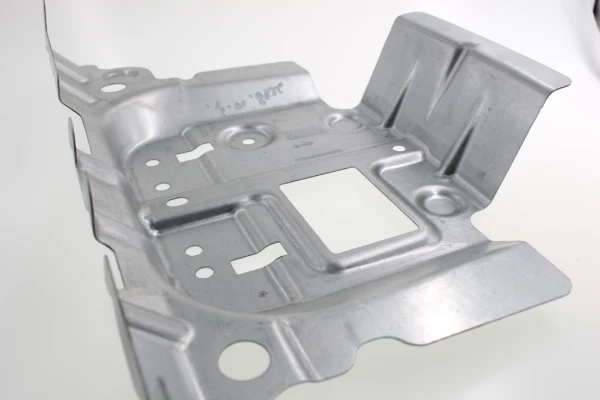
A key characteristic of springback in custom deep draw stamping is its uneven distribution across different regions of the formed geometry. In complex deep drawn stamped parts, due to the non-uniform deformation history experienced by different regions during the forming process, there are significant differences in the degree of elastic recovery among the side walls, flanges, corner radii, and base plate sections. Side walls are particularly prone to springback-related defects, such as dents, warping, and side wall curling—a phenomenon directly attributable to residual stresses generated by non-uniform deformation in the thickness direction of the sheet metal.
Corner regions, which are subject to higher stress concentrations and more severe strain gradients, typically exhibit springback behavior that differs from that of flat wall sections. These regional differences greatly increase the complexity of compensation efforts, as uniform die modifications cannot resolve local deviations without inducing new distortions in other areas.
Therefore, effective springback management requires region-specific compensation strategies based on high-fidelity finite element simulations capable of capturing the unique springback behavior of each geometric feature.
Methods for Quantitative Prediction of Springback in Deep Draw Stamping
Quantitative prediction of springback relies on coupled analysis of finite element simulation and material constitutive models, providing precise displacement field data and a basis for correction in die compensation for deep draw metal stamping.

Integrated Application of Finite Element Simulation and CAE in Deep Draw Stamping
In the deep draw stamping process, accurate springback prediction begins with high-fidelity finite element simulation. Commercial CAE platforms such as ABAQUS/EXPLICIT and AutoForm are capable of performing three-dimensional numerical simulations of the entire forming and unloading process, thereby capturing the coupled effects among die geometry, material anisotropy, friction conditions, and process parameters.
The predictive accuracy of these simulations depends largely on the constitutive model employed—strain-path-sensitive hardening models yield significantly different springback predictions compared to isotropic models. By generating displacement vectors that describe the springback deformation field, finite element simulation provides the quantitative data required for subsequent deep draw stamping die compensation, thereby reducing reliance on costly trial-and-error die development processes.
Advanced Optimization Framework
Contemporary springback prediction has moved beyond standalone finite element simulations and has evolved further through the integration of machine learning and meta-heuristic optimization algorithms. The “FEM-ANN-PSO” strategy, which combines finite element modeling (FEM), artificial neural networks (ANN), and particle swarm optimization (PSO), has demonstrated its effectiveness in reducing springback in custom deep draw stamping applications.
Dimension-reduction neural networks trained on ABAQUS/CAE simulation data have successfully enabled efficient springback prediction for multi-material cylindrical cups, significantly reducing computation time while maintaining prediction accuracy.
The combination of the response surface method and multi-objective genetic algorithms provides an automated optimization path capable of simultaneously minimizing springback and thickness deformation. These hybrid methods transform springback management from iterative physical prototyping into data-driven process engineering.
Deep Draw Stamping Die Surface Compensation: The Primary Correction Strategy
Die surface compensation is the primary strategy for springback control in deep draw stamping. It involves reversing the die surface based on simulated displacements to ensure the part springs back to the target position after unloading, relying on iterative compensation to achieve convergence. This method offsets elastic recovery through reverse geometric adjustments; its accuracy depends on the precision of the material constitutive model and the definition of boundary conditions, and requires multiple rounds of simulation-experiment closed-loop validation before it can be applied in mass production.
Geometric Reverse Compensation
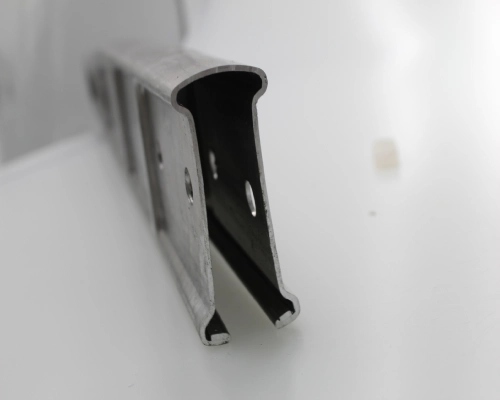
Geometric reverse compensation is the most critical die correction strategy in custom deep draw stamping. Its basic principle involves applying the springback displacement vector—derived from simulation predictions or actual measurements—in the opposite direction to the die surface, so that the formed part converges precisely to the target geometry after elastic recovery.
This process is not a simple equidistant offset—for complex 3D surfaces, traditional uniform offset methods often fail, requiring point-by-point reconstruction of the deep draw stamping die surface based on the node displacement field. The convergence of the compensation depends on an iterative closed-loop process: after each compensation, a springback simulation is performed to assess whether the deviation falls within the tolerance range; if the criteria are not met, corrections continue until the deviation converges.
For springback-sensitive materials such as high-strength steel and aluminum alloys, the accuracy of geometric inverse compensation directly depends on the accuracy of the material’s constitutive model—anisotropic hardening models provide more reliable displacement field predictions than isotropic formulations.
Surface Modification Techniques for Deep Draw Stamping Dies
In the deep draw stamping process, die surface modification techniques advance springback compensation from a conceptual level to an executable engineering operation, primarily achieved through two types of geometric optimization methods: the Smooth Displacement Adjustment (SDA) method and the Surface-Controlled Overbend (SCO) method.
The SDA method corrects geometric deviations by applying a smoothed displacement field to the die surface; it is suitable for conditions where springback is small and uniformly distributed. The SCO method, on the other hand, pre-compensates for elastic recovery by introducing controlled over-bends on the die surface; it is particularly suitable for addressing localized deformation issues such as sidewall warpage and corner springback in deep drawn stamped parts.
Both methods use finite element simulation results as input to optimize tool geometry. In terms of automated implementation, volume morphing technology has been widely applied to compensation in automotive body panel dies—as exemplified by the FESHAPE program.
Based on the volume morphing algorithm developed by Sederberg and Parry, this tool automatically reshapes CAD or finite element mesh models according to displacement vectors, eliminating the need for manual geometric modifications. FESHAPE has been validated in the production of over 500 stamping dies (covering deep drawing, trimming, and flanging operations).
Only 4 steps
online custom metal fabrication parts
Contact our experts team and experience the efficiency and economic benefits of digital metal fabrication services.
Upload Design Files
STL , STEP (.stp), IGES (.igs), (.ZIP), or PDF.
Also be a sample or an idea
Quote & Design Analysis
Instant factory quotes and DfM reports, the most reasonable solution.
Manufacturing Begins
Digital processes can initiate order tasks within 24 hours.
On-Time Delivery
Keeping delivery promises, approved by 3000+ Global Company buyers.
Parameter Optimization of the Deep Draw Stamping Process to Mitigate Springback
Process parameter optimization—by adjusting the blank holder force (BHF) and drawbead resistance—alters sheet metal flow and stress distribution, thereby reducing residual stress gradients during the forming stage and mitigating the springback effect in deep draw metal stamping. However, this requires balancing the forming safety margin.

Blank Holder Force and Draw-Bead Control
In the deep draw stamping process, blank holder force (BHF) has a dominant influence on the magnitude of springback. A quantitative study of parameters for the DP590 S-shaped U-channel stamping process shows that BHF accounts for 33.06% of the total variation in springback, ranking second only to the friction coefficient, which accounts for 56.21%. When properly selected, BHF can reduce springback in deep drawn stamped parts by regulating the flow of material into the die cavity and minimizing the residual stress gradient in the thickness direction of the sheet metal.
A variable BHF strategy—that is, applying a lower BHF early in the stroke to prevent reaching critical strain levels and gradually increasing BHF before the end of deformation—can effectively eliminate sidewall curling and reduce springback. Segmented blank holder systems can significantly compensate for springback anisotropy by applying different force distributions to different areas of the blank holder surface.
Drawbeads provide an additional mechanism for restricting material flow; their geometry and layout can be optimized using response surface methodology combined with genetic algorithms to minimize springback while preventing wrinkling in deep drawn stamped parts. Experimental evidence indicates that an increase in the embedding depth of drawbeads generally corresponds to a reduction in springback, while sidewall curvature and angle exhibit predictable responses to adjustments in drawbead geometry.
Combining spatially and temporally optimized BHF with strategically placed drawbeads is a reliable method for effectively suppressing springback without modifying the geometry of the deep draw stamping die.
Multi-Stage and Stress Superposition Approaches
The multi-stage deep draw stamping process offers a fundamentally different approach to reducing springback by controlling the stress history. It employs asymmetric and alternating draw-in methods to induce alternating bending along the die radius, thereby generating beneficial stress superposition in the part’s wall regions and reducing springback. By adopting a three-stage forming process that optimizes the blank pull-in kinematics, springback can be reduced by more than 75%.
The stress superposition method—which induces controlled stresses along the meridian direction of the formed part by modifying the die radius—is an emerging compensation strategy. In the deep draw stamping process, these stress superposition effects cause the workpiece area in contact with the punch radius to undergo repeated bending and straightening cycles. Using finite element (FE) simulation with LS-Dyna, the optimal blank draw kinematics were successfully defined, significantly reducing springback in a double-curved cap-shaped part made from DP 980 steel sheet.
This numerical method has been experimentally validated, and the die used enables alternating deep drawing of the blank during the sheet metal forming process. For high-strength steels and aluminum alloys where conventional compensation methods have reached their limits, the adoption of a stress-superposition-based multi-stage deep draw stamping process transforms springback management from passive die correction to active process design.
Secondary Processing and Final Correction of deep drawn Stamping Parts
When die compensation and process parameter optimization after the initial forming still fail to control springback within tolerance limits, secondary processing and final correction become the last line of defense for ensuring the dimensional accuracy of deep drawn stamping parts. Common correction methods include ironing, restriking (also known as calibration), and coining.
Ironing—which involves pulling the deep drawn cup over an ironing ring—can effectively improve surface quality and correct wall thickness irregularities; coining or restriking applies compression using a rigid tool with a gap smaller than the material thickness in the bent areas, introducing superimposed compressive stress to weaken the dominant bending stress state, thereby significantly reducing springback in deep draw stamping.
For springback-sensitive materials such as advanced high-strength steel (AHSS), post-stretch operations can effectively eliminate sidewall curling by converting the tensile-compressive elastic strain gradient in the sidewall thickness direction into a fully tensile elastic strain.
The trimming process must also not be overlooked—removing unconstrained material alters the stiffness distribution of the part and may induce additional springback; therefore, trimming operations must be incorporated into the complete simulation sequence for springback prediction.
The aforementioned correction measures are sequentially performed in the continuous stations of a transfer press, ultimately locking the geometry of deep drawn stamped parts to the target contour.
Conclusion
In the deep draw stamping process, springback is an inevitable consequence of elastoplastic deformation; however, its impact on dimensional accuracy can be systematically controlled through multi-level compensation strategies.
Combining finite element simulation for springback prediction, die surface compensation based on geometric reverse engineering, process parameter optimization, and selective secondary machining forms a comprehensive framework for achieving dimensional accuracy in deep drawn stamped parts.
For precision deep draw metal stamping manufacturers, the advantages of simulation-driven compensation methods are directly reflected in shorter die development cycles, minimized scrap rates, and consistent part quality throughout the entire production process. As the strength-to-weight ratio of materials continues to improve across various industries, sophisticated springback compensation strategies will remain a critical differentiator in high-performance deep draw stamping operations.
For inquiries regarding technical specifications, customized metal stamping project solutions, or OEM partnerships, please contact Supro immediately. Our professional engineering team is ready to provide you with tailored application solutions.