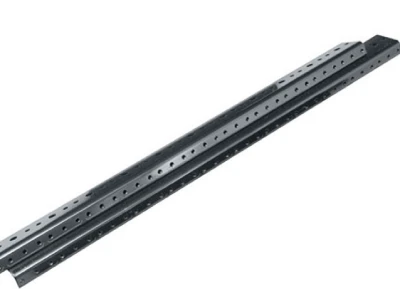

During the deployment of large data centers, few issues cause more unpredictable assembly delays than hardware interference within server rack rails. Standard EIA-310 square mounting holes require strict dimensional tolerances to ensure seamless compatibility with cage nuts and sliding mechanisms. However, uncontrolled powder coating buildup can significantly reduce the effective hole clearance, directly leading to fastener jamming, incorrect torque installation, or even the complete failure to complete rack integration.
At Supro MFG, our engineering failure analysis indicates that a seemingly insignificant 0.15-millimeter excess coating thickness on precision server rack rails is sufficient to bring time-sensitive installation schedules to a standstill. This specific dimensional deviation typically stems from uncontrolled electrostatic deposition and the Faraday cage effect during the surface treatment stage, rather than structural inaccuracies in the initial CNC stamping process.
This article explores in detail the fundamental physical causes of powder buildup in custom server rack rails and elaborates on the precise manufacturing process control measures required to ensure zero-defect installation compatibility and eliminate costly on-site rework.
Analysis of the Causes of Hardware Interference in Server Rack Rails: Powder Coating Buildup in Mounting Holes
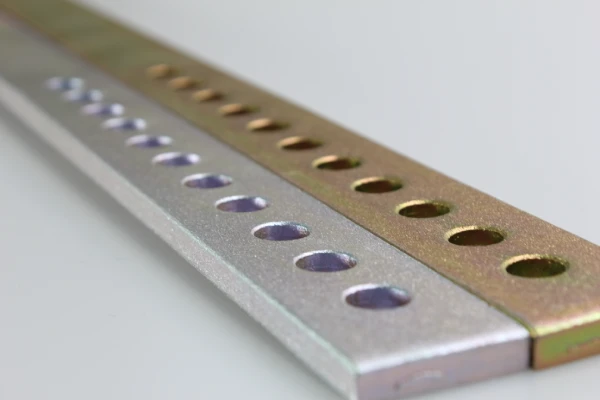
Dimensioning issues with metal server rack rails rarely originate from the initial CNC punching stage. Instead, hardware interference typically occurs during the surface treatment process, when complex powder deposition dynamics fundamentally alter the critical internal clearances of the mounting holes.
Abnormal Electrostatic Voltage and the Faraday Cage Effect
When applying surface treatment to custom server rack rails, standard 9.5-millimeter EIA square holes naturally trigger the Faraday cage effect during the electrostatic powder coating process.
If the spray gun voltage is set too high—typically exceeding 80 kV for complex profiles—electrostatic repulsive forces prevent powder particles from penetrating the inner walls uniformly. Conversely, charged polymer accumulates heavily at the outer edges of the mounting holes, causing severe localized buildup. Once cured in the oven, this uneven edge thickness directly violates critical dimensional tolerance requirements.
By finely adjusting the electrostatic voltage and modifying the powder cloud velocity, this edge buildup can be mitigated, ensuring that metal server rack rails maintain precise internal clearances so that standard M6 cage nuts can be inserted without mechanical friction.
Pre-Curing Masking and Process Failures
Even with optimized spraying parameters, process errors prior to the curing oven remain the primary cause of hardware interference. During mass production of precision server rack rails, inadequate pre-curing procedures—particularly the failure to use high-temperature silicone masking plugs or perform precise compressed air purging—can result in residual powder remaining in the mounting areas.
Once the metal enters the oven (typically at 200°C), these loose particles melt and cross-link, solidifying into a hard, fused polymer crust that significantly reduces the hole diameter. This hardened deposit often causes thread seizure or makes it completely impossible to install fasteners during final assembly.
To eliminate this defect, Supro MFG has implemented strict in-line quality control checkpoints to ensure that every custom server rack rail undergoes rigorous mechanical masking and air purging prior to the heat-curing stage, thereby maintaining the original CNC-punched dimensions.
Are you looking for reliable & cost-effective
China Sheet Metal Fabricators
More than 150,000 OEM metal fabrication products delivered to 5,000+ global buyers.
And benefit from it!
Advanced Process Control for Server Rack Rail Coatings
To overcome these gap defects, it is necessary to shift from standard surface treatment processes to a precisely controlled powder coating process. Manufacturing defect-free precision server rack rails requires the use of micron-level automatic parameter adjustment technology, combined with strict thermal shielding protocols, to ensure interference-free hardware integration on the assembly line.
Optimizing Automated Powder Coating Parameters
To achieve uniform coating thickness on metal server rack rails, manual spraying must be replaced with an automated, multi-axis robotic spraying process.
At Supro MFG, we optimize fluidization pressure through engineering design and precisely adjust the spray gun’s microampere (µA) parameters to strictly control powder flow rate. By limiting corona charging to optimal levels, we effectively prevent excessive particle entanglement at perforations. Our goal is to achieve a consistent cured thickness of 60 to 80 micrometers. To maintain this standard, automated reciprocating spray guns dynamically adjust the distance between the gun and the workpiece based on the geometric complexity of the custom server rack rails.
This robotic-level precision eliminates localized overspray that causes interference with cage nuts, ensuring that mounting interfaces meet precise dimensional tolerances while providing robust corrosion protection.
Application of Precision Air Blowing and Thermal Shielding Technologies in Server Rack Rail Production
To preserve the integrity of the holes, physical intervention prior to entering the curing oven is essential. For the high-density arrays of square holes in precision server rack rails, manually installing heat-resistant silicone plugs into each slot is often prohibitively costly and inefficient. Therefore, we have deployed a precision-directed compressed air blowing system immediately at the exit of the spray booth.
Calibrated nozzles selectively remove uncured powder from the inner edges of the mounting holes without damaging the protective coating on the main surfaces. For the specific threaded structures within the server rack rails, selective heat-shielding tape is used to protect the internal threads from the effects of polymer cross-linking.
These targeted physical control measures ensure that, after the components undergo a 200°C curing cycle, the mounting interfaces still strictly meet tolerance requirements, thereby guaranteeing friction-free hardware assembly.
Only 4 steps
online custom metal fabrication parts
Contact our experts team and experience the efficiency and economic benefits of digital metal fabrication services.
Upload Design Files
STL , STEP (.stp), IGES (.igs), (.ZIP), or PDF.
Also be a sample or an idea
Quote & Design Analysis
Instant factory quotes and DfM reports, the most reasonable solution.
Manufacturing Begins
Digital processes can initiate order tasks within 24 hours.
On-Time Delivery
Keeping delivery promises, approved by 3000+ Global Company buyers.
Balancing Corrosion Resistance and Dimensional Accuracy in Server Rack Rails
When designing custom server rack rails, a trade-off must be made between environmental protection and mechanical clearances. To achieve excellent corrosion resistance without compromising EIA-310 dimensional accuracy, it is necessary to develop a precise coating formulation and implement a rigorous micron-level coating thickness verification process.
Selection of Coating Materials for Server Rack Rails: A Comparison of Epoxy and Polyester Hybrid Coatings
For server rack rail systems operating in temperature-controlled data centers where corrosive environments may be present, selecting the correct powder coating formulation is critical.
Pure epoxy powders offer excellent chemical resistance and adhesion to metal, but their rapid curing rate often exacerbates edge buildup within square holes. Conversely, pure polyester powders provide outstanding flow and leveling properties but have poor edge coverage, which may leave bare metal exposed to an oxidizing environment.
As a specialized server rack rail manufacturer, Supro employs a proprietary epoxy-polyester hybrid formulation to design its surface coatings. This hybrid formulation fully leverages the mechanical toughness of epoxy resin while utilizing the controllable melt viscosity of polyester, thereby ensuring the formation of a smooth and uniform coating film.
This specialized formulation not only provides powerful rust protection but also minimizes localized coating buildup, thereby preventing cage nut interference issues in precision server rack rails.
Micrometer-Level Coating Thickness Measurement and Verification
Relying solely on visual inspection to determine hardware compatibility is bound to lead to failure. To ensure strict compliance with the EIA-310 dimensional tolerance standard, high-quality metal server rack rails must undergo rigorous micrometer-level thickness verification. We use a non-destructive magnetic induction testing method that strictly complies with the ASTM D7091 standard to measure dry film thickness (DFT).
Our quality assurance engineers not only perform sampling inspections on broad, flat surfaces but also specifically inspect the inner peripheries of stamped square holes. By strictly controlling the dry film thickness (DFT) between 60 and 80 micrometers at the exact points of hardware integration, we statistically eliminate the risk of fastener jamming.
Each shipment of custom server rack rails is accompanied by a detailed inspection report, providing procurement teams with verifiable empirical data confirming both comprehensive corrosion protection and flawless mechanical assembly.
Looking for a reliable custom sheet metal fabrication companies?
Talk To Supro MFG Expert Team
Contact us for competitive ex-factory prices,
and a full range of technical support services.
Design for Manufacturability (DFM) in Server Rack Rail Fabrication
True hardware compatibility begins in the CAD environment, long before the steel blanks enter the powder coating chamber. To achieve zero-defect assembly in server rack rail manufacturing, dry film thickness (DFT) must be precisely accounted for through proactive Design for Manufacturability (DFM).
Since standard EIA-310 square mounting holes must maintain a strict 9.5-millimeter internal clearance after curing, our engineering team performs precise dimensional compensation during the initial CNC programming phase.
If a specified mixed powder coating requires a build-up of 75 micrometers per side to achieve optimal corrosion resistance, the flat pattern geometry must be explicitly scaled up by 0.15 millimeters prior to stamping. Failure to incorporate this pre-scaling adjustment into the design of metal server rack rails will inevitably result in cage nuts seizing during assembly, forcing installers to scrape off the cured coating and exposing the bare metal to oxidation.
By integrating these critical DFM (Design for Manufacturability) calculations early in the process, Supro MFG has completely eliminated corrective rework. This data-driven engineering approach ensures that every custom server rack rail we deliver achieves perfect mechanical integration, thereby safeguarding deployment schedules and reducing the total cost of ownership for procurement teams.
Conclusion
To achieve seamless hardware integration, powder coating alone is far from sufficient. For any precision server rack rails, maintaining strict EIA-310 dimensional tolerances after curing is the ultimate benchmark of manufacturing capability. By combining proactive DFM tolerance compensation with micron-level automated powder deposition technology, Supro MFG completely eliminates the risk of fastener binding and on-site assembly friction, ensuring your data center deployment proceeds strictly according to schedule while permanently reducing the total cost of ownership.
Supro is a specialized custom server rack rail manufacturer. Leveraging advanced equipment, extensive manufacturing experience, and a professional engineering team, we have provided flawless custom server rack rail services to over 3,000 companies worldwide and offer genuine manufacturer quotes.
We deliver a wide range of products efficiently and on time. From product design and rapid sheet metal prototype fabrication to mass production, we provide professional technical support and exceptional quality.
We offer one-stop manufacturing solutions and highly cost-competitive product supply! For technical specifications or inquiries regarding OEM partnerships, please contact our engineering team.