
Selecting the optimal metal forming process is a critical decision that directly impacts part structural integrity, production scalability, and final cost. For procurement specialists, understanding the distinction between deep draw stamping and standard stamping is not merely theoretical knowledge—it is key to project success.
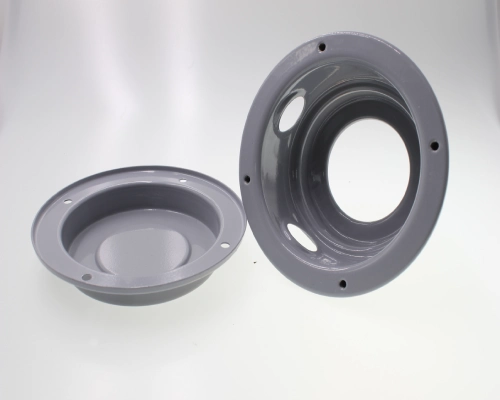
Standard stamping excels at cutting, bending, and forming flat or contour geometries, while deep draw stamping is a specialized process that mechanically draws metal blanks into forming dies to create seamless hollow components with depths exceeding their diameters. This technical distinction makes deep drawing stamping services the preferred solution for manufacturing complex enclosures, pressure vessels, and automotive structural components demanding exceptional strength and uniform wall thickness.
When evaluating deep draw metal stamping versus standard stamping, considerations extend beyond forming capability to include tooling strategy, material flow characteristics, and long-term production stability. Deep drawn stamping parts achieve progressive metal deformation through fillet dies, preserving grain structure while eliminating costly secondary welding. Conversely, standard stamping dies typically employ sharp cutting edges to shear material. Thus, process selection constitutes a strategic decision directly impacting supply chain efficiency and final component performance.
Types of Stamping Methods Explained
Metal stamping covers a lot of ground, from simple cuts to serious forming like deep draw stamping. When you split the phrase into its core—deep, draw, stamping—you start to see how depth, material flow, and press force all connect. From high-volume runs to complex deep draw parts, each method has its own groove.
Progressive Die Stamping for High Volume Production
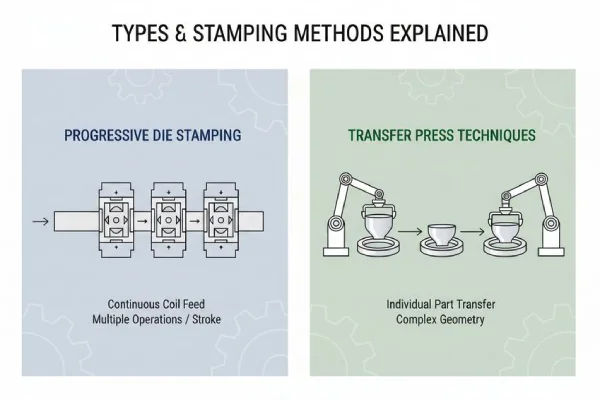
In high-speed production, a progressive die setup keeps the stamping process moving without pause. It blends automation, efficiency, and smart tooling into one steady rhythm.
Core Workflow:Material feeds continuously into the die.Each station performs part of the metal forming action.Finished components exit at every press stroke.
Production Strengths:Consistent quality in high volume automotive brackets.Tight repeatability for electronics housings.Reduced downtime due to synchronized tooling design.
While deep draw stamping usually demands specialized draw stations, progressive systems can integrate shallow draw stamping stages for lighter-depth parts, keeping output fast and cost per unit low.
Transfer Press Techniques in Deep Forming
A transfer press shines when deep forming meets complex geometry. For shops handling deep draw stamping, this method allows controlled part transfer between stations, reducing distortion during heavy draw stamping operations.
Key Advantages:
Better control for deep drawn cavities
Stable forming of aluminum alloy panels
Flexible tooling design for shape changes
In real production, the cycle flows like this: blanking → initial draw → redraw → trimming → final inspection. Each stage supports precision in metal stamping, especially for deep draw components used in HVAC housings and appliance shells.
For demanding draw depths and consistent results in deep draw stamping, manufacturers like supro mfg tune press force curves and transfer timing to protect dimensional accuracy.
Blanking and Piercing for Stainless Steel Enclosures
When shaping stainless steel for medical or electronic enclosures, clean edges matter. The combo of blanking and piercing sets the foundation before any deep draw stamping begins.
Material Preparation:Sheet metal selection.Surface inspection.Lubrication for smoother draw stamping
Cutting Accuracy:Profile cut through blanking.Hole formation via piercing.Edge conditioning to prevent cracking in later deep draw stamping
Precise precision cutting ensures that when the sheet moves into deep draw stamping, the material flows instead of tearing.
Parameter | Typical Range | Impact on Deep Draw Stamping |
Sheet Thickness (mm) | 0.5–3.0 | Affects draw ratio |
Clearance (%) | 5–10 | Influences burr height |
Press Tonnage (T) | 40–200 | Determines cut quality |
Hardness (HV) | 150–220 | Impacts formability |
Draw Ratio | 1.5–2.2 | Controls depth capability |
Coining and Trimming of Tight Tolerance Parts
For high-precision machining, stamping compresses materials under high pressure to sharpen features. Trimming then removes excess material from formed shells—particularly after deep draw stamping processes, where flange control is critical.
In practice:
Coining strengthens corners in precision parts.
Trimming smooths edges for plating or anodizing.
Combined with the deep draw stamping process, it enables simultaneous optimization of strength and surface treatment effects.
This approach supports metal finishing needs in aerospace housings and structural brackets where microns count.
Compound Dies vs. Carbide Tooling Designs
Choosing between compound dies and carbide tooling depends on output goals and material type.
Compound Dies:Multiple cuts in one press stroke.Efficient for flat parts.Ideal before secondary deep draw stamping stages.
Carbide Tooling:High wear resistance.Longer life in abrasive stainless runs.Stable edges during repetitive draw stamping cycles.
Material Selection Considerations:Carbon steel for cost control.Aluminum for lighter deep drawn parts.Aerospace alloys needing precision stamping dies.
For manufacturers scaling deep draw stamping in demanding industries, the smart mix of tooling design and material choice keeps production steady. Teams working with supro mfg often balance compound die speed with carbide durability to hit both cost and lifespan targets without cutting corners.
online custom metal fabrication parts
Only 4 steps
Contact our experts team and experience the efficiency and economic benefits of digital metal fabrication services.
Upload Design Files
STL , STEP (.stp), IGES (.igs), (.ZIP), or PDF.
Also be a sample or an idea
Quote & Design Analysis
Instant factory quotes and DfM reports, the most reasonable solution.
Manufacturing Begins
Digital processes can initiate order tasks within 24 hours.
On-Time Delivery
Keeping delivery promises, approved by 3000+ Global Company buyers.
3 Reasons Deep Draw Stamping Outperforms Standard Stamping
deep draw stamping process isn’t just another metal forming trick—it’s the go-to move when parts need depth, strength, and clean lines. By breaking down “deep draw stamping” into deep draw + draw stamping + metal stamping, you start to see why this process beats basic press work in real-world production.
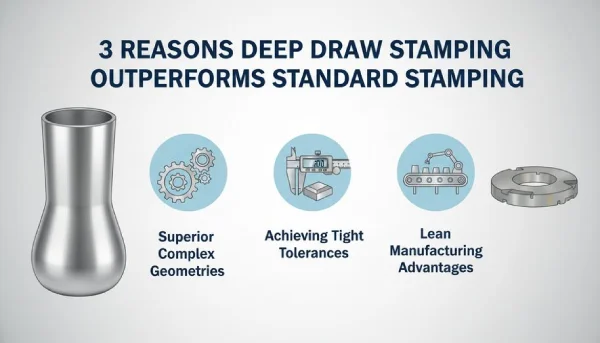
Superior Complex Geometries with Deep Draw Components
When faced with highly complex shapes, the advantages of the deep draw stamping process become evident. Unlike traditional methods that primarily rely on cutting or bending metal, deep draw metal stamping creates components with exceptional aspect ratios and continuous cylindrical walls by controlling material flow, effectively reducing welded joints.
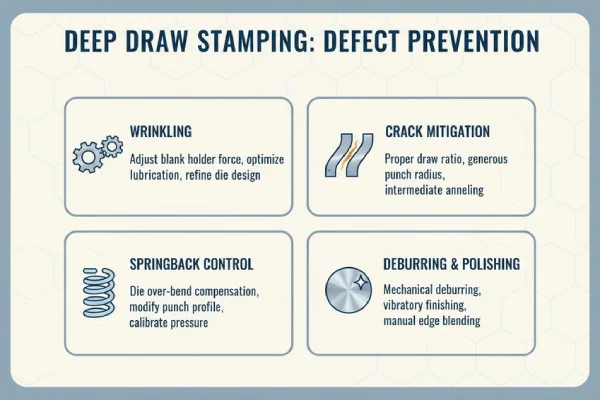
By precisely regulating blank holder pressure and balancing tensile forces during drawing, deep draw metal stamping manufacturers mitigate fracture risks while achieving smooth fillet transitions that optimize stress distribution. This technology produces precision enclosures for automotive, aerospace, and electronics applications with smoother surfaces and more stable geometries. Compared to shallow drawing processes, deep draw metal stamping reduces seam processing and shortens product development cycles. Consequently, when geometries become complex, teams partnering with Supro Mfg often prioritize the deep draw stamping process.
Achieving Tight Tolerances in High Precision Parts
It is precisely in meeting stringent specifications that deep draw metal stamping truly demonstrates its value:
Controlled punch speed improves dimensional accuracy.
Refined die clearance strengthens quality control outcomes.
Stable lubrication enhances component reliability.
In the deep draw stamping process, mold precision determines tolerance specifications, which standard metal stamping processes struggle to meet. Below is a brief technical comparison:
Parameter | Standard Stamping | Deep Draw Stamping | Tolerance Range (mm) |
Wall Thickness Variation | ±0.15 | ±0.05 | 0.05–0.15 |
Concentricity | ±0.20 | ±0.08 | 0.08–0.20 |
Roundness | ±0.25 | ±0.10 | 0.10–0.25 |
Surface Finish (Ra µm) | 3.2 | 1.6 | 1.6–3.2 |
Repeatability (Cpk) | 1.1 | 1.6 | 1.1–1.6 |
Lean Manufacturing Advantages and Reduced Setup Times
The lean benefits delivered by deep draw metal stamping accumulate rapidly.
Integrated forming stages: Fewer secondary trims, Less rework
Rapid die alignment: Shortened debugging cycles
Production Efficiency:Automated assembly lines.Reduced part handling.Lower scrap rates
Operational Cost Control:Simplified deep drawing process.Minimized manual intervention points.Enhanced predictability of metal forming schedules
By streamlining redundant forming operations, the deep draw stamping process overcomes traditional bottlenecks to empower lean manufacturing. In high-volume deep draw metal stamping projects, these advantages rapidly translate into shorter delivery cycles and lower operational costs.
Are you looking for reliable & cost-effective
China Sheet Metal Fabricators
More than 150,000 OEM metal fabrication products delivered to 5,000+ global buyers.
And benefit from it!
Cost Comparison: Deep Drawing vs. Standard Stamping
When evaluating deep drawing versus standard stamping from a total cost perspective, the analysis extends far beyond initial tooling investment. Although deep drawing typically requires more complex tooling, this process significantly reduces per-unit costs through material optimization, reduced secondary operations, and faster cycle times for high-volume production. Deep draw metal stamping manufacturers minimize scrap by controlling material flow and eliminate welding processes. Compared to standard processes that may require multiple assembly steps, this directly lowers your final costs.
Deep Draw Stamping
For high-volume structural shells, supro mfg often recommends deep draw stamping process because the higher tooling spend gets absorbed fast through better material utilization and lower scrap rate.
1)Upfront Investment
Tooling:Higher die complexity for deep draw tooling.Precision engineering for complex part complexity
Setup time:Longer initial dial-in.Fewer adjustments once stabilized
2)Production Economics
Material utilization:Optimized blank design reduces scrap rate.Controlled metal flow improves draw stamping consistency.
Production speed:High repeatability in long runs.Stable cycle times after validation.
3)Operational Impact
Labor:Reduced welding and trimming.Fewer secondary operations
Structural Efficiency:Complex geometries formed in a single deep draw stamping cycle.Lower assembly stacking tolerance issues
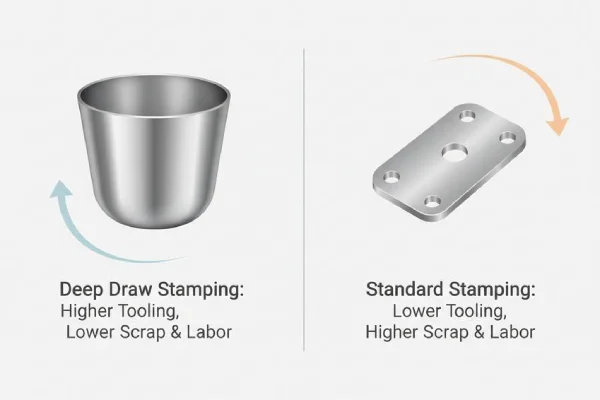
Standard Stamping
Standard stamping keeps things simple. Lower tooling complexity means shorter setup time and less upfront risk.
Good fit for shallow shapes
Faster die changes
Lower initial capital
But cost creeps in elsewhere:
1) Extra forming hits labor.
2) Trimming steps increase scrap rate.
3) Welded assemblies slow production speed.
In short runs, that’s fine. For deeper cavities, traditional stamping may struggle with part complexity, pushing teams toward secondary forming. At this point, deep draw metal stamping demonstrates its advantages.
At supro mfg, engineers break it down like this: if the part needs depth, strength, and clean walls, deep draw stamping wins long term. If it’s flat and simple, standard stamping keeps cash flow steady.
Get instant ex-factory price quotation.
If you only have an idea or an old sample,Let us know.
with photo or video and get our quotation and manufacturing solutions.
- Product design drawings or 3D model files.
- Material standards and appearance requirements.
- Product quantity demand.
- Industry standards in the application field.
- Functional requirements
Contact Us
Ultimately, the choice between deep draw metal stamping and standard stamping hinges on part geometry and lifecycle requirements. For professional procurement, partnering with experienced deep draw metal stamping manufacturers like Supro MFG enables efficient material utilization and seamless production of high-strength components.
With over 20 years of ISO 9001-certified expertise, Supro delivers comprehensive technical analysis—from deep draw stamping process optimization to DFM (Design for Manufacturability)—transforming complex designs into manufacturable, cost-effective deep drawn stamping parts. We provide one-stop manufacturing solutions and highly competitive product supply!