

In the field of piping systems, our experience indicates that the root cause of failure in the vast majority of systems lies not in the pipes themselves, but in their support systems—metal pipe brackets. A common oversight across industries is prioritizing the procurement of pipes while neglecting the design of metal pipe brackets; focusing solely on initial costs while ignoring total lifecycle costs. For non-standard, custom piping systems, such negligence can lead to catastrophic consequences.
Standard metal pipe brackets are only suitable for idealized straight pipe sections and cannot address the unique stress concentrations, complex load paths, and demanding center-of-gravity distribution issues arising from irregular pipeline geometries. The consequence is compromised structural integrity of the piping system, leading to significant property damage.
This paper presents a systematic approach to custom metal pipe brackets grounded in engineering mechanics and materials science, demonstrating that custom brackets are not secondary accessories but critical structural components ensuring the lifelong stability and safety of the entire piping system.
Root Cause Analysis—Typical System Failures Caused by Substandard or Mismatched Metal Pipe Brackets
For non-standard water pipe assembly configurations, the systemic risks posed by using substandard or improperly matched metal pipe brackets directly translate into high maintenance costs, production interruptions, and potential liability issues.
Static Failure: Exceeding the Load Capacity of Metal Pipe Brackets
When a metal pipe bracket’s load-bearing capacity is insufficient to support the combined static load of the pipe, medium, and fittings, catastrophic plastic deformation or collapse occurs. The issue is more severe for non-standard pipe fittings. Components like valves, tees, or elbows introduce asymmetric loads and significant moments, forces often overlooked in standard calculations. If metal pipe brackets are selected based solely on pipe dead weight without accounting for these concentrated loads and leverage effects, the actual stresses can far exceed the material’s yield strength.
Practical experience reveals numerous cases where underestimating valve weight caused metal pipe brackets to bend, subsequently damaging connected pump interfaces. Such failures ultimately stem from inadequate load assessment and inappropriate safety factors applied to the brackets. Therefore, a comprehensive static load analysis covering all components and potential water accumulation weight is fundamental to mitigating these risks.
Dynamic Instability: Effects of Vibration and Water Hammer on Metal Pipe Brackets
Pump operation or valve actuation induces periodic vibrations and pressure pulsations (water hammer). These dynamic loads subject metal pipe brackets to high-frequency alternating stresses. If the bracket’s natural frequency aligns with the system’s excitation frequency, resonance occurs, significantly amplifying stress levels. This can trigger and propagate metal fatigue cracks even when static loads remain within safe limits.
Water hammer phenomena induce pipeline vibrations and generate dynamic stresses. A poorly designed metal pipe bracket—lacking sufficient rigidity or exhibiting stress concentrations—fails to effectively dampen these vibrations. Such brackets themselves may fail due to fatigue well below their rated static load capacity. This issue becomes particularly pronounced in long pipeline spans.

Electrochemical Corrosion
In humid environments, when metal pipe brackets and pipes are made of dissimilar metals (e.g., carbon steel brackets supporting copper pipes) and an electrolyte (such as condensation) is present, a galvanic cell forms, triggering galvanic corrosion.
Typically, the metal pipe bracket material, acting as the anode, accelerates corrosion. Additionally, crevice corrosion may occur in the gap areas where metal pipe brackets contact pipes due to differences in oxygen concentration.
Our experience indicates that metal pipe brackets are more susceptible to corrosion in acidic environments. This localized corrosion can drastically reduce the effective load-bearing cross-section of the bracket, severely compromising its structural integrity. Such corrosion may be difficult to detect externally but can significantly weaken the internal structural integrity of the metal pipe brackets, posing a risk of sudden failure. Therefore, selecting appropriate metal pipe bracket materials and corrosion prevention measures based on the specific environment is critical.
Improper Constraints: Destructive Forces Caused by Thermal Displacement
Pipeline systems undergo thermal expansion and contraction due to temperature variations during operation. If the metal pipe bracket system is not properly designed to accommodate this thermal displacement, it may lead to the upheaving of anchor bolts, distortion of the brackets themselves, or even cause leaks at pipe joints or impose excessive stress on sensitive terminal equipment (such as pumps).
For non-standard piping, the three-dimensional motion patterns become more complex. Therefore, precise finite element analysis is required to design and validate the restraint scheme for metal pipe brackets, ensuring they provide necessary support while accommodating anticipated pipe displacement.
In summary, it is crucial to understand these failure modes as interconnected systemic risks rather than isolated incidents. Custom metal pipe brackets serve as the first line of defense and the most cost-effective method for mitigating these risks and ensuring the long-term reliability of the piping system.
Why choose Supro MFG's Custom metal bracket Services
Provide the most cost-effective cost solution for manufacturing and assembling products, expanding product competitiveness.
a technical team specializing in custom shell manufacturing for more than 30 years.
Advanced Manufacturing Equipment: Industry-leading custom metal enclosure manufacturer with in-house sheet metal, die casting, precision machining workshops, and surface coating workshops.
ISO 9001-2015, PPAP III level, RoHS, NEMA, CE and other certified production standards.
24H*7 online English technical support: The professional English team responds quickly to users’ technical questions online at any time.
help users from product design, prototype, batch manufacturing, surface treatment, assembly and packaging, transportation and a series of value-added services.
With in-house mechanics and chemistry laboratories, it can quickly monitor manufacturing process quality control to ensure the delivery of high-quality products.
Accept to sign NDA documents to ensure that customers‘ product information is protected.
Door-to-door delivery in customizable secure packaging after complying with the delivery details agreed with the customer.

Core Selection Criteria for Metal Pipe Brackets—Building a Robust Custom Pipe System
When customizing metal pipe brackets for irregular pipe systems, relying solely on basic load data from specification sheets is insufficient. A truly robust solution must be grounded in metal pipe bracket material, structural design, functional configuration, and precision—factors that collectively determine the system's long-term performance and total cost.
Material Compatibility with Environmental Conditions
When selecting brackets for non-standard pipe systems, material choice is the primary decision ensuring long-term structural integrity. In humid or chemically aggressive environments, corrosion resistance must be prioritized. For instance, austenitic stainless steel 316/L offers superior resistance to pitting and crevice corrosion compared to 304 stainless steel due to its molybdenum content.
When metal pipe brackets and pipes are dissimilar metals (e.g., carbon steel brackets with copper pipes), galvanic cells form in the presence of electrolytes (such as condensate), triggering galvanic corrosion that internally weakens the bracket’s structural integrity. Therefore, requiring suppliers to provide appropriate corrosion prevention measures (e.g., using insulating washers) during procurement is critical.
Structural Design and Mechanical Properties of Metal Pipe Brackets
For non-standard pipes, their complex geometries can induce asymmetric loads and stress concentrations. Therefore, the structural design of metal pipe brackets must exceed standard operating conditions. Finite Element Analysis (FEA) serves as a critical tool for evaluating stress distribution in metal pipe brackets under combined concentrated loads, bending moments, and torsional forces. Designs must ensure sufficient bracket stiffness to limit pipe displacement while maintaining fatigue strength against dynamic loads.

Functional Configuration and System Integration of Metal Pipe Brackets
Bracket systems must precisely manage pipe movement and restraint as an integrated whole. This requires rational configuration of metal pipe bracket types:
Fixed Brackets: Serve as system anchor points, bearing all axial forces and moments.
Guide supports: Permit axial pipe movement to release thermal stresses while restricting lateral displacement.
Flexible supports: Provide vibration isolation.
For non-standard pipe fittings, their center of gravity and thermal displacement paths may be unconventional. Therefore, pipe stress analysis is required to precisely determine the types and locations of metal pipe brackets.
Installation Accuracy and Construction Feasibility of Metal Pipe Brackets
Even excellent designs can fail due to poor on-site execution. When procuring, prioritize metal pipe bracket systems featuring modular design and three-dimensional adjustability, which effectively compensate for unavoidable structural tolerances. Furthermore, the tightness of the joint wedge is one of the most critical factors affecting the ultimate load-bearing capacity of disk-coupling brackets. Therefore, providing clear installation torque specifications is essential for ensuring connection integrity.
Furthermore, professional installation guidance from the metal pipe bracket supplier is a critical step in guaranteeing the design intent is correctly executed and preventing the introduction of new stresses due to installation errors.
Only 4 steps
online custom metal fabrication parts
Contact our experts team and experience the efficiency and economic benefits of digital metal fabrication services.
Upload Design Files
STL , STEP (.stp), IGES (.igs), (.ZIP), or PDF.
Also be a sample or an idea
Quote & Design Analysis
Instant factory quotes and DfM reports, the most reasonable solution.
Manufacturing Begins
Digital processes can initiate order tasks within 24 hours.
On-Time Delivery
Keeping delivery promises, approved by 3000+ Global Company buyers.
Practical Application—Standardized Process from Calculation to Installation of Custom Metal Pipe Brackets
Transforming custom metal pipe brackets from concept to reliable field-operated components requires a rigorous, auditable standardized process. This process is critical for ensuring long-term stable bracket performance, particularly for complex irregular pipe systems.
Step One: System Analysis and Data Collection
Custom metal pipe brackets begin with comprehensive, precise data collection. This extends far beyond documenting pipe dimensions and fluid types. For irregular piping systems, we must establish a comprehensive component database, precisely weighing and recording the three-dimensional center-of-gravity coordinates for every valve, filter, and specialized fitting.
Environmental corrosion assessments for custom metal pipe brackets are classified according to NACE standards, while all dynamic excitation sources—such as pump rotational speeds and their vibration spectra—are quantified. This data forms the boundary conditions for subsequent piping stress analysis.
Step Two: Metal Pipe Bracket Types and Layout Design
At this stage, we transform raw data into engineering design solutions. Using specialized software such as CAESAR II or AutoPIPE, we perform pipe stress analysis to precisely simulate the mechanical behavior of the piping system under gravity, pressure, thermal displacement, and accidental loads (e.g., seismic events).
Analysis results will specify the magnitude and direction of loads at each support point, enabling the assignment of appropriate metal pipe bracket functions: fixed brackets bear all thrust and moments, guide brackets restrain lateral movement while allowing axial displacement, and spring hangers support pipe sections with vertical movement. The layout design of metal pipe brackets must adhere to strict spacing specifications and perform stress intensity factor calculations near irregular components to eliminate risks of local stress concentration.
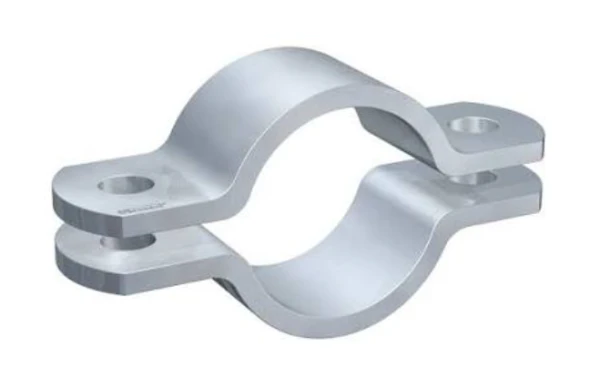
Step Three: Developing Detailed Metal Pipe Bracket Specifications
Specifications are technical documents ensuring procured products meet design requirements. All metal pipe bracket materials must include material certificates and comply with ASTM standards. Anti-corrosion processes (e.g., hot-dip galvanizing zinc layer thickness) require clearly defined acceptance criteria. Specifications should also mandate metal pipe bracket suppliers to provide detailed installation guidelines, including bolt torque values, welding procedure specifications, and installation tolerances. This is critical for accurately translating design intent into the construction phase.
Step Four: Installation Supervision and Final Acceptance of Metal Pipe Brackets
The ultimate performance of custom metal pipe brackets hinges on precise on-site execution. Prior to installation, verify anchor point locations to ensure compliance with design drawings. During installation, calibrated torque wrenches must be used, and the established tightening sequence must be strictly followed.
Key quality control points for metal pipe brackets include: confirming full contact without gaps between fixed brackets and structural elements; maintaining precise clearances between guide brackets and sliding brackets according to thermal displacement calculations; ensuring no obstructions beneath all sliding brackets that could impede pipe movement.
During system commissioning, perform hot inspections to verify all metal pipe brackets function normally at operating temperatures, confirming no abnormal deformation, displacement, or visible signs of stress.
Looking for a reliable custom sheet metal fabrication companies?
Talk To Supro MFG Expert Team
Contact us for competitive ex-factory prices,
and a full range of technical support services.
Conclusion
If you require custom metal pipe brackets, contact us immediately! The Supro team is here to assist you. Established in 2004, we are a custom metal pipe bracket manufacturer. With extensive manufacturing experience, a robust technical team, and comprehensive production resources, we have provided one-stop custom metal pipe bracket services to over 3,000 enterprises worldwide.
At Supro, our dedicated quality control team, experienced QC personnel, and scientific quality control processes ensure products undergo rigorous inspection to meet specified technical standards. We maintain full traceability of defective products, covering: raw material inspection, mold inspection, equipment inspection, process sampling, packaging inspection, and final inspection. Our QA (Quality Assurance) ensures products meet necessary tolerances and quality standards. We guarantee on-time delivery for all products. From design and rapid prototype fabrication to mass production, we deliver expert technical support and exceptional quality with highly cost-competitive supply.
Contact us today to start an efficient partnership!