


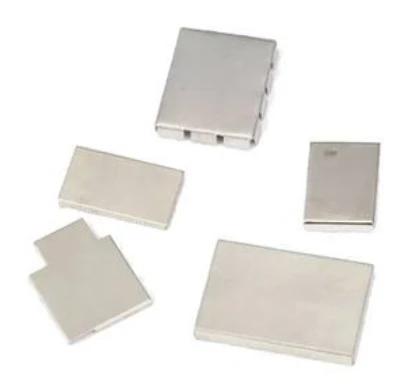
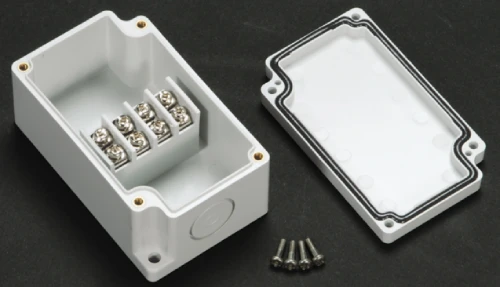


When evaluating mass production strategies for precision metal components, selecting progressive die stamping, compound die stamping, or transfer die stamping directly determines part cost, quality, and delivery cycle. As a specialized metal stamping manufacturer, Supro understands that the core distinction among these methods lies in how parts move between die stations.
Compound die stamping completes multiple operations (such as blanking and punching) in a single press stroke at one station, making it particularly suitable for flat parts requiring strict concentricity. In contrast, progressive die stamping feeds coil material through consecutive stations, with the strip carrying the part as it advances. This process excels at producing complex geometries at speeds exceeding 150 strokes per minute while maintaining precision tolerances of ±0.0005 inches. Transfer die stamping addresses another set of challenges: after blanking from coil at the first station, parts are mechanically transferred to independent forming stations. This method is suitable for deep drawing or large components that cannot be supported by continuous strip.
Selecting the appropriate metal stamping process requires comprehensive analysis of part geometry, production volume, and material utilization to determine whether progressive die stamping’s speed advantage, compound die stamping’s precision characteristics, or transfer die stamping’s deep-drawing capability best aligns with project requirements. The following section analyzes the mechanical differences between these three processes to guide your procurement decisions.
Key Characteristics of Compound Dies, Transfer Dies, and Progressive Dies in Stamping
Metal stamping isn’t just about pressing steel into shape. It’s about control, timing, and smart die design. From Compound Die systems to advanced progressive die stamping, each setup changes how parts move, form, and finish. Here’s how these die types actually work on the shop floor.
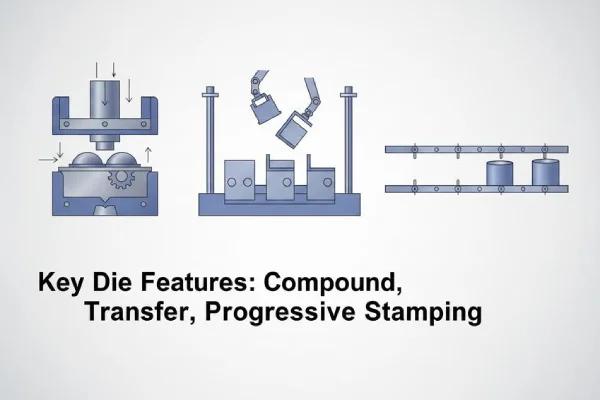
compound die stamping
The coordinated operation of multiple punches within a single die set is precisely the core advantage of compound die stamping.
Simultaneous Operations happen in one press stroke:Blanking the outer profile.Forming critical bends.Coining fine surface details
Operation flow inside the die:Sheet metal seats against the lower die cavity.Upper punches descend together.Blanking, Forming, and Coining occur at once.
Tooling coordination:Precision-ground punch faces.Balanced pressure distribution.Tight shut-height control
This setup reduces handling and keeps tolerances tight. Shops running progressive die stamping often pair compound tooling for secondary features when geometry demands extreme accuracy. At supro mfg, this hybrid thinking keeps cycle times lean without sacrificing finish.
transfer die stamping
A Transfer Die works across Multiple Stations, moving each part step by step.
Core stabilization system:Guide Pins align the workpiece.Strippers release material cleanly.Automated Part Transfer arms reposition parts
Material control chain:Coil feed advances strip or blank.Cut piece enters first station.Mechanical fingers shift it forward.
Automation backbone:Synchronized press motion.Controlled Coil Handling tension.Sensor-verified positioning
Transfer systems suit larger components that don’t flow well in progressive die stamping lines. Compared to standard die stamping, part independence between stations allows deeper forms without strip distortion.
progressive die stamping
In Progressive Die layouts, the strip keeps moving. Every stroke adds something new.
Registration control:Pilots lock into pre-pierced holes.Strip alignment resets each cycle.
Station-by-station build:Sequential Piercing creates internal features.Form stations add bends.Deep Drawing shapes cups or shells.
Material efficiency loop:Continuous Coil Feed.Defined Workpiece Progression.Minimal scrap bridges
Progressive die stamping shines in high-volume runs. The steady rhythm of die and stamping motion keeps output consistent. For brands scaling fast, including clients of supro mfg, progressive die stamping and precision progressive tooling make mass production feel almost effortless.
online custom metal fabrication parts
Only 4 steps
Contact our experts team and experience the efficiency and economic benefits of digital metal fabrication services.
Upload Design Files
STL , STEP (.stp), IGES (.igs), (.ZIP), or PDF.
Also be a sample or an idea
Quote & Design Analysis
Instant factory quotes and DfM reports, the most reasonable solution.
Manufacturing Begins
Digital processes can initiate order tasks within 24 hours.
On-Time Delivery
Keeping delivery promises, approved by 3000+ Global Company buyers.
Compound Die Stamping vs. Transfer Die Stamping: Which Prevails?
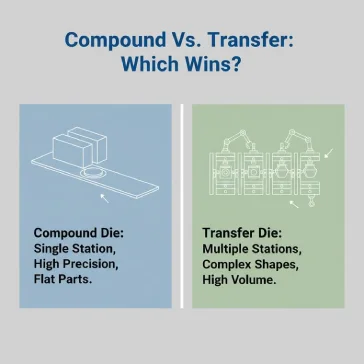
When comparing compound die stamping and transfer die stamping, the decision hinges not on superiority but on geometric compatibility. Compound die stamping delivers unmatched flatness and concentricity for gasket-type parts through simultaneous force application in a single station. Transfer die stamping, however, mechanically moves blanks between dies, eliminating the need for carrier belts. This approach accommodates deep drawing or complex three-dimensional shapes—processes prone to tearing in progressive die configurations. For metal stamping manufacturers, the choice of stamping process hinges on whether part design prioritizes strict tolerance control or dimensional depth requirements.
Advantages and Applications of Compound Die Stamping
A Compound Die runs as a single station tool where multiple operations happen through simultaneous operations in one press stroke. In contrast to progressive die stamping—where strip material advances through stations—this setup completes the cut in one hit.
Core capability:Blanking and piercing occur together.Light forming can be added.Built for high precision.
Best-fit production:Moderate volume runs.Tight tolerance flat parts.Lower maintenance than complex progressive tooling.
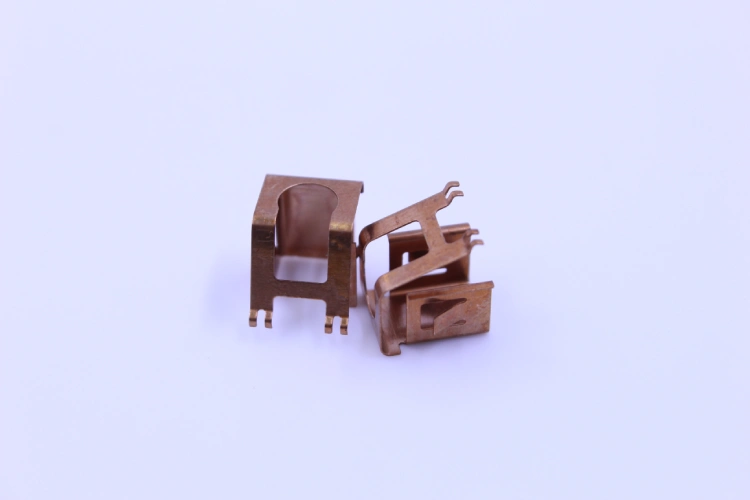
For simple washers, brackets, and flat electrical contacts, compound die stamping effectively reduces scrap rates and ensures high precision. No strip movement or part transfer is required—only a single, precise stamping cycle.
Feature | Compound Die | Progressive Die Stamping |
Stations | 1 | Multiple |
Stroke Output | 1 finished part | 1 part per strip index |
Geometry Type | Flat/simple | Staged/complex |
Advantages and Application Scenarios of Transfer Die Stamping
A Transfer Die uses multiple stations, but unlike progressive die stamping where the strip carries parts forward, here part transfer systems move individual blanks between individual dies.
Key advantages show up fast:
Handles complex shapes and deep draws
Supports large stainless panels
Suited for high volume with automation
Workflow often runs like this: blanking → mechanical transfer → redraw → trim → final form. Each station can be tuned without disturbing the rest of the line, which makes adjustments easier than in tightly linked progressive die setups.
When geometry grows taller or deeper than progressive stamping tolerates, transfer systems step in. For flat precision parts, compound die stamping holds the edge; while for complex three-dimensional structures, transfer die stamping reigns supreme.
Are you looking for reliable & cost-effective
China Sheet Metal Fabricators
More than 150,000 OEM metal fabrication products delivered to 5,000+ global buyers.
And benefit from it!
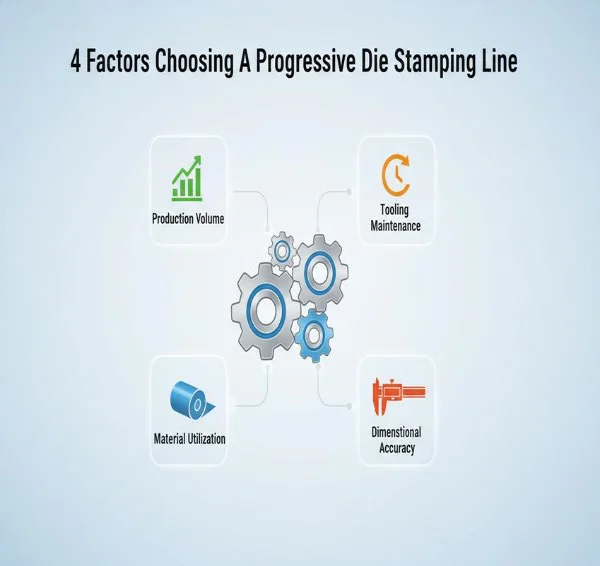
4 Factors Choosing A Progressive Die Stamping Line
Choosing a progressive die stamping line is not just about machines. It’s about output, timing, material flow, and part quality. As progressive die stamping projects scale up, variables such as material utilization and maintenance cycles will determine the true unit cost. Metal stamping manufacturers must balance the number of stamping stations with equipment speed to avoid production bottlenecks.
Production Volume and Cost Efficiency in Progressive Die Runs
The cost efficiency of progressive die stamping hinges on aligning production volume commitments with tooling investment. For high-volume runs exceeding 50,000 pieces, the fixed costs of multi-station progressive dies depreciate rapidly, lowering unit costs. As a specialized metal stamping manufacturer, Supro rigorously controls strokes per minute (SPM) targets and coil change frequency to optimize variable costs.
True operational efficiency in progressive die stamping extends beyond press speed to balancing station loads, minimizing inter-station transfers and scrap-related downtime. By aligning die design with annual demand forecasts, we eliminate production bottlenecks, ensuring our metal stamping services deliver consistent stamped parts at the lowest per-unit cost.
Tooling Maintenance Impact on Lead Time
Tooling maintenance serves as the hidden lead time regulator in progressive die stamping processes. Even well-designed tools exhibit wear signs—such as punch edge rounding or forming station galling—which progressively degrade part quality and increase unplanned downtime.
At Supro, we implement condition-based monitoring, inspecting critical dimensions after predetermined stroke counts to intervene before wear causes catastrophic failure. Proactive lubrication, alignment calibration, and other planned interventions continuously optimize die guide performance. Spare dies for high-wear stations significantly reduce repair cycles. This rigorous progressive die stamping process management ensures precise execution of production plans, enabling metal stamping services to deliver parts within predictable, exact time windows. supro mfg optimizes maintenance cycles using production data, guaranteeing precise and controllable delivery lead times.
Material Utilization: Minimizing Scrap Rate with CAD Design
In progressive die stamping, raw materials typically represent the largest variable cost. Therefore, CAD-based utilization becomes a direct lever for profitability. During the design phase, intelligent layout algorithms rotate part geometries and reduce carrier strip widths to accommodate more blanks per coil.
At Supro, we apply Design for Manufacturing (DFM) principles to balance material savings with die strength, ensuring guide holes and material bridging structures maintain overall stability. Scrap tracking functions not as an after-the-fact remedy but as a diagnostic tool—analyzing burr direction or feeding errors feeds data back into CAD models for continuous optimization. In progressive die stamping, tighter nesting means less waste and smoother feeding, ensuring metal stamping services deliver cost-effective parts without compromising quality.
At Supro Mfg, optimized strip layouts directly translate to reduced total costs per shipment.
Dimensional Accuracy and Surface Finish Requirements
In precision progressive die stamping, quality is built into every station. During multi-stage forming, tolerance stack-up demands precise control of springback and die clearance, especially when processing thin-gauge copper alloys or high-strength steels. As a specialized metal stamping manufacturer, Supro strictly adheres to Geometric Dimensioning and Tolerancing (GD&T) specifications, monitoring press stability and burr height at each station to detect deviations before they affect the strip.
Surface finish requirements demand consistent lubrication and flawless material transfer. By maintaining precise punch-to-die alignment, the progressive die stamping process produces stamped parts with repeatable accuracy. At Supro, we validate every production batch to ensure metal stamping parts fully comply with your drawing specifications, eliminating unexpected issues.
Why Choose Supro?
Provide the most cost-effective cost solution for manufacturing and assembling products, expanding product competitiveness.
a technical team specializing in custom shell manufacturing for more than 30 years.
Advanced Manufacturing Equipment: Industry-leading custom metal enclosure manufacturer with in-house sheet metal, die casting, precision machining workshops, and surface coating workshops.
ISO 9001-2015, PPAP III level, RoHS, NEMA, CE and other certified production standards.
24H*7 online English technical support: The professional English team responds quickly to users’ technical questions online at any time.
help users from product design, prototype, batch manufacturing, surface treatment, assembly and packaging, transportation and a series of value-added services.
With in-house mechanics and chemistry laboratories, it can quickly monitor manufacturing process quality control to ensure the delivery of high-quality products.
Accept to sign NDA documents to ensure that customers’ product information is protected.
Door-to-door delivery in customizable secure packaging after complying with the delivery details agreed with the customer.
Frequent Jams? Optimize Progressive Die Stamping Feeds
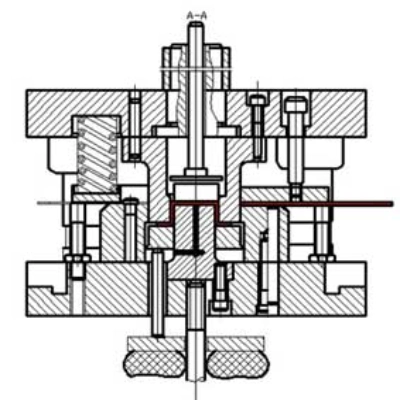
Frequent feed jams can turn progressive die stamping into a headache fast. When the die, strip, and press aren’t in sync, even small alignment errors snowball. In high-speed progressive stamping, steady material flow is everything. Tighten up your coil handling, clean up strip tracking, and your progressive die press line will run smoother with fewer surprises.

Feed Line Alignment for Consistent Coil Handling
Stable coil movement starts with precise feed line alignment. In progressive die stamping, even slight angular error affects strip advance and overall handling.
Press-to-Feed Centerline Control:Press bolster height.Feeder mounting plane.Entry angle into the die.
Coil Path Management:Uncoiler exit height.Straightener entry window.Pilot release timing in progressive die.
Material Behavior Check:Stainless vs. aluminum springback.Strip edge condition.Lubrication spread across the material
According to the 2025 Precision Metalforming Association industry outlook, feed alignment remains one of the top three contributors to downtime in progressive die stamping operations, especially in high-speed progressive stamping lines.
When alignment is dialed in, consistency improves. The strip tracks true. The die runs cooler. And coil processing feels steady instead of chaotic.
Straightener and Uncoiler Setup to Smooth Material Flow
Clean coil processing keeps progressive die stamping predictable:
Set uncoiler brake tension to prevent overspin.
Adjust straightener roll pressure to remove coil set without marking the surface.
Confirm loop control between feeder and press.
Dialing in setup works best in a simple flow:
Load the coil and check edge condition.
Pre-level through the straightener.
Fine-tune roll depth for smoothness.
Test short feeds before full-speed feeding.
Too much pressure kills material flow. Too little leaves camber. A balanced feeding system protects the progressive die, reduces punch stress, and keeps progressive stamping output steady. Small tweaks here often solve “mystery” jams that show up during die stamping runs.
Guide Pins and Pilots: Ensuring Accurate Strip Tracking
In the progressive die stamping process, guide pins and pilots serve as the mechanical core for ensuring precise strip positioning at each station. When the feeder releases material, the pilot enters a pre-punched hole—precisely engineered to maintain a 0.0005 to 0.001-inch clearance—correcting any feeding errors before forming operations commence. Supro maintains vertical stability by balancing spring pressure against bushing wear, preventing strip warping during high-speed advancement.
When pilots seat correctly, accuracy improves across every stamping station. Burr height drops. Misfeeds shrink. The progressive die press sounds different too—less snap, more rhythm.
Keep tracking tight, and progressive die stamping becomes predictable instead of stressful.
Get instant ex-factory price quotation.
If you only have an idea or an old sample,Let us know.
with photo or video and get our quotation and manufacturing solutions.
- Product design drawings or 3D model files.
- Material standards and appearance requirements.
- Product quantity demand.
- Industry standards in the application field.
- Functional requirements
Summary
Supro is a professional metal stamping manufacturer. Leveraging advanced equipment, extensive manufacturing experience, and a specialized engineering team, we provide perfect metal stamping services to over 3,000 companies worldwide, offering genuine manufacturer quotes.
As an industry-leading metal fabrication manufacturer, we efficiently deliver diverse products on schedule. From product design and rapid sheet metal prototype fabrication to mass production, we provide expert technical support and exceptional quality. We offer one-stop manufacturing solutions and highly cost-competitive product supply!