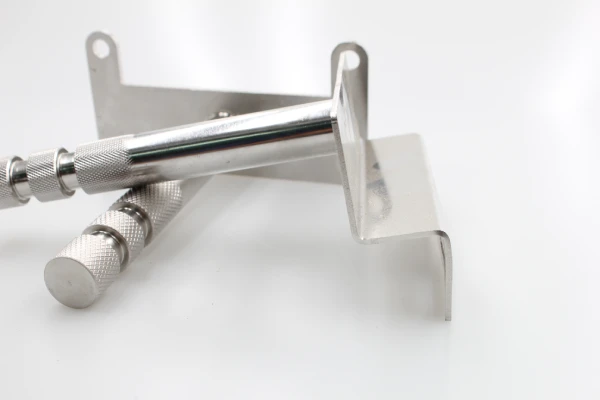


Metal fence post brackets serve as critical load-transfer components between vertical posts and horizontal rails. Their engineering specifications directly determine the entire fence system’s load-bearing capacity, wind resistance stability, and service life. Despite their significant structural importance, metal fence post brackets are often underestimated during the design phase, leading to engineering failures in commercial and industrial applications.
The core engineering challenges for metal fence post brackets revolve around three critical elements: First, the efficiency of static and dynamic load transfer under varying environmental conditions; second, the compatibility and corrosion resistance of bracket materials across specific exposure classes (ASTM C1-C5); and third, the implementation of installation tolerance management to ensure structural integrity.
This paper systematically analyzes the core pain points in metal fence post bracket applications from engineering and materials science perspectives, proposing systematic solutions grounded in mechanical principles and long-term durability considerations.
Structural Challenges Analysis of Metal Fence Post Brackets
From an engineering perspective, the primary structural issues with metal fence post brackets center on three key failure modes. First, under dynamic loading conditions, limitations in shear and pull-out load-bearing capacity frequently compromise connection integrity. Second, material fatigue induced by cyclic loading poses latent risks. Third, manufacturing and installation tolerances for metal fence post brackets often lead to compatibility issues.
Failure of Metal Fence Post Brackets: Insufficient Shear and Pull-Out Load Capacity
In practical engineering applications, connection failure of metal fence post brackets primarily manifests as insufficient shear and pull-out load-bearing capacity. When fence systems endure strong winds, impacts, or other lateral loads, these forces transmit through the connection points of metal fence post brackets. Improper design or selection often leads to bolt hole elongation over time, connection loosening, or plastic yielding of the bracket body.
Enhancing the material properties of metal fence post brackets is fundamental to addressing connection failures. We recommend using high-strength low-alloy steel as the primary bracket material, as its superior yield strength directly improves bending and shear resistance.
Secondly, reinforcing the structural design of metal fence post brackets can guide and redistribute stresses. Reinforcing ribs and flanges should be systematically incorporated into critical stress zones of the brackets. These designs significantly increase the sectional moment of inertia, effectively suppressing buckling and deformation of the plate under load. For multi-bolt connections in metal fence post brackets, meticulous optimization of the bolt group layout is essential, fully considering the effects of end distance, edge distance, and spacing.
Finally, the fastening system for custom metal fence post brackets is critically important. Connections should comply with ASTM F3151-17 standards using 3/8-inch diameter high-strength bolts. These bolts provide reliable preload, ensuring sufficient friction at the joint to resist a portion of the shear load.
Fatigue and Creep of Metal Fence Post Brackets: Hidden Risks Under Long-Term Dynamic Loading
Fatigue and creep issues in metal fence post brackets subjected to long-term dynamic loading represent an often underestimated latent risk. Under cyclic wind loads or frequent vibrations, the material of metal fence post brackets undergoes fatigue crack initiation and propagation, particularly in stress concentration zones such as welds and sharp corner transitions. For low-alloy steel brackets, micro-creep effects also emerge under long-term static loads, causing gradual relaxation of preload.
To address this challenge, we employ finite element analysis to precisely predict stress distributions in metal fence post brackets under high fatigue loads, enabling targeted reinforcement during the design phase. Increasing plate thickness and reducing unsupported areas significantly improves buckling response at connection points. Proper installation procedures for metal fence post brackets are equally critical. We must explicitly specify bolt torque values to ensure load distribution is uniform across all fasteners.
Tolerance Compatibility and Installation Fit of Metal Fence Post Brackets
Compatibility issues arising from manufacturing and installation tolerances of metal fence post brackets are highly prevalent in practical engineering applications. Size variations among posts from different suppliers often exceed ±3mm, leading to poor fit when paired with standard metal fence post brackets. Such dimensional mismatches cause stress concentration within the brackets, compromising their load-bearing capacity.
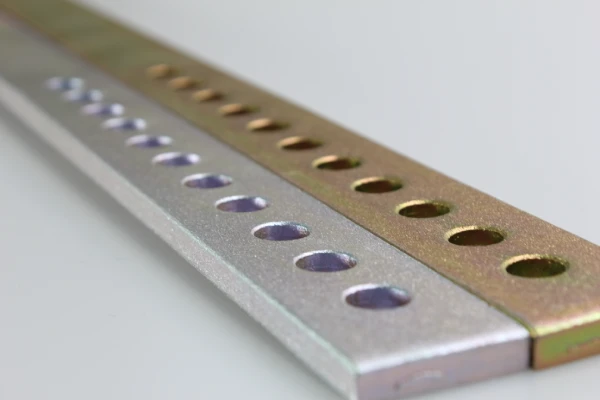
In such cases, employing brackets with elongated mounting holes/slotted holes or custom metal fence post brackets represents the most effective solution, successfully mitigating manufacturing and installation errors.
Why choose Supro MFG's Custom metal bracket Services
Provide the most cost-effective cost solution for manufacturing and assembling products, expanding product competitiveness.
a technical team specializing in custom shell manufacturing for more than 30 years.
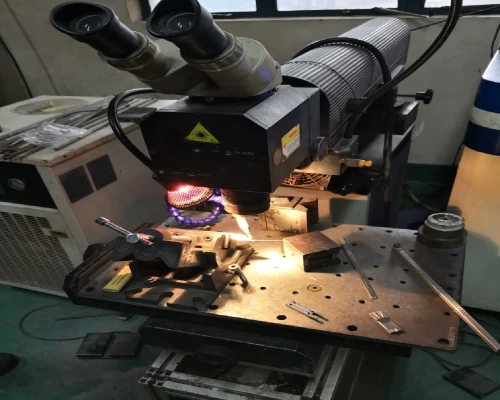
Advanced Manufacturing Equipment: Industry-leading custom metal enclosure manufacturer with in-house sheet metal, die casting, precision machining workshops, and surface coating workshops.
ISO 9001-2015, PPAP III level, RoHS, NEMA, CE and other certified production standards.
24H*7 online English technical support: The professional English team responds quickly to users’ technical questions online at any time.
help users from product design, prototype, batch manufacturing, surface treatment, assembly and packaging, transportation and a series of value-added services.
With in-house mechanics and chemistry laboratories, it can quickly monitor manufacturing process quality control to ensure the delivery of high-quality products.
Accept to sign NDA documents to ensure that customers‘ product information is protected.
Door-to-door delivery in customizable secure packaging after complying with the delivery details agreed with the customer.

Metal Fence Post Bracket Material and Environmental Durability
The material selection and environmental durability of custom metal fence post brackets form the core considerations for product lifecycle cost-effectiveness. Significant variations exist in the corrosion resistance of different metal fence post bracket materials, which directly determines their service life in specific environments.
Electrochemical Corrosion Issues of Metal Fence Post Bracket Materials
Electrochemical corrosion represents one of the most severe challenges metal fence post brackets face in harsh environments. When dissimilar metals come into contact within an electrolyte solution, they form a galvanic cell, triggering electrochemical corrosion that accelerates the corrosion of the more active metal.
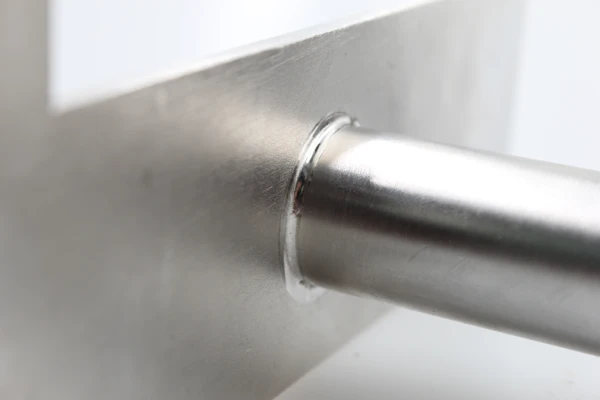
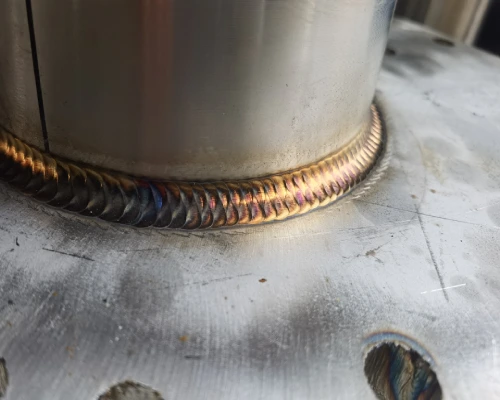
Particularly in coastal areas, chloride ion penetration can compromise the chromium-rich oxide protective layer on stainless steel surfaces, triggering pitting and crevice corrosion. Additionally, areas like weld points and cut edges, where the protective layer is damaged, become corrosion initiation points that can progressively spread throughout the entire custom metal fence post bracket system. This corrosion not only compromises structural integrity but also significantly shortens the service life of the fence system.
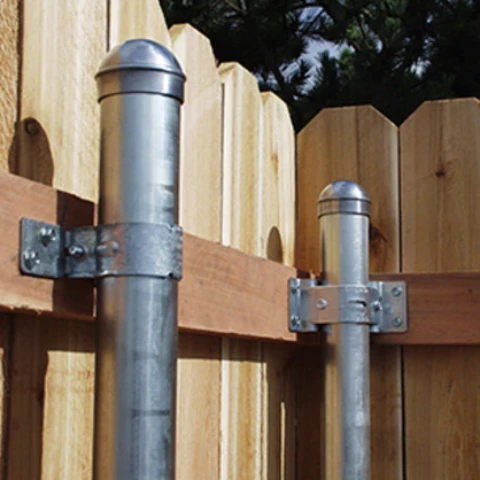
Therefore, when selecting metal fence post bracket materials, we must strictly adhere to the principle of matching materials with similar electrochemical series. For instance, carbon steel brackets should be paired with carbon steel posts. When connecting dissimilar metals—such as aluminum brackets with stainless steel fasteners—effective isolation must be achieved using polymer washers. Simultaneously, coating techniques like hot-dip galvanizing can be employed to enhance the corrosion resistance of metal fence post brackets.
UV Aging and Mechanical Wear Issues of Metal Fence Post Brackets
The synergistic effects of UV radiation and mechanical wear are key factors causing performance degradation in outdoor metal fence post brackets. Prolonged UV exposure causes photo-oxidative degradation of polymer coatings, leading to chalking, discoloration, and embrittlement. Simultaneously, continuous friction between metal fence post brackets and fence wires due to vibration gradually wears away the protective coating, exposing the underlying metal. These degradation processes not only compromise aesthetics but also significantly reduce the brackets’ structural integrity and service life.
To address UV aging in metal fence post brackets, we employ engineering plastic spacers infused with UV stabilizers. For coating systems, we recommend highly weather-resistant acrylic paint systems, enhanced through high-temperature curing to increase crosslink density and UV stability. These materials effectively resist photodegradation from prolonged outdoor exposure.
Simultaneously, improving the abrasion resistance of metal fence post bracket coatings is crucial. We select coating systems with high hardness and excellent adhesion, such as epoxy-based powder coatings or specially modified acrylic paints. Electrostatic spraying technology ensures uniform coating distribution and strong adhesion on metal fence post brackets, significantly improving wear resistance. Innovative nanocomposite coating technology incorporates functional nanoparticles to substantially enhance surface hardness and abrasion resistance without compromising flexibility.
Installation Efficiency and Total Life Cycle Cost of Metal Fence Post Brackets
When customizing metal fence post brackets, installation efficiency and total life cycle cost are core factors directly impacting the project's overall cost.
Installation Process and Specialized Tools for Metal Fence Post Brackets
Traditional metal fence post bracket installation processes exhibit significant efficiency bottlenecks and technical barriers. Welding or bolting techniques require specialized skills and specific equipment, leading to complex on-site management and uncontrollable labor costs. Additionally, the low integration of conventional brackets necessitates additional vertical frame components for stability, increasing material procurement costs while reducing transportation and storage efficiency.
Current metal fence post brackets are transitioning from traditional welding to modular mechanical connection systems. Snap-fit and bolt-fastening designs significantly reduce reliance on specialized welding skills and heavy equipment. Modular design not only saves substantial labor during installation but also enables maintenance or partial replacements without compromising the overall structure, greatly simplifying long-term maintenance complexity and costs for metal fence post brackets.
Life Cycle Cost and Maintainability of Metal Fence Post Brackets
When customizing metal fence post brackets, a comprehensive evaluation requires introducing a life cycle cost calculation model (Formula: Total Cost = Initial Purchase Cost + Installation Cost + Maintenance Cost × Number of Maintenance Cycles + Replacement Cost × Number of Replacement Cycles – Residual Value).
Procurement decisions focused solely on the initial material cost of metal fence post brackets often result in high total costs.
Taking a typical coastal fence project (with a 20-year expected lifespan) as an example: – Standard galvanized metal fence post brackets may require rust prevention maintenance around Year 8 and replacement around Year 15. – High-quality stainless steel metal fence post brackets (e.g., 304/316 grade) typically require no maintenance during this period and retain significant residual material value.
Only 4 steps
online custom metal fabrication parts
Contact our experts team and experience the efficiency and economic benefits of digital metal fabrication services.
Upload Design Files
STL , STEP (.stp), IGES (.igs), (.ZIP), or PDF.
Also be a sample or an idea
Quote & Design Analysis
Instant factory quotes and DfM reports, the most reasonable solution.
Manufacturing Begins
Digital processes can initiate order tasks within 24 hours.
On-Time Delivery
Keeping delivery promises, approved by 3000+ Global Company buyers.
Professional Selection and Installation of Metal Fence Post Brackets
For custom metal fence post brackets tailored to specific projects, a systematic engineering assessment is required. Selection decisions should be based on a comprehensive analysis of fence type, environmental corrosion level, anticipated loads, and budget constraints.
Application-Based Selection of Metal Fence Post Brackets
Application Scenarios | Metal Fence Post Bracket Types | Reason |
Temporary Construction Barrier | Drive-type anchoring bracket | Quick deployment/dismantling, reusable, no concrete foundation required, adapts to various ground conditions |
Chain-link fence | Galvanized steel bracket | Complies with ASTM F567 installation specifications, capable of withstanding fabric tension and wind loads; terminal posts require diagonal bracing. |
Decorative Fence | Stainless steel or coated brackets | Aesthetic appeal, corrosion resistance, and excellent compatibility with PVC, composite wood, or decorative metal materials |
Regional Boundary Fencing | Heavy-duty galvanized brackets | High resistance to impact and vandalism, with posts extending at least 4 feet underground. |
For temporary fencing or sites with poor soil conditions, the driven anchor system (compliant with ASTM F3151-17) provides an alternative solution without requiring concrete foundations. This system mandates metal fence post brackets made from rolled steel of minimum 11-gauge specification, featuring a 1.2 oz/ft² hot-dip galvanized coating, secured with 3/8-inch diameter bolts.
In highly corrosive environments, specify 316 stainless steel components or metal fence post brackets with a minimum hot-dip galvanized coating weight of 1.8 oz/ft². For areas with unstable soil conditions, incorporate diagonal bracing and consider deeper foundation embedment, potentially exceeding the standard minimum requirement of 4 feet.
Pre-Installation Verification of Metal Fence Post Brackets
Proper pre-installation verification of metal fence post brackets is critical to ensuring the long-term structural integrity of the fence system. First, verify the material certificates and coating inspection reports for all metal fence post brackets to confirm compliance with project specifications and relevant standards such as ASTM F3151-17. Simultaneously, verify that all fasteners (e.g., bolts) meet specified material grades (e.g., 8.8 or higher) and quantities, and ensure appropriate washers are used.
During installation, tighten bolts to the design-specified preload value using a torque wrench. Ensure posts are installed vertically.
Looking for a reliable custom sheet metal fabrication companies?
Talk To Supro MFG Expert Team
Contact us for competitive ex-factory prices,
and a full range of technical support services.
Conclusion
As a core component of fencing engineering systems, the selection of metal fence post brackets directly impacts the long-term performance of the entire project. Through systematic analysis of key factors such as structural mechanics, materials science, and installation techniques, we can clearly state: Successful fencing projects require not only components compliant with standards like ASTM F3151-17, but also a scientifically grounded selection methodology for metal fence post brackets based on engineering data.
Supro is a specialized metal fence post bracket manufacturer. Leveraging advanced equipment, extensive manufacturing experience, and a professional engineering team, we provide perfect custom metal fence post bracket services to over 3,000 companies worldwide, along with genuine manufacturer pricing.
Simultaneously, we deliver diverse products efficiently and on schedule. From product design and rapid sheet metal prototype fabrication to mass production, we provide expert technical support and exceptional quality. Furthermore, we offer one-stop manufacturing solutions and highly cost-competitive product supply!