

In the field of metalworking, selecting the right forming process is a strategic decision that directly impacts die investment, production throughput, the feasibility of part geometries, and long-term cost structures. Deep draw stamping, hydroforming, and metal spinning are three widely used forming technologies, each with its own unique technical advantages and process constraints.
Estampado profundo excels at high-speed production of deep drawn parts but requires significant die investment; hydroforming uses fluid as a flexible punch, enabling complex geometries and improving wall thickness distribution; metal spinning, through rotational forming, offers the lowest die cost for axially symmetric parts. For purchasers, understanding the differences among these three processes in terms of die investment, production batch size, part complexity, and wall thickness uniformity is the foundation for making sound technical decisions.
This article will systematically compare the applicable scenarios and economic boundaries of these three processes from a professional manufacturing perspective, providing a reference framework for procurement decisions.
Understanding Deep Drawing Stamping, Hydroforming, and Metal Spinning
Deep draw metal stamping uses rigid dies to form deep cavities at high speeds; hydroforming optimizes wall thickness using fluid pressure; and metal spinning forms parts point by point through rotation, resulting in the lowest die costs. These three processes are fundamentally different; below, we will discuss their technical characteristics and application limits.
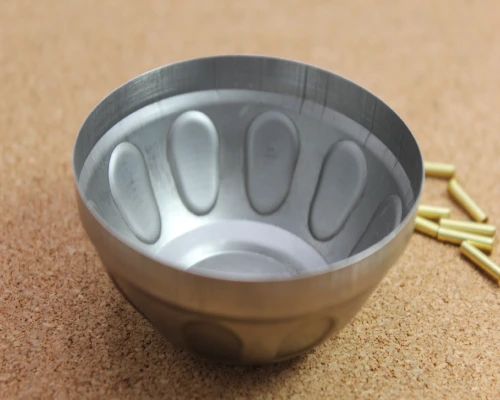
Deep Draw Stamping: Suitable for High-Speed Production of Deep-Cavity Parts
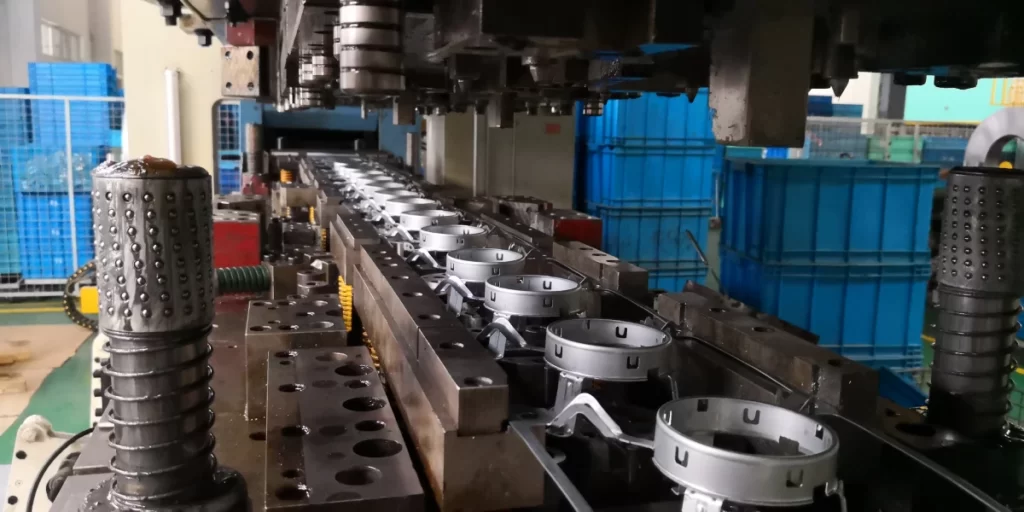
The deep draw stamping process uses a rigid punch to radially pull a metal blank into the die cavity, forming hollow parts with a depth exceeding twice their diameter. This process can achieve production rates of 15 to 40 parts per minute on mechanical presses and offers extremely high dimensional repeatability. The limiting draw ratio is typically controlled between 1.8 and 2.3; complex parts require the use of multi-stage deep draw stamping technology.
The core advantage of custom deep draw stamping lies in high-speed, high-volume production, but this comes at the cost of high tooling investment—each set of precision punches and dies must be custom-manufactured for specific material thicknesses. Wall thinning is generally controlled within 10% to 15%, and through optimized step-by-step draw ratios, the thinning rate in critical fillet areas can be strictly limited to less than 10%.
Hydroforming: Fluid-Pressure Forming Suitable for Complex Geometries
Hydroforming replaces a rigid die with high-pressure fluid (typically 150 to 600 MPa) to form the metal blank by pressing it against the punch via the fluid medium. This process requires only a single rigid punch, eliminating the need for a matching die and significantly reducing tooling costs.
The uniform distribution of fluid pressure effectively reduces friction between the punch and the sheet metal, delays material fracture, and preserves the original surface finish on non-contact surfaces. In deep drawing applications, hydroforming can achieve a stretch ratio of up to 3:1, significantly reducing the number of forming passes and intermediate annealing processes.
Wall thickness distribution is superior to that of traditional deep draw stamping, with the maximum thinning ratio controllable between 5% and 6%. This process is particularly suitable for parts with complex asymmetric geometries, thin sheets, and stringent surface quality requirements.
Metal Spinning: Rotational Forming for Axially Symmetric Parts
Hilado de metales involves clamping a circular blank onto a spindle and rotating it (typically at 300 to 1,200 RPM under CNC control), applying localized pressure point by point via roller tools to cause the material to conform to a mandrel. This process employs a localized, progressive deformation mechanism, with forming loads amounting to only one-twentieth of those in hydroforming. The die structure is greatly simplified—requiring only a single core die (male die) with no need for a matching cavity die—and manufacturing costs are only one-third to one-sixth of those for deep draw stamping dies.
This process is suitable for axisymmetric geometries such as cones, hemispheres, and cylinders. It accommodates a wide range of material thicknesses and can process thick sheets and difficult-to-form alloys that are challenging to handle with deep draw metal stamping. Its limitations include an inability to effectively process asymmetric parts and a relatively long production cycle for single-piece production, making it primarily suited for small- to medium-volume production and prototype development scenarios.
Comparative Analysis of Deep Drawing Stamping, Hydroforming, and Metal Spinning Based on Key Decision Factors
In procurement decisions for metal forming processes, die investment, production batch size, part geometric complexity, wall thickness uniformity, and surface quality constitute the core trade-off dimensions. Deep draw stamping technology offers significant unit cost advantages for high-volume production; however, the applicability boundaries of each process must be evaluated on a case-by-case basis according to specific part characteristics and production capacity targets.
Dimensiones de comparación | Hidroformado | ||
Mold Investment Costs | High. Multi-station progressive dies typically cost between $5,000 and over $50,000; for large parts, the cost can range from $35,000 to $100,000. Matching punch and die sets are required, and multiple sets of dies are needed for multi-pass drawing. | Low to moderate. Typically only 50% of that required for deep drawing dies; hydraulic forming using rubber diaphragms can reduce this by 70%–90%. Only a punch and a blank holder are required; the punch can be made of 4140 steel or resin. | The lowest. Requires only one core die (male die), with a cost of approximately 10%–30% that of a deep drawing die. No matching female die is required, and there is no complex die structure. |
Suitability for Production Batches | High volume. Annual production of 30,000–50,000 units or more is the break-even point. Suitable for large-scale projects requiring long-term, stable production. | Medium- to low-volume production. Cost-effective starting at 250 units; even single-unit prototypes are possible. Suitable for high-mix production with an annual output of less than 60,000 units. | Small to medium production runs. 1–3,000 units per year is the most cost-effective. Suitable for prototype development, custom production, and scenarios involving frequent design changes. |
Velocidad de producción | Fastest. Mechanical presses: 15–40 pieces per minute; high-speed presses: up to 100 pieces per minute; multi-station automatic molds: 100–300 pieces per minute | Slow. Typical cycle time: 1.5–2 strokes per minute (approximately 7–13 pieces per hour); advanced equipment can achieve a cycle time of less than 30 seconds. | Medium speed. Manual spinning is relatively slow (several hours per piece); CNC automated systems can produce 500–10,000 pieces per day. |
Part Geometric Suitability | deep drawn, axisymmetric parts. Depth > 2 times the diameter; cylindrical, rectangular, or closed-end structures. The maximum drawing ratio is typically 1.8–2.3; complex parts require multiple drawing passes and intermediate annealing. | Complex and asymmetrical geometries. Capable of handling irregular contours, sharp features, and undercuts. Stretch ratios up to 3:1; can replace multi-piece welded assemblies with a single-piece shell. | Axially symmetric rotating bodies. Cones, hemispheres, cylinders, lampshades, and vessel heads. Not suitable for asymmetric parts. |
Uniformidad del espesor de pared | Fairly good. The thinning rate is typically 10%–15%; under optimized parameters, the deviation can be controlled to 4.77%; in complex areas, it can reach up to 30%. | Superior to deep drawing. Uniform fluid pressure reduces localized thinning; compared to conventional deep drawing, the thinning rate can be reduced by 34%; the maximum thinning rate is controlled between 13% and 14.3%. | Poor. The thinning rate can reach 20%–70%; with CNC control, multi-pass spinning can be limited to 10%–15%. |
Calidad de la superficie | Average. Metal-to-metal contact may cause scratches, gouges, or tool marks; re-polishing may be required. | Optimal. Rubber diaphragms or fluid media prevent metal-to-metal contact and can be pre-polished before forming; no surface defects caused by tool wear. | Medium. Spinning marks may remain; surface uniformity is improved under CNC control; the surface condition must be evaluated based on the roller path. |
Rango de espesor del material | 0.1 mm–6 mm. Specialized molds are required for different material thicknesses. | Ultra-thin to medium. Capable of processing ultra-thin metal sheets while maintaining the original surface finish; a single die can accommodate different thicknesses. | Widest. Can process soft metals up to 12 mm thick; offers advantages for difficult-to-form alloys and thick plates |
Precisión dimensional | Highest. Up to ±0.0005 inches (±0.013 mm); IT8–IT10 precision | High. The uniform distribution of fluid pressure reduces springback, resulting in higher precision than conventional stamping; typically ±0.5 mm. | Moderate. CNC control can achieve tolerances ranging from ±0.005 to ±0.015 inches (±0.13–0.38 mm); accuracy is lower than that of deep drawing. |
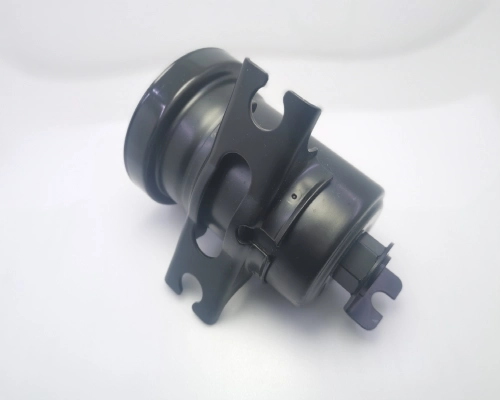
Die Investment and Installation Costs
Die costs are typically the most significant distinguishing factor among these processes. Custom deep draw stamping requires precisely matched punches and die sets (usually made of hardened tool steel), resulting in the highest upfront investment.
Hydroforming offers a significant advantage in terms of die costs. Since it requires only a single punch (male die) and a blank-holding ring—and the punch is typically made of 4140 alloy steel rather than hardened steel—its die costs are generally 50% lower than those of deep draw stamping. Data indicates that hydroforming can reduce development, die, and debugging costs by up to 70%.
The metal spinning process has the lowest tooling requirements. This process typically requires only a single mandrel, which can be made of steel, aluminio, or even hardwood, making it suitable for small-batch production. These minimal tooling requirements make metal spinning particularly attractive for prototyping, projects with frequent design changes, and small- to medium-volume production.
Production Volume and Unit Cost Efficiency
Production volume determines the economic boundaries of each process. The deep draw stamping process offers significant unit cost advantages for high-volume production—once the die is in place, the press can operate continuously at high speed, bringing the unit cost down to less than $0.10. The break-even point for return on investment is typically at an annual production volume of 30,000 to 50,000 units.
Hydroforming is suitable for low- to medium-volume scenarios; it becomes cost-effective starting at 250 pieces and can even be used for single-unit prototypes. Its economic upper limit is approximately 60,000 units per year, making it suitable for production environments with high product mix and low- to medium-volume output. Metal spinning is most economical for small- to medium-volume production (1,000 to 3,000 units per year); since it does not require complex dies, the process from design to first-article delivery can be completed within a few days, making it particularly suitable for customized and small-batch requirements.
Geometría y complejidad de las piezas
Part geometry is the primary constraint on process feasibility. Deep draw stamping technology excels at producing deep hollow shapes with uniform wall thickness and seamless structures. Cylindrical, rectangular, and closed-end geometries are natural applications for custom deep draw stamping. However, this process also has limitations: draw depth, corner radii, and flange features are all constrained by material ductility, posing risks of arrugas, lagrimeo, o afinar.
Hydroforming offers greater flexibility in terms of geometry. This process can effectively handle complex, asymmetrical shapes and irregular contours. Compared to traditional deep draw metal stamping, hydroforming can produce parts with smaller radii and sharper edges, and its uniform pressure distribution reduces wall thinning at critical corners. Parts that would otherwise require multiple welded components can typically be formed into a single shell, thereby reducing assembly costs and improving structural integrity.
Metal spinning is best suited for rotationally symmetric parts—such as cones, hemispheres, cups, and cylindrical components. Although modern CNC metal spinning can produce complex free-form surfaces, the process is fundamentally limited to axisymmetric geometries. For non-rotationally symmetric parts, custom deep draw stamping or hydroforming is generally more appropriate.
Uniformidad del espesor de pared
Wall thickness control directly affects a part’s structural integrity and material utilization. The deep draw stamping process typically achieves a thinning ratio of 10% to 15%, and the overall wall thickness of the formed part is relatively uniform. Compared to metal spinning, this process offers greater predictability in maintaining wall thickness consistency.
Compared to traditional deep draw estampado de metal, hydroforming achieves superior wall thickness distribution. The uniform application of fluid pressure reduces localized thinning; the maximum thinning rate at corners in hydroforming can be as low as 5% to 6%, whereas in traditional deep draw stamping it can reach as high as 12%. Additionally, by eliminating friction between metal surfaces, this process reduces springback and stress concentration.
Metal spinning exhibits the greatest variation in wall thickness. The wall thinning rate can range from 20% to 70%, particularly in shear spinning and flow forming operations. While this is advantageous for weight reduction in certain applications, it makes wall thickness prediction and control more challenging compared to custom deep draw stamping.
Calidad de superficie y acabado
Surface quality requirements are often a decisive factor in process selection. The hydroforming process eliminates direct metal-to-metal contact by using a flexible rubber diaphragm or a fluid medium, thereby achieving exceptional surface finish. Materials can be pre-polished before forming, and the finished parts exhibit virtually no scratches or defects. For applications where surface quality is critical—such as aerospace, medical devices, and commercial cooking equipment—hydroforming is the preferred process.
The deep draw stamping process carries a higher risk of surface defects due to metal-to-metal contact between the blank and the die. Scratches, bite marks, and die marks may require secondary finishing. However, with proper lubrication and die maintenance, deep draw stamping technology can still provide acceptable surface quality for most industrial applications.
Surface finish in the metal spinning process depends largely on the operator’s skill and process parameters. Localized deformation and tool contact may produce tool marks, although CNC metal spinning technology has improved surface consistency. For applications with high aesthetic requirements, secondary finishing may be necessary.
Compatibilidad de materiales
All three processes support a wide range of ductile metals, but each has different material thickness limits. deep draw metal stamping is suitable for low-carbon steel, stainless steel (300 series), aluminum alloys (1000 and 3000 series), copper, brass, and certain nickel alloys. Material thickness typically ranges from 0.1 mm to 6 mm.
Hydroforming offers similar material adaptability, capable of processing extremely thin sheets while maintaining the metal’s original surface finish. Since hydraulic pressure is adjusted according to material properties, a single set of hydroforming dies can accommodate materials of varying thicknesses.
Metal spinning can handle the widest range of thicknesses, with soft metals processable up to 12 mm. Its progressive forming nature enables the process to handle harder materials that might crack during deep draw stamping. However, for workpieces with complex geometries, metal spinning is typically limited to thinner materials.
Solo 4 pasos
piezas de fabricación de metal personalizadas en línea
Póngase en contacto con nuestro equipo de expertos y experimente la eficiencia y los beneficios económicos de los servicios de fabricación digital de metales.
Subir archivos de diseño
STL, STEP (.stp), IGES (.igs), (.ZIP) o PDF.
También sea una muestra o una idea.
Cotización y análisis de diseño
Cotizaciones instantáneas de fábrica e informes DfM, la solución más razonable.
Comienza la fabricación
Los procesos digitales pueden iniciar tareas de pedidos dentro de las 24 horas.
El tiempo de entrega
Cumplir las promesas de entrega, aprobadas por más de 3000 compradores de empresas globales.
Deep Drawing Stamping, Hydroforming, and Metal Spinning: How to Choose
Purchasing decisions require a comprehensive balance of production volume, part geometry, and investment constraints. The deep draw stamping process offers the lowest unit cost for high-volume production, while hydroforming and metal spinning each have their own specific applications. The following provides a specific selection guide.
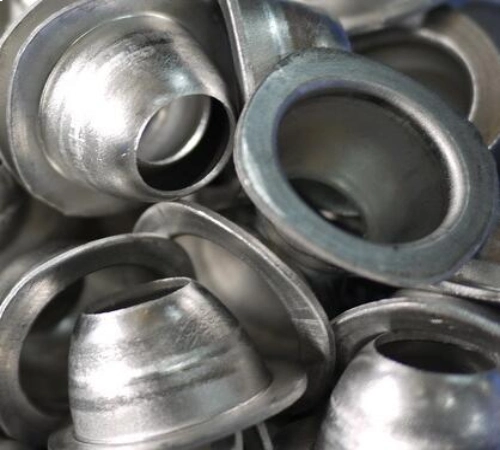
When to Choose Deep Draw Stamping
Deep draw metal stamping is typically the preferred solution when part geometry features deep cavities, hollow sections, or cylindrical shapes, and wall thickness consistency is critical to structural strength. This process is particularly suitable for closed-end parts where the depth exceeds twice the diameter, such as housings, fluid transfer components, and structural parts subjected to pressure or vibration.
The economic threshold for annual production volume in deep draw stamping is typically 3,000 units or more; high-speed automated presses enable consistent dimensional accuracy in high-volume production. The deep draw stamping process also offers advantages for complex parts requiring asymmetrical features or multiple forming operations.
Purchasers should focus on the following: whether the part is cup- or shell-shaped, whether a seamless structure is required to avoid welding defects, and whether annual demand is sufficient to amortize the die investment (typically $5,000–$50,000 or more). Typical applications include battery cases, fire extinguisher cylinders, automotive oil filter housings, and medical device enclosures.
When to Use Hydroforming
Hydroforming is suitable for crack-free forming scenarios that are difficult to achieve with conventional deep draw stamping. Hydroforming offers unique advantages when parts have complex, asymmetrical, or sharp geometries and require stringent surface quality. This process is particularly well-suited for low- to medium-volume production runs of 250 to 2,000 pieces—die costs are only 50% or less of those for deep draw stamping dies, and the same set of tools can accommodate different material thicknesses. Furthermore, the uniform distribution of fluid pressure effectively reduces springback and stress concentration.
Hydroforming is the preferred process in the following situations: when parts require excellent surface finish and secondary polishing is not feasible; when complex geometries necessitate a single part to replace multiple welded assemblies; or when the material is a difficult-to-form alloy such as high-strength aluminum alloys or titanium alloys.
Typical application areas include aerospace fuselage panels, automotive chassis components, and medical device housings.
When to Choose the Metal Spinning Process
Metal spinning is best suited for hollow, axisymmetric, rotationally symmetric parts—such as cones, hemispheres, cylinders, and lampshades. When parts are started from discs, tubes, or simple preforms, and seamless structures and good surface quality are required, metal spinning is a cost-effective solution.
This process is particularly well-suited for prototype development and small- to medium-volume production runs of 1,000 to 3,000 units per year. Die investment is extremely low—the cost of a mandrel (male die) typically ranges from $500 to $2,000, approximately 10% of the cost of a deep draw stamping die—and the lead time from design to first-article delivery is significantly shorter.
Metal spinning is the most suitable choice in the following situations: when parts are strictly axisymmetric; when budgets are limited and design changes are likely to occur frequently; or when material thickness exceeds the economic range of deep draw metal stamping (metal spinning can handle soft metals up to 12 mm thick).
Typical applications include satellite antenna reflectors, commercial cookware, lighting fixtures, aerospace nose cones, and pressure vessel heads.
Conclusión
The choice between deep draw stamping, hydroforming, and metal spinning ultimately depends on a comprehensive evaluation of production volume, part geometry, and quality requirements.
For high-volume production of deep drawn parts, custom deep draw stamping offers unmatched production speed and cost-effectiveness per unit, and its higher die investment can be recouped through economies of scale. Hydroforming provides exceptional geometric flexibility and surface quality for low- to medium-volume production of complex parts. The metal spinning process has the lowest entry barrier for the production of axisymmetric parts, particularly when die budgets are limited or design flexibility is critical.
For buyers evaluating these alternatives, the decision-making framework is clear: prioritize the deep draw stamping process to achieve economies of scale, choose hydroforming to address complex designs, and select metal spinning to meet the needs of axisymmetric parts and the flexibility required for small-batch production. Each process has its distinct economic and technical advantages—selecting the right process requires a rigorous evaluation of the entire production plan, not just a consideration of the cost per unit.
Supro is a specialized metal fabrication manufacturer. Leveraging advanced equipment, extensive manufacturing experience, and a professional engineering team, we provide perfect, customized metal fabrication solutions to over 3,000 companies worldwide, along with genuine manufacturer quotes.
Entregamos una amplia gama de productos de forma eficiente y puntual. Desde el diseño del producto y la fabricación rápida de prototipos de chapa metálica hasta la producción en masa, brindamos soporte técnico profesional y una calidad excepcional. ¡También ofrecemos soluciones de fabricación integrales y productos altamente competitivos en precio! Para especificaciones técnicas o consultas sobre colaboraciones OEM, póngase en contacto con nuestro equipo de ingeniería.